


US President Donald Trump on Tuesday ordered a “blockade” of all sanctioned oil tankers entering and leaving Venezuela, in Washington’s latest move to increase pressure on Venezuelan President Nicolas Maduro’s government, targeting its main source of income.
It is unclear how Trump would impose the move against the sanctioned vessels, and whether he would turn to the US Coast Guard to interdict vessels as he did last week. The administration has moved thousands of troops and nearly a dozen warships — including an aircraft carrier — to the region.
“For the theft of our Assets, and many other reasons, including Terrorism, Drug Smuggling, and Human Trafficking, the Venezuelan Regime has been designated a FOREIGN TERRORIST ORGANIZATION,” Trump wrote on Truth Social. “Therefore, today, I am ordering A TOTAL AND COMPLETE BLOCKADE OF ALL SANCTIONED OIL TANKERS going into, and out of, Venezuela.”
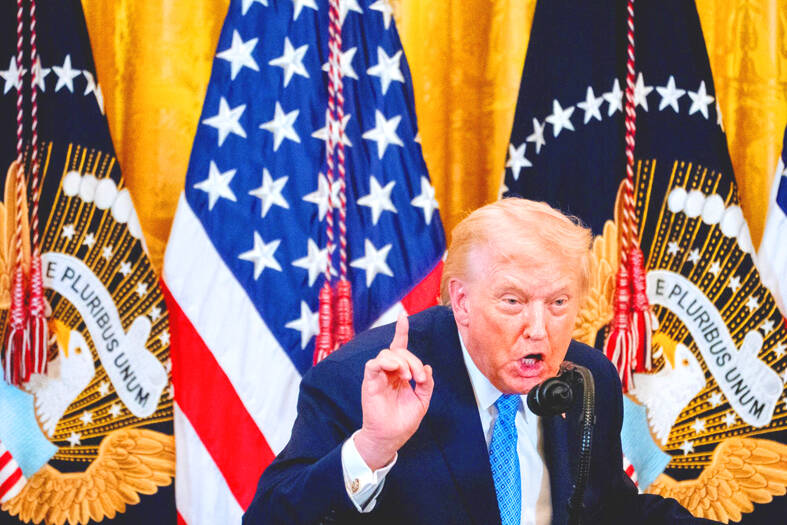
Photo: Bloomberg
In a statement, Venezuela’s government said it rejected Trump’s “grotesque threat.”
Oil prices rose more than 1 percent in Asian trade yesterday.
Oil market participants said prices were rising in anticipation of a potential reduction in Venezuelan exports, although they were still waiting to see how Trump’s blockade would be enforced and whether it would extend to include non-sanctioned vessels.
Germany yesterday warned against any steps that would jeopardize peace and security in the region.
“The German government has an interest in preventing the situation in the region from deteriorating further. We are therefore viewing the overall situation with concern,” a German Federal Foreign Office spokesperson told a news conference.
US presidents have broad discretion to deploy US forces abroad, but Trump’s asserted blockade marks a new test of presidential authority, said international law expert Elena Chachko, an assistant professor at UC Berkeley Law School.
Blockades have traditionally been treated as permissible “instruments of war,” but only under strict conditions, Chachko said.
“There are serious questions on both the domestic law front and international law front,” she added.
US Representative Joaquin Castro called the blockade “unquestionably an act of war.”
“A war that the Congress never authorized and the American people do not want,” Castro wrote on X.
There has been an effective embargo in place after the US last week seized a sanctioned oil tanker off Venezuela, with loaded vessels carrying millions of barrels of oil staying in Venezuelan waters rather than risk seizure.

A signaling system malfunction disrupted high-speed rail (HSR) services beginning at 8am today, with trains temporarily reduced to three northbound and three southbound trains per hour as authorities conduct inspections. The malfunction occurred on a section of track in Miaoli County during pre-operation checks early this morning, forcing northbound and southbound trains to use a single track, the HSR operator said. The regular schedule has been replaced with three hourly trains offering only nonreserved seating in each direction, stopping at every station, it said, adding that business class cars would still have reserved seating. Departures from terminal stations are scheduled at the top

Taiwan is still in the process of assessing the possibility of recruiting workers from Eswatini, the Ministry of Foreign Affairs said yesterday, adding that its goal is to help Eswatini upgrade its vocational training centers. If there are plans to recruit workers from Eswatini, safeguarding national security, protecting public health and ensuring the employment rights of Taiwanese would be prerequisites, Department of West Asian and African Affairs Director-General Yen Chia-liang (顏嘉良) told a news conference. Key considerations would also include filling labor shortages in specific industries, and fostering bilateral professional and technical exchanges, he said. Yen was asked about the progress of labor

VERBOSE VESSELS: A CGA cutter and a China Coast Guard exchanged verbal barbs for more than a day in Taiwanese-controlled waters before the Chinese vessel left The Taiwanese and Chinese coast guards had a standoff near the strategically located Pratas Islands (Dongsha Islands, 東沙群島) in the north of the South China Sea, the Coast Guard Administration (CGA) said yesterday. The two sides engaged in intense radio exchanges over sovereignty claims during the 33-hour standoff. China Coast Guard vessel 3501 eventually left the restricted waters, 26.6 nautical miles (49.2km) west of the Pratas Islands, at 5pm yesterday, the CGA said. Lying approximately between southern Taiwan and Hong Kong, the Taiwan-controlled Pratas are seen by some security experts as vulnerable to Chinese attack due to their distance — more than

A US uncrewed surface vessel (USV) encountered multiple Chinese warships during an autonomous transit of the Taiwan Strait, US defense company Seasats said in a statement on Wednesday. Seasats announced that a Lightfish USV had completed the first autonomous transit of the Taiwan Strait. Over five days, the USV traversed the entire length of the Strait while constantly monitoring surface vessel traffic, the company said. The Lightfish encountered multiple Chinese warships, one of which was a Chinese People’s Liberation Army Navy (PLAN) Type 056 corvette, it said. The Chinese vessels were operating “well within Taiwan’s exclusive economic zone without transmitting their identity via the


 RSS
RSS