


The Ministry of the Interior has proposed amendments that would allow civil servants to visit relatives or attend funerals in China only if they are within third-degree kinship, with the Mainland Affairs Council (MAC) yesterday saying that the proposed changes would help deter abuse of the regulations.
The amendments to the Regulation Governing Permissions for Civil Servants and Designated Personnel of Taiwan to Enter China (台灣地區公務員及特定身分人員進入大陸地區許可辦法) were proposed in light of efforts in China, including Hong Kong and Macau, to recruit Taiwanese civil servants, the ministry said in a statement.
Senior government officials and police officers would be required to submit applications to travel to China seven days in advance, even if they do not handle national security affairs, the ministry said.
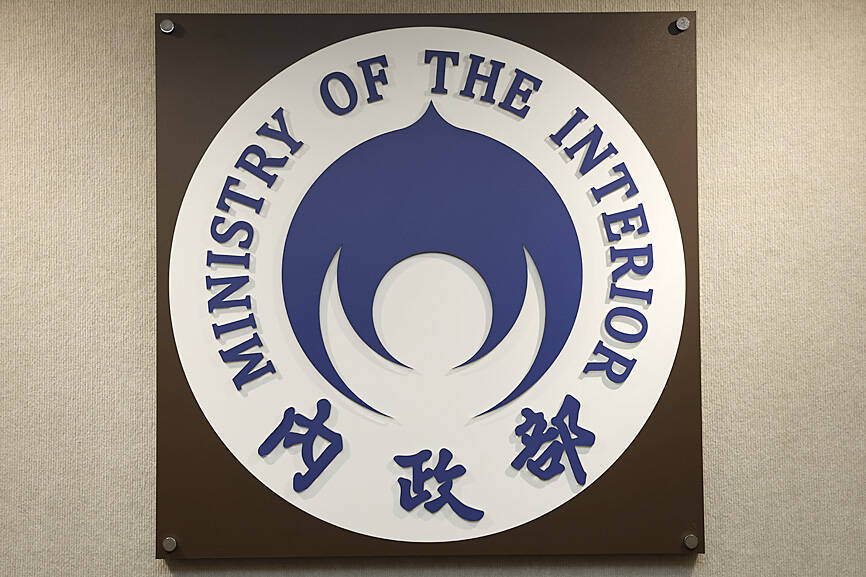
Photo: Huang Hsin-po, Taipei Times
Article 6 of the regulations allows political appointees holding administrative posts; regional mayors, including the heads of special municipalities; personnel involved in work related to national security, interests or classified matters; and those engaged in tasks involving nationally critical and key technologies to visit relatives in China if the relatives are of fourth-degree kinship or closer.
“To ensure the safety of cross-strait exchanges, we have proposed revising the article by limiting the visits to Chinese relatives who are within third-degree of kinship, following reviews of actual demands as well as Article 23 of the Regulations Governing the Entry of People from Mainland China into the Taiwan Area (大陸地區人民進入台灣地區許可辦法),” the ministry said.
“That would apply to civil servants requesting permission to visit sick relatives or attend funerals,” it said.
A degree-of-kinship chart released by the government lists parents and children as first degree; siblings, grandparents and grandchildren as second degree; uncles and aunts, great-grandparents, great-grandchildren, nephews and nieces as third degree; and paternal and maternal cousins as fourth degree.
MAC Deputy Minister and spokesman Liang Wen-chieh (梁文傑) said that the proposed changes followed many rounds of discussions.
“The policy of allowing civil servants to visit relatives in China of fourth degree or closer was implemented when cross-strait exchanges began in 1987,” Liang said. “Many civil servants, particularly those who arrived in Taiwan after 1949, were able to visit their families in China because of the policy.”
“However, some might have abused the policy, such as claiming that they went to China to visit a cousin, which might not align with what the public considers to be visiting relatives,” he said.
Senior civil servants, even those who do not handle national security issues, applying to visit China would be required to apply at least seven work days in advance, rather than two days, the proposed amendments say.
The seven-day requirement applies to civil servants at grade 11 or higher, or the equivalent, whose duties do not involve national security, national interests or classified matters; police officers at the rank of third-class commissioner or above; and personnel without civil-service status working at the National Security Bureau, the Ministry of National Defense, the Ministry of Justice Investigation Bureau, as well as their subordinate agencies, the interior ministry said.
The requirement is necessary as government agencies need time to review the applications, it added.
Government agencies must report any abnormalities following the return of civil servants from China or if they lose contact with them while they are there, it said, adding that the agencies that should be notified include the MAC, the Ministry of Justice, the Agency Against Corruption, the National Police Agency and the National Immigration Agency.
Meanwhile, incidents of Taiwanese being illegally arrested, detained and interrogated while traveling in China and the two Chinese territories continue to increase, heightening personal safety risks for civil servants as well, it said.
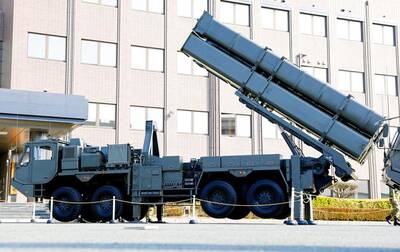
Japan has deployed long-range missiles in a southwestern region near China, the Japanese defense minister said yesterday, at a time when ties with Beijing are at their lowest in recent years. The missiles were installed in Kumamoto in the southern region of Kyushu, as Japan is attempting to shore up its military capacity as China steps up naval activity in the East China Sea. “Standoff defense capabilities enable us to counter the threat of enemy forces attempting to invade our country ... while ensuring the safety of our personnel,” Japanese Minister of Defense Shinjiro Koizumi said. “This is an extremely important initiative for

The nation’s fastest supercomputer, Nano 4 (晶創26), is scheduled to be launched in the third quarter, and would be used to train large language models in finance and national defense sectors, the National Center for High-Performance Computing (NCHC) said. The supercomputer, which would operate at about 86.05 petaflops, is being tested at a new cloud computing center in the Southern Taiwan Science Park in Tainan. The exterior of the server cabinet features chip circuitry patterns overlaid with a map of Taiwan, highlighting the nation’s central position in the semiconductor industry. The center also houses Taiwania 2, Taiwania 3, Forerunner 1 and
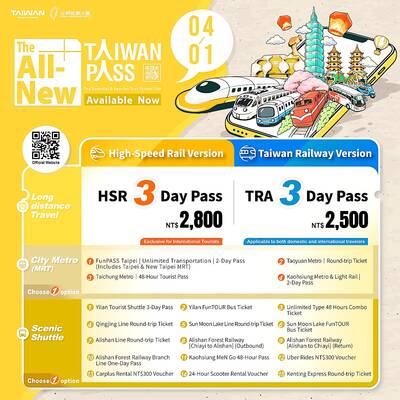
MORE POPULAR: Taiwan Pass sales increased by 59 percent during the first quarter compared with the same period last year, the Tourism Administration said The Tourism Administration yesterday said that it has streamlined the Taiwan Pass, with two versions available for purchase beginning today. The tourism agency has made the pass available to international tourists since 2024, allowing them to access the high-speed rail, Taiwan Railway Corp services, four MRT systems and four Taiwan Tourist Shuttles. Previously, five types of Taiwan Pass were available, but some tourists have said that the offerings were too complicated. The agency said only two types of Taiwan Pass would be available, starting from a three-day pass with the high-speed rail and a three-day pass with Taiwan Railway Corp. The former costs NT$2,800
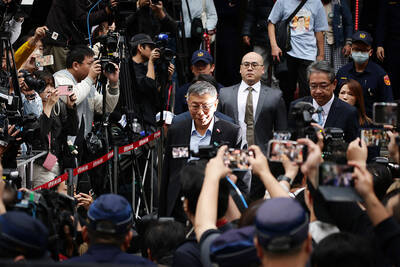
FIRST TRIAL: Ko’s lawyers sought reduced bail and other concessions, as did other defendants, but the bail judge denied their requests, citing the severity of the sentences Former Taipei mayor Ko Wen-je (柯文哲) was yesterday sentenced to 17 years in prison and had his civil rights suspended for six years over corruption, embezzlement and other charges. Taipei prosecutors in December last year asked the Taipei District Court for a combined 28-year, six-month sentence for the four cases against Ko, who founded the Taiwan People’s Party (TPP). The cases were linked to the Core Pacific City (京華城購物中心) redevelopment project and the mismanagement of political donations. Other defendants convicted on separate charges included Chinese Nationalist Party (KMT) Taipei City Councilor Angela Ying (應曉薇), who was handed a 15-year, six-month sentence; Core Pacific


 RSS
RSS