


Ukraine’s capital faced a night of attacks on Friday to yesterday, hours after Ukrainian President Volodymyr Zelenskiy removed his chief of staff and top negotiator following a raid on Andriy Yermak’s house as part of a sweeping corruption probe.
Yermak’s removal dealt a serious blow to Zelenskiy, who faces a mounting Russian offensive in the east as Washington peddles a plan to end the war that Kyiv fears would hand big concessions to Moscow.
Ukrainian negotiators are expected in the US this weekend for talks on the US plan to end the war. Yermak, 54, was supposed to have negotiated on behalf of Ukraine at the talks and Zelenskiy said he would hold consultations yesterday over a replacement for him.
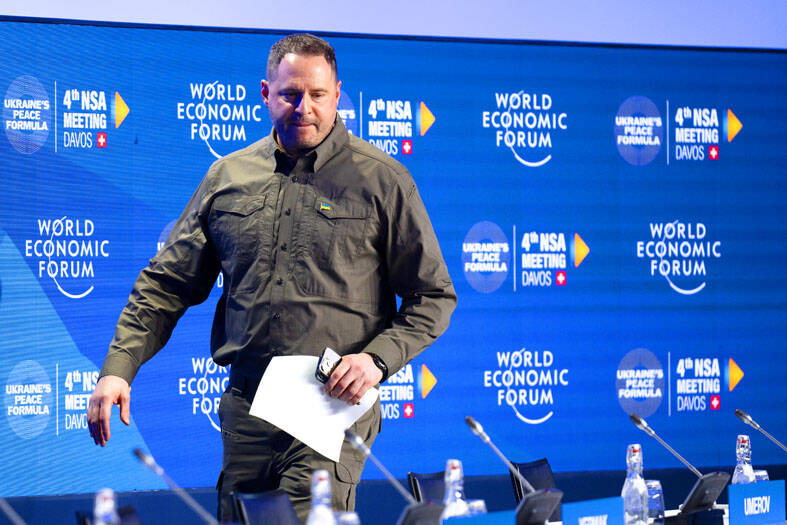
Photo: EPA
Russian drones struck Kyiv, killing at least two people, and causing damage and massive power cuts in the capital, officials said.
About a dozen people were wounded, as residential buildings were hit in several districts, they said.
Leading the talks this weekend is now Ukrainian National Security and Defense Council Secretary Rustem Umerov, according to two senior Ukrainian officials, who asked to remain anonymous due to the sensitivity of the matter.
Just last week, Zelenskiy had named Yermak as Ukraine’s top negotiator in a vote of confidence, despite growing pressure from opposition figures to remove the chief of staff.
On Friday, Zelenskiy announced in a video address: “The Office of the President of Ukraine will be reorganized. The head of the office, Andriy Yermak, has submitted his resignation.”
Minutes later, Zelenskiy signed a decree “to dismiss” Yermak.
On Friday, investigators from the Ukrainian National Anti-Corruption Agency (NABU) said it and the Specialized Anti-Corruption Prosecutor’s Office (SPO) had raided Yermak’s apartment as part of an investigation.
They did not say what it was about, and Yermak said he was cooperating fully.
Yermak has been accused of involvement in a US$100 million kickback scheme in the strategic energy sector, uncovered by investigators earlier this month.
The case triggered widespread public anger at a time when Russia is hammering Ukraine’s power grid, causing blackouts and threatening winter heating outages.
In the face of the scandal, Zelenskiy sought to rally the population on Friday.
“If we lose our unity, we risk losing everything: ourselves, Ukraine, our future,” he said in the address.
Yermak was Zelenskiy’s most important ally, but in Kyiv, his opponents say he has accumulated power, gate-keeps access to the president and ruthlessly sidelines critical voices.
A former film producer and copyright lawyer, he came into politics with Zelenskiy in 2019, having previously worked with the now-president during his time as a comedian.
Yermak was widely considered the second-most influential man in the country and even sometimes nicknamed “vice president.”
“Yermak doesn’t allow anyone to get to Zelenskiy except loyal people,” a former senior official who worked with Zelenskiy and Yermak told reporters, describing him as “super paranoid.”
“He definitely tries to influence almost every decision,” they added.
A senior source in Zelenskiy’s party said Yermak’s influence over the president was akin to “hypnosis.”
Speaking after the raid on Yermak, the EU backed the work of Ukraine’s anti-corruption agencies.
“We have a lot of respect for those investigations which show that the anti-corruption bodies in Ukraine are doing their work,” said European Commission spokeswoman Paula Pinho.
Zelenskiy had in the summer tried to strip the independence of NABU and SPO, triggering rare wartime protests and forcing him to walk back the decision after criticism from the EU.

The nation’s fastest supercomputer, Nano 4 (晶創26), is scheduled to be launched in the third quarter, and would be used to train large language models in finance and national defense sectors, the National Center for High-Performance Computing (NCHC) said. The supercomputer, which would operate at about 86.05 petaflops, is being tested at a new cloud computing center in the Southern Taiwan Science Park in Tainan. The exterior of the server cabinet features chip circuitry patterns overlaid with a map of Taiwan, highlighting the nation’s central position in the semiconductor industry. The center also houses Taiwania 2, Taiwania 3, Forerunner 1 and
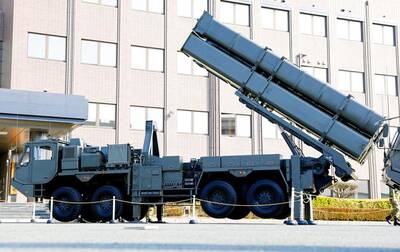
Japan has deployed long-range missiles in a southwestern region near China, the Japanese defense minister said yesterday, at a time when ties with Beijing are at their lowest in recent years. The missiles were installed in Kumamoto in the southern region of Kyushu, as Japan is attempting to shore up its military capacity as China steps up naval activity in the East China Sea. “Standoff defense capabilities enable us to counter the threat of enemy forces attempting to invade our country ... while ensuring the safety of our personnel,” Japanese Minister of Defense Shinjiro Koizumi said. “This is an extremely important initiative for

MORE POPULAR: Taiwan Pass sales increased by 59 percent during the first quarter compared with the same period last year, the Tourism Administration said The Tourism Administration yesterday said that it has streamlined the Taiwan Pass, with two versions available for purchase beginning today. The tourism agency has made the pass available to international tourists since 2024, allowing them to access the high-speed rail, Taiwan Railway Corp services, four MRT systems and four Taiwan Tourist Shuttles. Previously, five types of Taiwan Pass were available, but some tourists have said that the offerings were too complicated. The agency said only two types of Taiwan Pass would be available, starting from a three-day pass with the high-speed rail and a three-day pass with Taiwan Railway Corp. The former costs NT$2,800
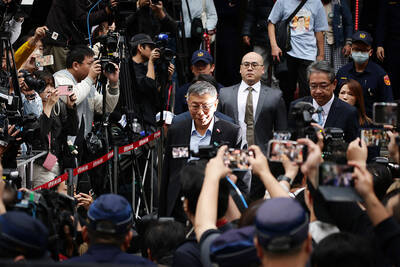
FIRST TRIAL: Ko’s lawyers sought reduced bail and other concessions, as did other defendants, but the bail judge denied their requests, citing the severity of the sentences Former Taipei mayor Ko Wen-je (柯文哲) was yesterday sentenced to 17 years in prison and had his civil rights suspended for six years over corruption, embezzlement and other charges. Taipei prosecutors in December last year asked the Taipei District Court for a combined 28-year, six-month sentence for the four cases against Ko, who founded the Taiwan People’s Party (TPP). The cases were linked to the Core Pacific City (京華城購物中心) redevelopment project and the mismanagement of political donations. Other defendants convicted on separate charges included Chinese Nationalist Party (KMT) Taipei City Councilor Angela Ying (應曉薇), who was handed a 15-year, six-month sentence; Core Pacific


 RSS
RSS