


Japan has warned its citizens in China to be careful of their surroundings and to avoid big crowds, as a diplomatic row spirals over Japanese Prime Minister Sanae Takaichi’s comments on Taiwan.
The escalating spat has already seen Beijing advise Chinese citizens to avoid traveling to Japan and hit Tokyo stocks.
The screenings of at least two Japanese movies are also to be postponed in China, state media reported.
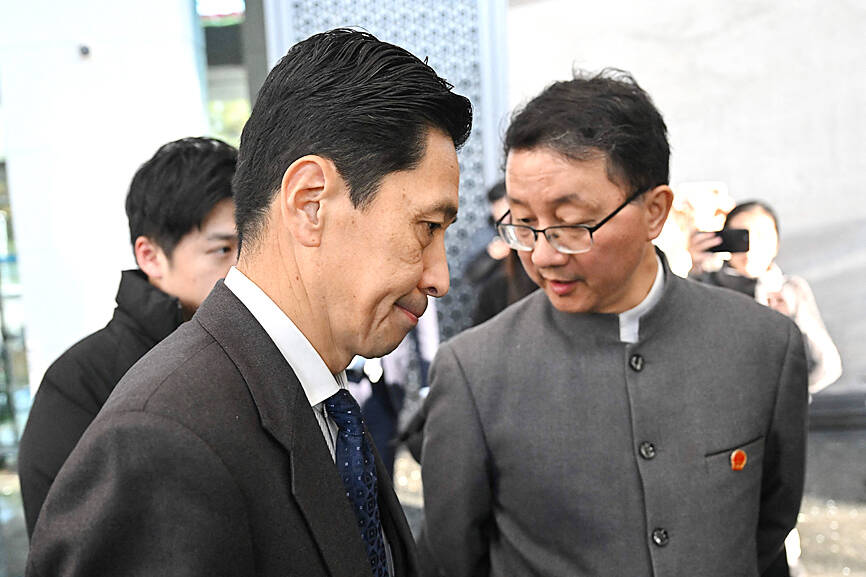
Photo: AFP
“Pay attention to your surroundings and avoid as much as possible squares where large crowds gather, or places that are likely to be identified as being used by many Japanese people,” the Japanese embassy in China said in a statement on its Web site dated Monday.
Beijing yesterday vowed to “protect the safety” of foreigners in China, but said it had again lodged a “strong protest” with Tokyo over Takaichi’s comments.
Japanese Chief Cabinet Secretary Minoru Kihara said the embassy’s advice was issued “based on a comprehensive assessment of the political situation, including the security situation in the relevant country or region, as well as the social conditions.”
The diplomatic feud between China and Japan was ignited by Takaichi’s suggestion that Tokyo could intervene militarily in any attack on Taiwan.
Seeking to defuse the row, Masaaki Kanai, director-general of the Japanese Ministry of Foreign Affairs’ Asian and Oceanian Affairs Bureau, yesterday held talks with his Chinese counterpart, Liu Jinsong (劉勁松).
“During the consultations, China once again lodged a strong protest with Japan” over “Takaichi’s erroneous remarks,” Chinese foreign ministry spokeswoman Mao Ning (毛寧) said.
“Takaichi’s fallacies seriously violate international law and the basic norms governing international relations,” Mao said
Takaichi’s comments “fundamentally damage the political foundation of China-Japan relations,” Mao added.
The Japanese embassy warning also advised citizens to “be careful about your words and attitudes when interacting with local people.”
It came as China Film News, which is supervised by the state-backed China Film Administration, announced that the release of imported Japanese movies Crayon Shin-chan the Movie: Super Hot! The Spicy Kasukabe Dancers and Cells at Work! would be postponed.
The two movies were originally expected to be released on Dec. 6 and on Saturday respectively, review site Douban said.
“Japan’s provocative comments will inevitably affect Chinese audiences’ perception of Japanese movies,” China Film News said in an article posted on WeChat on Monday.
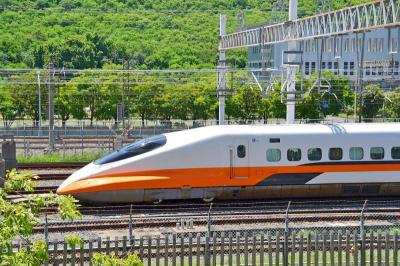
A signaling system malfunction disrupted high-speed rail (HSR) services beginning at 8am today, with trains temporarily reduced to three northbound and three southbound trains per hour as authorities conduct inspections. The malfunction occurred on a section of track in Miaoli County during pre-operation checks early this morning, forcing northbound and southbound trains to use a single track, the HSR operator said. The regular schedule has been replaced with three hourly trains offering only nonreserved seating in each direction, stopping at every station, it said, adding that business class cars would still have reserved seating. Departures from terminal stations are scheduled at the top

Taiwan is still in the process of assessing the possibility of recruiting workers from Eswatini, the Ministry of Foreign Affairs said yesterday, adding that its goal is to help Eswatini upgrade its vocational training centers. If there are plans to recruit workers from Eswatini, safeguarding national security, protecting public health and ensuring the employment rights of Taiwanese would be prerequisites, Department of West Asian and African Affairs Director-General Yen Chia-liang (顏嘉良) told a news conference. Key considerations would also include filling labor shortages in specific industries, and fostering bilateral professional and technical exchanges, he said. Yen was asked about the progress of labor
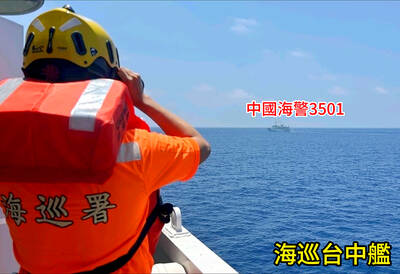
VERBOSE VESSELS: A CGA cutter and a China Coast Guard exchanged verbal barbs for more than a day in Taiwanese-controlled waters before the Chinese vessel left The Taiwanese and Chinese coast guards had a standoff near the strategically located Pratas Islands (Dongsha Islands, 東沙群島) in the north of the South China Sea, the Coast Guard Administration (CGA) said yesterday. The two sides engaged in intense radio exchanges over sovereignty claims during the 33-hour standoff. China Coast Guard vessel 3501 eventually left the restricted waters, 26.6 nautical miles (49.2km) west of the Pratas Islands, at 5pm yesterday, the CGA said. Lying approximately between southern Taiwan and Hong Kong, the Taiwan-controlled Pratas are seen by some security experts as vulnerable to Chinese attack due to their distance — more than

A US uncrewed surface vessel (USV) encountered multiple Chinese warships during an autonomous transit of the Taiwan Strait, US defense company Seasats said in a statement on Wednesday. Seasats announced that a Lightfish USV had completed the first autonomous transit of the Taiwan Strait. Over five days, the USV traversed the entire length of the Strait while constantly monitoring surface vessel traffic, the company said. The Lightfish encountered multiple Chinese warships, one of which was a Chinese People’s Liberation Army Navy (PLAN) Type 056 corvette, it said. The Chinese vessels were operating “well within Taiwan’s exclusive economic zone without transmitting their identity via the


 RSS
RSS