


The Presidential Office yesterday accused Beijing of saber-rattling at Japan for political gain, hours after Chinese maritime authorities said it would conduct live-fire missile drills in the Yellow Sea.
The Chinese People’s Liberation Army tomorrow through Thursday would conduct missile tests with live weapons in the center zone of the Yellow Sea, the Chinese Maritime Safety Administration said in a navigational hazard notice yesterday.
China’s Ministry of Foreign Affairs also issued a travel advisory on Friday, citing a rising number of criminal cases involving Chinese nationals and safety risks following Japan’s “provocative” statements regarding Taiwan.
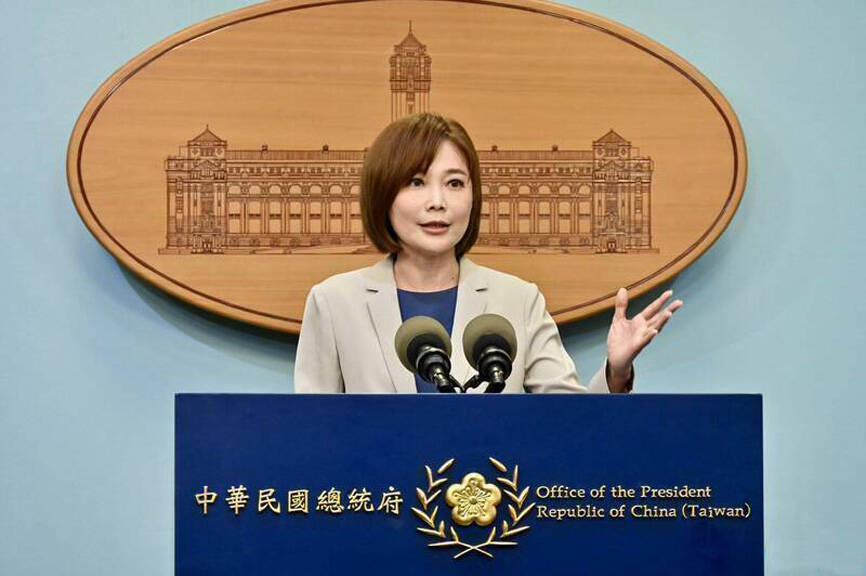
Photo: Taipei Times
Those “statements” refer to comments made by Japanese Prime Minister Sanae Takaichi during a parliamentary session on Nov. 7 that a “Taiwan contingency” involving a Chinese naval blockade could qualify as a “survival-threatening situation” for Japan.
Her comments drew a response from Chinese Consul General in Osaka Xue Jian (薛劍), who wrote on social media: “If you go sticking that filthy neck where it doesn’t belong, it’s gonna get sliced right off. You ready for that?”
The post was later deleted.
Presidential Office spokeswoman Karen Kuo (郭雅慧) said Beijing’s politically motivated bid to generate hybrid threats targeting Japan posed a grave risk to security in the Indo-Pacific region.
Taiwan urges China to desist from being the troublemaker or engaging in inappropriate unilateral activities, she said, adding that as a great power, Beijing should behave responsibly.
National Security Council Secretary-General Joseph Wu (吳釗燮) in a social media post yesterday criticized Beijing, saying China “continues to engage in humiliating rhetoric and military intimidation toward Japan” instead of reflecting on the “insulting” remarks made by Xue.
As a long-time target of China’s threats and coercion, Taiwan condemns the Chinese government’s uncivilized behavior that threatens to destabilize the region, he said.
An official familiar with foreign affairs yesterday said Beijing has adopted verbal violence, economic pressure and the threat of force as part of its routine strategy for dealing with other nations.
Japan is not the only victim of China’s hybrid threat, they said.
The change in Tokyo’s national security strategy did not begin with Takaichi, it has evolved gradually in response to changes in the regional situation, the official said.
Takaichi’s comments do not go against Japan’s strategic position, nor do they contradict the international community’s understanding of Tokyo’s security policy, they said.
China has reacted excessively and irrationally, the official said, adding that Beijing’s response not only failed help the situation in the Indo-Pacific region, but could also lead to regional misjudgments and increase unnecessary tensions.

National Taiwan University (NTU) yesterday said it disqualified a person from an entrance examination for using AI smart glasses to cheat, along with two others for making untruthful statements in their curriculum vitae. The three applicants were given null scores, Taiwan’s highest-ranked university said, calling on prospective students to be honest in the admissions process. NTU registrar Lee Hung-sen (李宏森) said that the cheating applicant wore a hat and thick-rimmed glasses to the second written exam for medical school, claiming that they felt cold. Suspicions were aroused when the applicant stared oddly at the test for long stretches while steadily bringing the paper
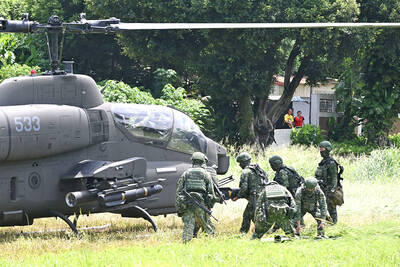
MILITARY ISSUES: A partisan divide between the Cabinet and the legislature ‘raised questions about Taiwan’s ability to adequately fund its defense,’ the report said Taiwan’s defense budget, military personnel numbers and resilience are challenges to its ability to meet national defense goals, the US Naval Institute said in a report published on Tuesday. In response to the perception of a growing military threat posed by China, Taiwan has embarked on an effort to enhance the capabilities needed to deter an attempt by Beijing to annex the nation by force, the institute said in the US Congressional Research Service report, titled Taiwan: Defense and Military Issues, which was filed on Thursday last week. Taiwan’s defense budget increased by about 7.5 percent from 2024 to last year, it
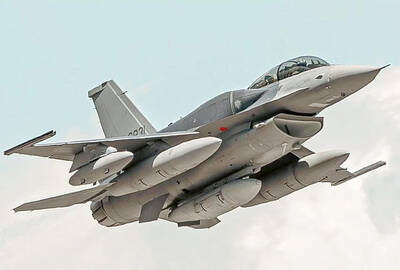
66 FIGHTER JETS: The aircraft is likely undergoing preparations for its transfer to Taiwan — a significant step forward in the nation’s modernization program, a lawmaker said The first of Taiwan’s order of F-16V Block 70 aircraft has been sighted in Texas ahead of delivery, Democratic Progressive Party (DPP) Legislator Wang Ting-yu (王定宇) said. Taiwan’s first F-16V Block 70 two-seat aircraft, tail number 6831, was seen flying from Lockheed Martin’s production facility in Greenville, South Carolina, to Naval Air Station Joint Reserve Base Fort Worth in Texas, Wang wrote on Facebook yesterday. The plane is likely undergoing preparations for its transfer to Taiwan, marking a significant step forward in the Republic of China Air Force’s modernization program, Wang said, citing military analysts. The F-16V Block 70 is a new-build version
NOT JUST NUMBERS: What matters to intelligence work is crucial, reliable information, so even a few credible leads can be highly valuable to national security, a legislator said The National Security Bureau (NSB) yesterday said it has finished the establishment of an information-reporting channel for Chinese nationals, the aim of which is to broaden intelligence gathering on China’s political, military, economic and social developments. Chinese nationals can submit information on the Web page, https://report.nsb.gov.tw, the NSB said in a statement. The move aims to expand the bureau’s diverse intelligence sources and is pursuant to the National Intelligence Services Act (國家情報工作法), it said, adding that it referenced practices adopted by intelligence agencies in the US, the UK and Israel. An increasing number of people are approaching Taiwanese agencies to provide information, as


 RSS
RSS