

The US Senate on Monday approved a compromise that would end the longest government shutdown in US history, breaking a weeks-long stalemate that has disrupted food benefits for millions, left hundreds of thousands of federal workers unpaid and snarled air traffic.
The 60-40 vote passed with the support of nearly all of the chamber’s Republicans and eight Democrats, who unsuccessfully sought to tie government funding to health subsidies that are due to expire at the end of the year.
While the agreement sets up a vote next month on those subsidies, which benefit 24 million Americans, it does not guarantee they will continue.
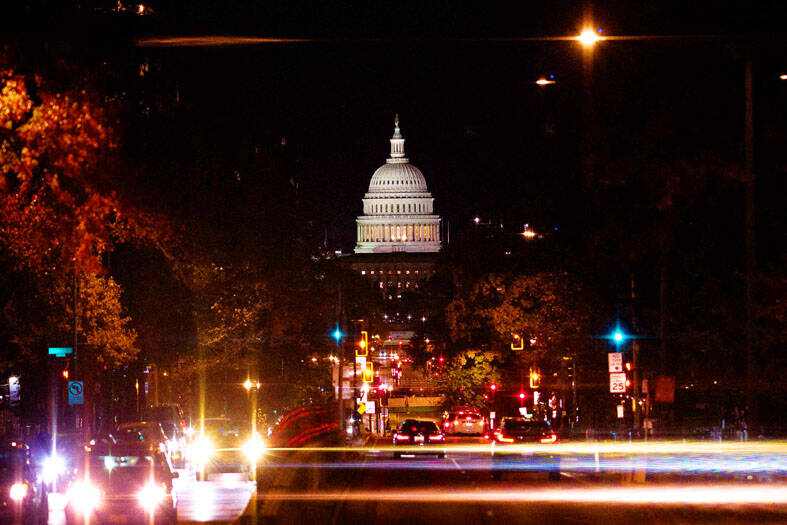
Photo: AFP
The deal, which would restore funding for federal agencies, includes a reversal of mass firings of federal workers since the shutdown started on Oct. 1 and would stall US President Donald Trump’s campaign to continue downsizing the federal workforce, preventing any layoffs until Jan. 30 next year.
The legislation next heads to the Republican-controlled US House of Representatives, where Speaker Mike Johnson has said he would like to pass it as soon as today and send it on to Trump to sign into law.
“It appears our long national nightmare is finally coming to an end,” said Johnson, who has kept the House out of session since mid-September, when the House passed a bill to continue government funding.
The deal would extend funding through Jan. 30, leaving the federal government, for now, on a path to keep adding about US$1.8 trillion a year to its US$38 trillion in debt.
Coming a week after Democrats won high-profile local elections in New Jersey, Virginia and elected a democratic socialist as the next mayor of New York, the deal has provoked anger among many Democrats who said there is no guarantee that the Republican-controlled Senate or House would agree to extend the health insurance subsidies.
“We wish we could do more,” said US Senator Dick Durbin, the chamber’s No. 2 Democrat. “The government shutting down seemed to be an opportunity to lead us to better policy. It didn’t work.”
Senate Democratic leader Chuck Schumer, who received blowback from his party in March when he voted to keep the government open, said he could not “in good faith” support it after meeting with his caucus for more than two hours on Sunday.
“We will not give up the fight,” Schumer said, adding that Democrats have “sounded the alarm” on healthcare.
A Reuters/Ipsos poll from late last month found that 50 percent of Americans blamed Republicans for the shutdown, while 43 percent blamed Democrats.

SHIFTING COOPERATION: With the new arrangement, US representatives would be able to participate directly in defense discussions, including weapons procurement Taiwan-US military cooperation is deepening, with the Pentagon expected to station personnel at the Ministry of National Defense (MND), sources said. The NT$470 million (US$14.77 million) joint program is scheduled to run from this year through 2028, under which the Pentagon would dispatch representatives from the Office of the Under Secretary of Defense for Policy and the Institute for Defense Analyses, a senior military official said on condition of anonymity, adding that one representative from each organization would be stationed at the ministry’s headquarters. The Office of the Under Secretary of Defense for Policy is one of the US’ bodies responsible for

The Presidential Office today condemned China's transnational repression after an alleged Chinese foreign agent was arrested in California yesterday on suspicion of surveilling President William Lai's (賴清德) son, Lai Ting-yu (賴廷與), the FBI said. The 34-year-old woman, named Wanying Heather Zhang (張婉瑩), was arrested on suspicion of acting as an unregistered foreign agent, US news agency CBS reported. She was apprehended at Los Angeles International Airport yesterday attempting to fly to Shanghai, it said. This represents a “typical case” of China’s transnational repression, Presidential Office spokeswoman Karen Kuo (郭雅慧) said today. "Our country expresses the strongest condemnation of such barbaric conduct that

Former president Tsai Ing-wen (蔡英文) on Monday arrived in San Francisco, receiving a warm welcome from hundreds of overseas Taiwanese as she launched a week-long visit. Accompanied by Representative to the US Alexander Yui (俞大?), and head of Taiwan’s San Francisco office Wu Chih-hsiang (伍志翔), Tsai arrived at her hotel, waving, smiling and giving high-fives to Taiwanese compatriots amid cheers of “Taiwan’s democracy involves you and me” to welcome her to the San Francisco Bay Area. It is Tsai’s first visit to the US since she left office in May 2024 after serving two four-year terms as president. Tsai is today to deliver

Light attack aircraft and military vehicles have arrived at a new China-Laos joint training facility announced on Tuesday last week, according to satellite images reviewed by Reuters. The images, taken by commercial satellite provider Vantor, show what security analysts believe are eight K-8 light attack jets and more than two dozen support vehicles on a runway that is still being built — China’s latest expansion of its overseas military presence. Taken on Wednesday last week — the day after the Chinese Ministry of National Defense announced it had set up the facility at Ban Keun outside the capital, Vientiane — the images


 RSS
RSS