

Israel yesterday said that the last 20 surviving hostages returned home after two years in captivity in Gaza, as US President Donald Trump received a standing ovation from Israeli lawmakers after brokering a ceasefire with Hamas.
Trump’s lightning visit to Israel came ahead of a summit in the Egyptian resort town of Sharm el-Sheikh cochaired by the US president, who has declared the war in Gaza “over.”
In Tel Aviv, a huge crowd which gathered to support hostage families erupted in joy, tears and song as news broke of the first hostage releases, although the pain for the loss of those who had not survived was palpable.
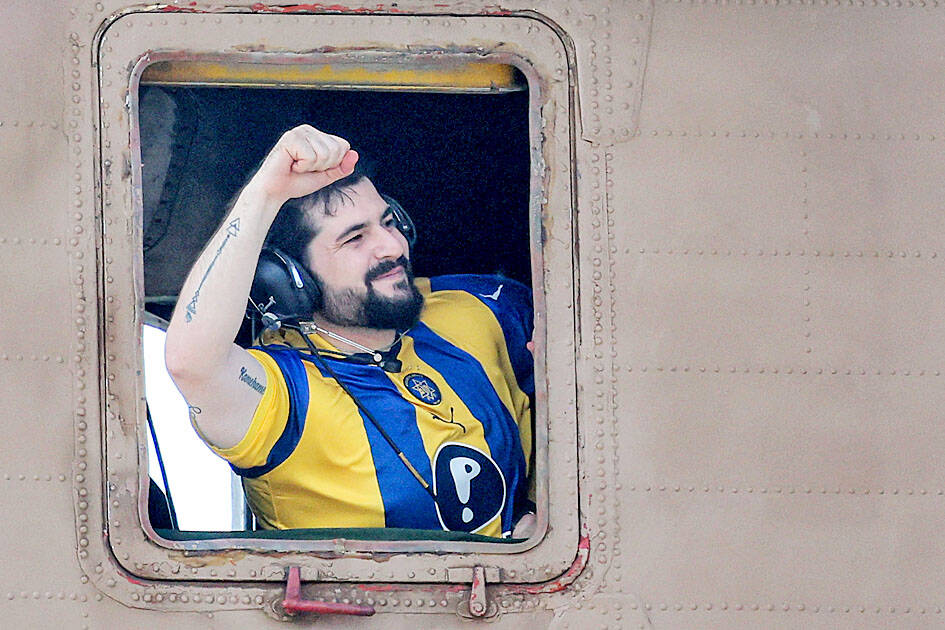
Photo: AFP
Under the ceasefire deal, Israel is due to release nearly 2,000 prisoners held in its jails.
In the Palestinian city of Ramallah, huge crowds gathered to welcome home the first buses carrying prisoners, with some chanting Allahu akbar, or “God is great,” in celebration.
“Welcome home,” the Israeli Ministry of Foreign Affairs said in a series of social media posts, hailing the return of the hostages.
On Tel Aviv’s Hostages Square, Noga shared her pain and joy.
“I’m torn between emotion and sadness for those who won’t be coming back,” she said.
Israel has said it did not expect all of the dead hostages to be returned yesterday.
Under the ceasefire agreement, Hamas is also due to return the bodies of the 27 hostages who died or were killed in captivity, as well as the remains of a soldier killed in 2014 during a previous Gaza conflict.
Among those Israel was due to release in exchange are 250 security detainees, including many convicted of killing Israelis, while about 1,700 were detained by the Israeli army in Gaza during the war.
On Oct. 7, 2023, militants seized 251 hostages during Hamas’ unprecedented attack on Israel, which led to the deaths of 1,219 people, most of them civilians.
In Gaza, too, the ceasefire has brought relief, but with much of the territory flattened by war, the road to recovery remains long.
“I returned to Sheikh Radwan with my heart trembling,” 38-year-old Fatima Salem said after she returned to her neighborhood in Gaza City. “My eyes kept searching for landmarks I had lost — nothing looked the same, even the neighbors’ houses were gone. Despite the exhaustion and fear, I felt like I was coming back to my safe place. I missed the smell of my home, even if it’s now just rubble. We will pitch a tent next to it and wait for reconstruction.”
Trump’s visit to the Middle East aims to celebrate his role in brokering last week’s ceasefire and hostage release deal, but comes at a precarious time as Israel and Hamas negotiate what comes next.
Speaking to reporters on Air Force One at the start of the “very special” visit, Trump brushed off concerns about whether the ceasefire would endure.
“I think it’s going to hold. I think people are tired of it. It’s been centuries,” he said of the fighting.
“The war is over. Okay? You understand that?” the US president added.

The Philippine Coast Guard yesterday said it has deployed its largest vessel and an aircraft to challenge a Chinese research ship operating off northern Batanes near Taiwan, adding that a Chinese coast guard vessel had also moved in. The Philippine operation “disrupted the vessel’s unauthorized marine scientific research and compelled it to leave its loitering position,” said Jay Tarriela, Philippine Coast Guard spokesperson on South China Sea issues. The Philippine Coast Guard said the BRP Teresa Magbanua and an aircraft were deployed to counter the Chinese vessel, which it said had remained about 37 nautical miles northwest of Itbayat Island since Monday. The
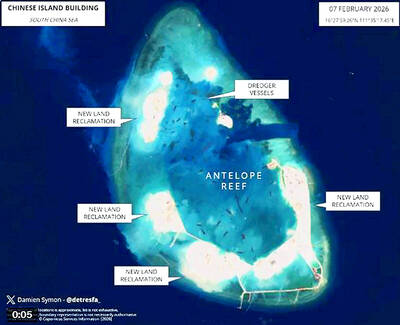
RUNWAY: Analysts said the first aircraft landing is expected by the middle of next year, while Chinese state media said it would serve civilian needs Chinese construction of a runway on Antelope Reef (Lingyang Reef, 羚羊礁) in the Paracel Islands (Xisha Islands, 西沙群島), is well under way with analysts estimating it could be completed by the middle of next year, strengthening Beijing’s military control over the disputed South China Sea. Satellite images reviewed by Reuters show grading work, piles of gravel and concrete, and compaction cranes in operation to build a full-scale runway that military attaches and security analysts say could be one of China’s most important offshore bases in the region. The images, taken on Friday last week by commercial satellite imagery provider Vantor, also show

SHIFTING COOPERATION: With the new arrangement, US representatives would be able to participate directly in defense discussions, including weapons procurement Taiwan-US military cooperation is deepening, with the Pentagon expected to station personnel at the Ministry of National Defense (MND), sources said. The NT$470 million (US$14.77 million) joint program is scheduled to run from this year through 2028, under which the Pentagon would dispatch representatives from the Office of the Under Secretary of Defense for Policy and the Institute for Defense Analyses, a senior military official said on condition of anonymity, adding that one representative from each organization would be stationed at the ministry’s headquarters. The Office of the Under Secretary of Defense for Policy is one of the US’ bodies responsible for

The Presidential Office today condemned China's transnational repression after an alleged Chinese foreign agent was arrested in California yesterday on suspicion of surveilling President William Lai's (賴清德) son, Lai Ting-yu (賴廷與), the FBI said. The 34-year-old woman, named Wanying Heather Zhang (張婉瑩), was arrested on suspicion of acting as an unregistered foreign agent, US news agency CBS reported. She was apprehended at Los Angeles International Airport yesterday attempting to fly to Shanghai, it said. This represents a “typical case” of China’s transnational repression, Presidential Office spokeswoman Karen Kuo (郭雅慧) said today. "Our country expresses the strongest condemnation of such barbaric conduct that


 RSS
RSS