


Official standards for food delivery fees are to be set by the Ministry of Transportation and Communications, with implementation expected as early as next month.
The Legislative Yuan’s Transportation Committee in its last session amended the Transportation Management Regulations (汽車運輸業管理規則), requiring the ministry to set official standards for food delivery rates.
Food delivery companies currently set their own prices.
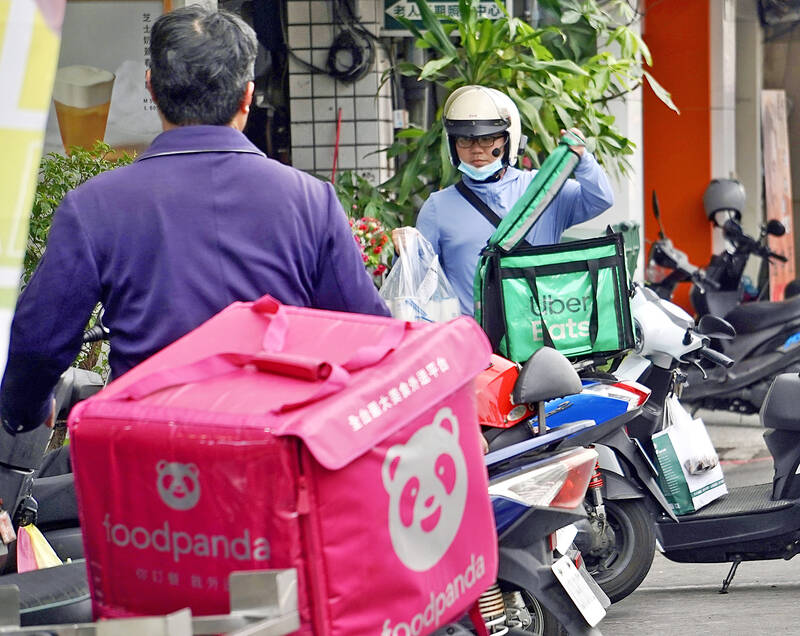
Photo: CNA
The new pricing scheme would reference rates used by the three transportation industries — automobile transportation, limited-route automobile transportation and container transportation — and take into account that scooters are the primary food delivery vehicle, the amendments say.
Companies could cite fuel, tires, vehicle depreciation, repairs, delivery personnel salaries, incurred costs of operation, maintenance crew salaries, maintenance costs, administrative fees, administrative personnel salaries, depreciation of equipment, management fees, salaries for managers and taxes as overhead costs, the amendments say.
The ministry would only be responsible for setting the standard equation and basic rates, while companies and unions should discuss and finalize the actual fares, they say.
Delivery fees should be calculated as an aggregate of multiple fees, including the base fare, a predefined distance and the lowest amount a consumer should pay after purchasing products and having them delivered, they say.
Base fares should be calculated in kilometers, they say.
Additional fees should be included for deliveries outside the defined distance of the base fare, the amendments say.
The changes would allow delivery workers to charge for wait times, regardless of whether they are waiting for a restaurant to pack a delivery or for the buyer to collect, they say.
Buyers would have to pay an additional set fee for each floor the deliverer has to go up to provide doorstep delivery, they say.
The driver would also be entitled to nighttime and Lunar New Year delivery surcharges, they say.
The National Delivery Industrial Union yesterday said that the amendments provide a legislative basis for food delivery rates and guarantee drivers’ rights.
The ministry demonstrated sincerity with the amendments, which resulted from repeated negotiations between the ministry, the union and business representatives, it said.
It would guarantee delivery workers’ incomes, and allow healthy and sustainable development of the delivery industry, it added.
Uber Eats said it would need to go over the amendments before it could comment.
Foodpanda had not responded to a request for comment as of press time last night.

Taiwan has received more than US$70 million in royalties as of the end of last year from developing the F-16V jet as countries worldwide purchase or upgrade to this popular model, government and military officials said on Saturday. Taiwan funded the development of the F-16V jet and ended up the sole investor as other countries withdrew from the program. Now the F-16V is increasingly popular and countries must pay Taiwan a percentage in royalties when they purchase new F-16V aircraft or upgrade older F-16 models. The next five years are expected to be the peak for these royalties, with Taiwan potentially earning
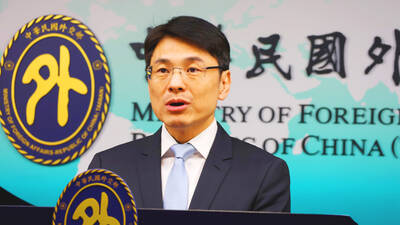
STAY IN YOUR LANE: As the US and Israel attack Iran, the ministry has warned China not to overstep by including Taiwanese citizens in its evacuation orders The Ministry of Foreign Affairs (MOFA) yesterday rebuked a statement by China’s embassy in Israel that it would evacuate Taiwanese holders of Chinese travel documents from Israel amid the latter’s escalating conflict with Iran. Tensions have risen across the Middle East in the wake of US and Israeli airstrikes on Iran beginning Saturday. China subsequently issued an evacuation notice for its citizens. In a news release, the Chinese embassy in Israel said holders of “Taiwan compatriot permits (台胞證)” issued to Taiwanese nationals by Chinese authorities for travel to China — could register for evacuation to Egypt. In Taipei, the ministry yesterday said Taiwan
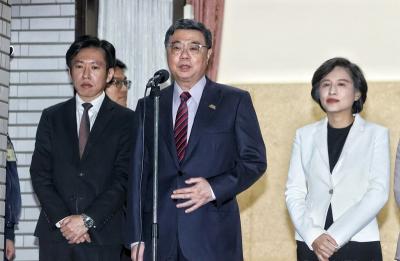
Taiwan is awaiting official notification from the US regarding the status of the Agreement on Reciprocal Trade (ART) after the US Supreme Court ruled US President Donald Trump's global tariffs unconstitutional. Speaking to reporters before a legislative hearing today, Premier Cho Jung-tai (卓榮泰) said that Taiwan's negotiation team remains focused on ensuring that the bilateral trade deal remains intact despite the legal challenge to Trump's tariff policy. "The US has pledged to notify its trade partners once the subsequent administrative and legal processes are finalized, and that certainly includes Taiwan," Cho said when asked about opposition parties’ doubts that the ART was
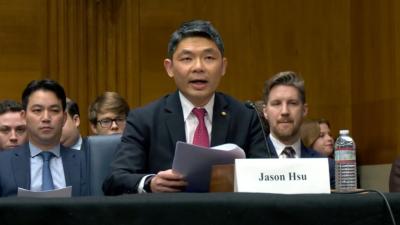
If China chose to invade Taiwan tomorrow, it would only have to sever three undersea fiber-optic cable clusters to cause a data blackout, Jason Hsu (許毓仁), a senior fellow at the Hudson Institute and former Chinese Nationalist Party (KMT) legislator, told a US security panel yesterday. In a Taiwan contingency, cable disruption would be one of the earliest preinvasion actions and the signal that escalation had begun, he said, adding that Taiwan’s current cable repair capabilities are insufficient. The US-China Economic and Security Review Commission (USCC) yesterday held a hearing on US-China Competition Under the Sea, with Hsu speaking on


 RSS
RSS