


Retired badminton champion Lee Yang (李洋) yesterday took office as the nation’s first minister of sports, saying that his top priority would be to launch a “sports for all” campaign — a pledge President William Lai (賴清德) made during his election campaign last year.
The ministry was also inaugurated yesterday.
“I really hope that people can adopt the habit of exercising... I will set an example and encourage my colleagues at the ministry to exercise for 30 minutes every day,” he told reporters after his inauguration.
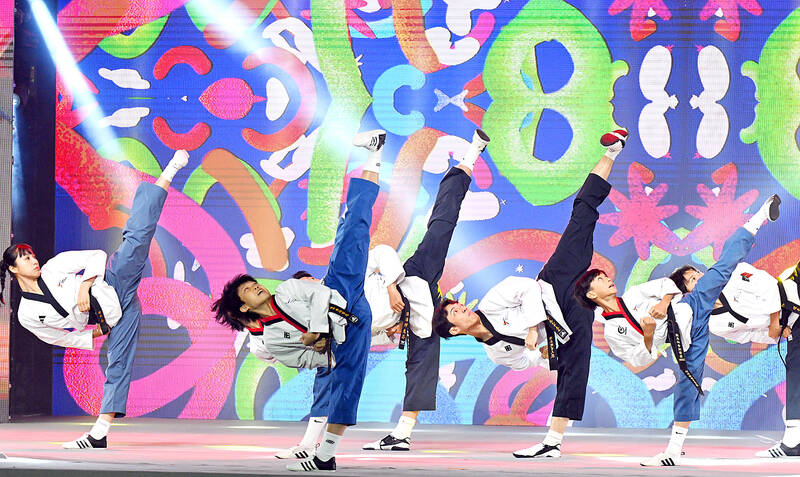
Photo: Liao Chen-huei, Taipei Times
Lee also said that he would review the Golden Plan, a government-funded project focused on training elite athletes who are most likely to win medals in the Olympic Games and other top-tier international sporting events.
“I was a beneficiary of the plan, but there are problems and controversies that need to be addressed. Aside from top athletes, I will also pay attention to athletes aged 18 to 24 who have great potential, but access to fewer resources,” he said.
Golden Plan 3.0 divides athletes into six categories, with training funds allocated to categories I, II and III athletes totaling NT$15 million (US$493,746), NT$10 million and NT$8 million respectively.
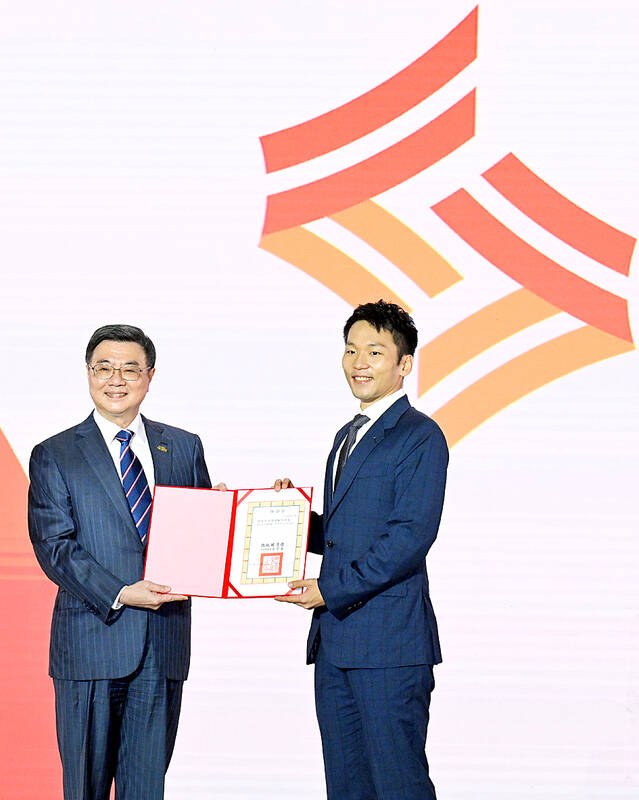
Photo: Liao Chen-huei, Taipei Times
Category VI athletes are those who are 18 or younger.
Sports associations examine athletes’ performances in international tournaments every six months to determine if their funding would continue.
Lee has become the nation’s youngest minister and first minister with an Olympic gold medal.
He said he had experienced many challenges when he was an athlete and understands how to deal with challenges.
He also vowed to boost the development of competitive sports.
Lee said that he aims to have more international sporting events held in Taiwan and facilitate growth of the domestic sports industry.
The ministry would focus on long-term development plans for student athletes at all levels, and uphold values of sustainability and diversity, he said.
“As an athlete, I craved challenges and enjoyed winning games with my team. With that spirit, I hope to achieve new milestones for sports in Taiwan,” he said.
Lai and Premier Cho Jung-tai (卓榮泰) also attended the ministry’s launching ceremony.
The Ministry of Sports is to oversee the Sports for All Agency, which was also established yesterday, as well as the National Sports Training Center, the Taiwan Institute of Sports Science and the Taiwan Sports Industry Development Center, Cho said.
The Executive Yuan has allocated a budget of NT$24.8 billion for next year to the newly established ministry, he said.
Prior to the establishment of the ministry, the Cabinet convened five consultation meetings for the plan, he said.
Lee was one of the people who the Cabinet consulted and attended all the meetings, having given valuable input, Cho said.
“Lee is not only an Olympic gold medalist. He has attended meetings concerning the nation’s sports development. He is the most qualified to be the minister of sports,” Cho said.
“I told him that things are always tough at the beginning, but nothing is more difficult than winning an Olympic gold medal, and he did it twice,” he added.
The premier said he hopes that the ministry would expedite reform of athletic classes in schools, ensure the healthy development of sports associations and enforce a new national sports policy that focuses on “sports for all.”
Lai said that the nation was united when baseball player Chen Chieh-hsien (陳傑憲) made a gesture after hitting a decisive three-run homer in the final game of the World Baseball Softball Confederation’s Premier12 championship against Japan last year, when he placed both hands over his chest to signal that he and his teammates were from Taiwan.
The iconic gesture also inspired the creation of the ministry’s logo, the president said.
“I thank Lee for undertaking the mission of leading the sports ministry. He appears to be completely ready to work with athletes and accept the challenges ahead,” Lai said. “I want him to know that he has the full backing of me and the Executive Yuan.”

‘NO SECURITY RISK’: The Railway Bureau reassured the public that the technicians’ activities were limited to technical guidance and did not involve sensitive systems The Railway Bureau yesterday said it had invited eight Chinese technicians to assist with an airport MRT construction project. The bureau issued the confirmation after an Internet user said Chinese nationals had entered the construction zone of Taiwan Taoyuan International Airport’s Terminal 3 project. They asked why “individuals from an enemy state” were allowed access to such a major national infrastructure project, which raised serious concerns over Taiwan’s industrial safety, sensitive systems and information security. The bureau’s Northern Region Engineering Branch Office said subcontractor Taiwan Handle Industrial Co (台灣手把工業) of the Taoyuan airport MRT’s “Contract No. CU05 Project A14 Station Civil, MEP &
Taiwan is still in the process of assessing the possibility of recruiting workers from Eswatini, the Ministry of Foreign Affairs said yesterday, adding that its goal is to help Eswatini upgrade its vocational training centers. If there are plans to recruit workers from Eswatini, safeguarding national security, protecting public health and ensuring the employment rights of Taiwanese would be prerequisites, Department of West Asian and African Affairs Director-General Yen Chia-liang (顏嘉良) told a news conference. Key considerations would also include filling labor shortages in specific industries, and fostering bilateral professional and technical exchanges, he said. Yen was asked about the progress of labor

A US uncrewed surface vessel (USV) encountered multiple Chinese warships during an autonomous transit of the Taiwan Strait, US defense company Seasats said in a statement on Wednesday. Seasats announced that a Lightfish USV had completed the first autonomous transit of the Taiwan Strait. Over five days, the USV traversed the entire length of the Strait while constantly monitoring surface vessel traffic, the company said. The Lightfish encountered multiple Chinese warships, one of which was a Chinese People’s Liberation Army Navy (PLAN) Type 056 corvette, it said. The Chinese vessels were operating “well within Taiwan’s exclusive economic zone without transmitting their identity via the
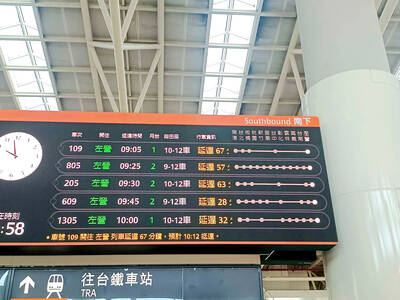
The nation’s usually punctual high-speed rail system yesterday was hit by major disruptions after all scheduled services were canceled and replaced with three hourly trains offering only non-reserved seating, affecting more than 200,000 passengers. Preliminary findings indicate the disruption was caused by a faulty power module in a track switch control cabinet, Taiwan High-Speed Rail Corp (THSRC) said, adding that as a full system inspection could only be conducted after operations end for the day, a decision on whether normal service would resume today would be announced before the first train departs. During a routine inspection early yesterday, a switch signal abnormality


 RSS
RSS