


Russian missiles and drones early yesterday ripped through apartment blocks in the Ukrainian capital, Kyiv, killing at least 15 people, including four children, an attack that Ukrainian President Volodymyr Zelenskiy said showed Moscow’s rejection of peace negotiations.
Russia has rained down aerial attacks on Ukrainian cities despite US President Donald Trump’s push for a ceasefire and even as it talks up the importance of ending the war, started by its full-scale invasion in February 2022.
The attack — one of the deadliest on Kyiv — blasted a five-story crater in one apartment block, ripping the building in two.
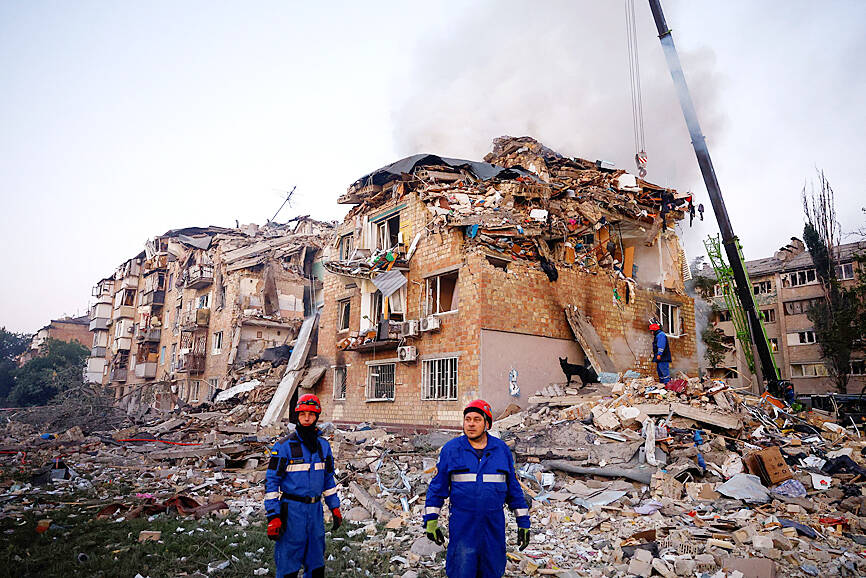
Photo: Reuters
Rescuers carried victims away in body bags as they sifted through the smoldering rubble, and heavy construction machinery was deployed to scoop up mounds of debris.
Officials said that several people were believed to be still trapped under the collapsed building.
“Glass was flying ... we were screaming when the bombs went off,” said Galina Shcherbak, who was at a parking lot close to one of the strikes.
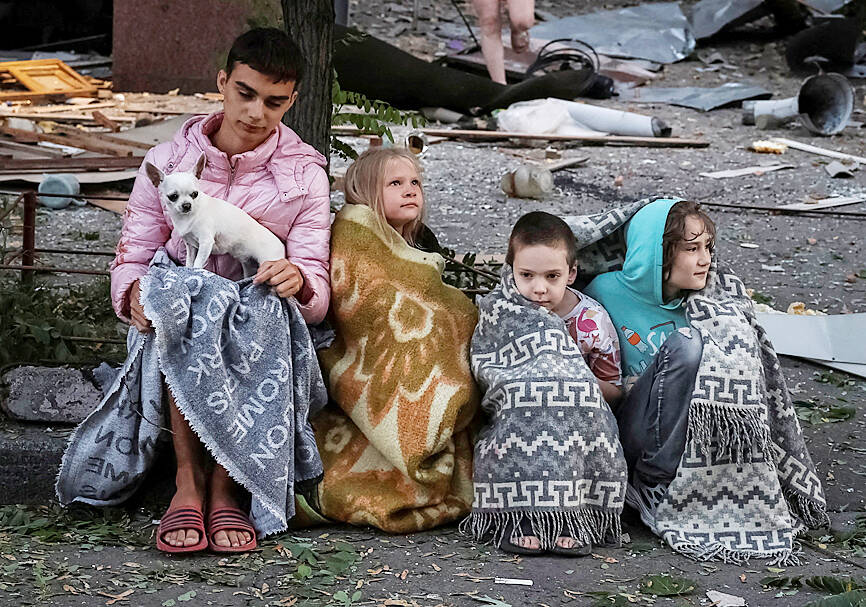
Photo: Reuters
The Ukrainian Air Force said Moscow fired 629 drones and missiles, which would make it the second-largest overnight barrage of the war, according to Agence France-Presse’s analysis of Kyiv’s data.
Andriy, whose apartment was destroyed in the strike, said that he had only just made it out alive.
“If I had gone to the shelter a minute later, I would not be here now, I would have been buried,” he said. “I came out, could not hear anything, there was fog everywhere, and my left eye was completely covered in blood.”
Zelenskiy called the attack “a horrific and deliberate killing of civilians.”
“The Russians are not choosing to end the war, only new strikes,” he said on social media, calling for Moscow to face fresh sanctions.
“For the spurning of ceasefire and for the constant Russian attempts to weasel out of negotiations, new strong sanctions are needed,” he added.
The Kremlin said it was still interested in diplomacy, but that its strikes on Ukraine would “continue.”
“The Russian armed forces are fulfilling their tasks,” Kremlin spokesman Dmitry Peskov told reporters. “They continue to strike military and military-adjacent infrastructure facilities.”
“At the same time, Russia remains interested in continuing the negotiation process. The aim is to achieve our goals through political and diplomatic means,” he added.
The EU summoned Russia’s ambassador after the overnight barrage damaged its delegation offices in Kyiv, while the British Council said its premises had been “severely damaged” and would be closed until further notice.

SILENCING CRITICS: In addition to blocking Taiwan, China aimed to prevent rights activists from speaking out against authoritarian states, a Cabinet department said The Ministry of Foreign Affairs (MOFA) yesterday condemned transnational repression by Beijing after RightsCon, a major digital human rights conference scheduled to be held in Zambia this week, was abruptly canceled due to Chinese pressure over Taiwanese participation. This year’s RightsCon, the world’s largest conference discussing issues “at the intersection of human rights and technology,” was scheduled to take place from tomorrow to Friday in Lusaka, and expected to draw 2,600 in-person attendees from 150 countries, along with 1,100 online participants. However, organizers were forced to cancel the event due to behind-the-scenes pressure from China, the ministry said, expressing its “strongest condemnation”
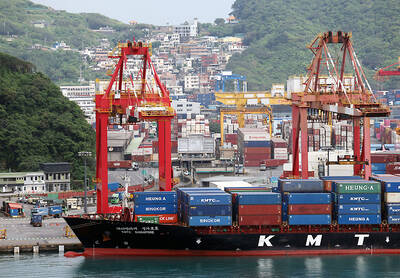
Taiwan’s economy grew far faster than expected in the first quarter, as booming demand for artificial intelligence (AI) applications drove a surge in exports, spilling over into investment and consumption, the Directorate-General of Budget, Accounting and Statistics (DGBAS) said yesterday. GDP growth was 13.69 percent year-on-year during the January-to-March period, beating the DGBAS’ February forecast by 2.23 percentage points and marking the most robust growth in nearly four decades, DGBAS senior official Chiang Hsin-yi (江心怡) told a news conference in Taipei. The result was powered by exports, which remain the backbone of Taiwan’s economy, Chiang said. Outbound shipments jumped 51.12 percent year-on-year to
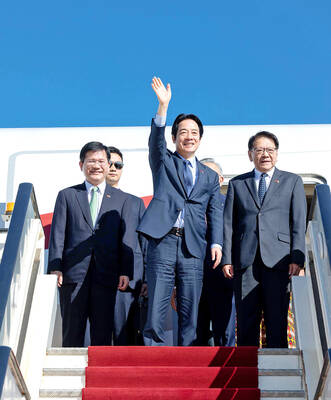
DELAYED BUT DETERMINED: The president’s visit highlights Taiwan’s right to international engagement amid regional pressure from China President Willaim Lai (賴清德) yesterday arrived in Eswatini, more than a week after his planned visit to Taiwan’s sole African ally was suspended because of revoked overflight permits. “The visit, originally scheduled for April 22, was postponed due to unforeseen external factors,” Lai wrote on social media. “After several days of careful arrangements by our diplomatic and national security teams, we successfully arrived today.” Lai said he looked forward to further deepening Taiwan-Eswatini relations through closer cooperation in the economy, agriculture, culture and education, as well as advancing the nation’s international partnerships. The president was initially scheduled to arrive in time to celebrate
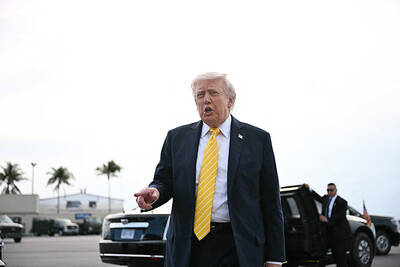
Iran’s Islamic Revolutionary Guard Corp (IRGC) yesterday said the US faced a choice between an “impossible” military operation or a “bad deal” with Tehran, after US President Donald Trump disparaged Iran’s latest peace proposal. Negotiations between the two countries have been deadlocked since a ceasefire came into effect on April 8, with only one round of direct peace talks held so far. Iran’s Tasnim and Fars news agencies reported that Tehran had submitted a 14-point proposal to mediator Pakistan, but Trump was quick to cast doubt on it. “I will soon be reviewing the plan that Iran has just sent to us, but


 RSS
RSS