


Philippine President Ferdinand Marcos Jr yesterday said his country would inevitably be drawn “kicking and screaming” into any war over Taiwan due to its proximity and the presence of large numbers of Filipino workers there, despite China’s strong protest over such remarks.
Relations between China and the Philippines have been severely strained after Marcos, who took office in 2022, and his administration emerged as some of the most vocal critics in Asia of Beijing’s increasingly aggressive actions in the South China Sea.
The Marcos administration deepened its treaty alliance engagements with the US and started broadening security alliances with other Western and Asian countries such as Japan, Australia, India and some EU member states to strengthen deterrence against Beijing’s assertiveness.
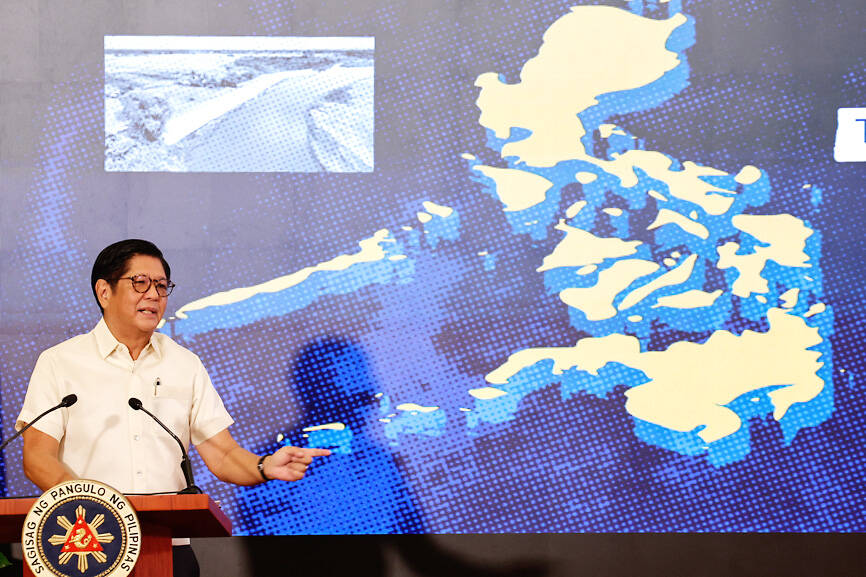
Photo: EPA
China protested last week and accused Marcos of interfering in its domestic affairs and contravening its “one China” policy when he told reporters on the sidelines of a visit to India that there was no way the Philippines could stay out of a possible war in Taiwan because of his country’s proximity to it and the presence of about 200,000 Filipino workers in Taiwan.
The Chinese Ministry of Foreign Affairs said through a spokesperson that “‘geographic location’ and a ‘large volume of Filipinos’ in Taiwan should not be used as pretexts to interfere in the internal and sovereign affairs of other countries” and urged the Philippines “to earnestly abide by the One China principle” and “refrain from playing fire on issues bearing on China’s core interests.”
Asked to comment on China’s protest, Marcos said he was perplexed and could not understand Beijing’s concern.
“I don’t know what they’re talking about, playing with fire? I was just stating facts. We do not want to go to war, but I think if there is a war over Taiwan, we will be drawn, we will be pulled in whether we like it or not, kicking and screaming,” Marcos said. “We will be drawn and dragged into that mess. I hope it doesn’t happen, but, if it does, we have to plan for it already.”
The Ministry of Foreign Affairs (MOFA) on Sunday expressed gratitude after the Philippine Department of Foreign Affairs on Friday stated Manila’s longstanding position on the importance of peace and stability in Taiwan.
The department’s statement “highlights that peace and stability in the Taiwan Strait is a shared concern among countries in the region,” MOFA said, adding that Taiwan, under the “integrated diplomacy” strategy, would continue to deepen its substantial cooperative relationship with the Philippines, and together work toward regional peace and prosperity.
Separately, Philippine Coast Guard Commodore Jay Tarriela said China Coast Guard ships chased and staged dangerous blocking maneuvers yesterday against Philippine coast guard and fishing vessels in the hotly disputed Scarborough Shoal (Huangyan Island, 黃岩島), which Taiwan also claims.
A Philippine Coast Guard ship managed to evade being hit by a Chinese coast guard water cannon during the melee, he said.
While chasing a Philippine Coast Guard vessel, a Chinese coast guard ship accidentally collided with a Chinese navy ship, he said, adding that the Chinese coast guard ship sustained “substantial damage,” and the Philippine Coast Guard offered to provide help, including medical assistance.
There was no immediate comment from Chinese officials on Tarriela’s statements.
Asked if the Philippine vessels would be instructed to withdraw from the disputed shoal, Marcos said his government would never back away from any fight.
“There is no silver bullet that if you fire it, all our problems would be solved,” Marcos said.
“What will happen is, we will continue to be present, we will continue to defend our territory, we will continue to exercise our sovereign rights and despite any opposition from anyone, we will continue to do that as we have done in the past three years,” he added.

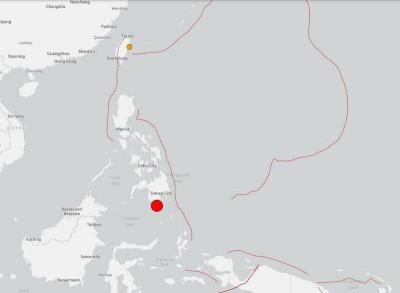
A magnitude 7.8 earthquake struck off the southern coast of Mindanao in the Philippines at 7:38am today, prompting the US Tsunami Warning System to issue an alert for neighboring countries, including Taiwan. The system issued a purple alert indicating a "tsunami threat." The potential threat zone includes Taiwan, the Philippines, Papua New Guinea, Yap and Palau. Philippine authorities were assessing the damage from the quake, with the office of civil defense seeking to verifying initial reports that 15 people had been killed and 129 injured in the region, mostly from falling debris. Arlene Hollero, disaster chief of Maasim town in the Philippines' Sarangani Province,
RESILIENCE: Taiwan plays a key role in semiconductors, energy, information infrastructure and advanced manufacturing, AIT Director Raymond Greene said Taiwan’s continued investment in deterrence and resilience remains vital, especially in uncrewed systems and other emerging technologies, American Institute in Taiwan (AIT) Director Raymond Greene said yesterday. Greene made the remarks at the annual National Strategic Summit on Supply Chain Resilience held by the Research Institute for Democracy, Society and Emerging Technology (DSET), a government-backed think tank. As Taiwan last year became the US’ fourth-largest trading partner and supply chain security is becoming more important, cooperation in emerging technologies continues to deepen between the two countries, he said. The US is committed to accelerating innovation, building key infrastructure, strengthening cooperation

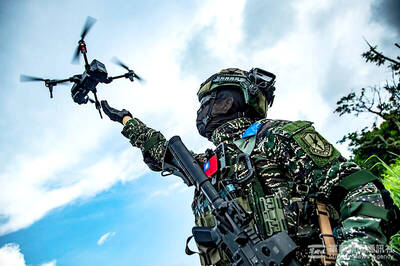
The National Chungshan Institute of Science and Technology yesterday showcased its locally developed variants of the Vision 60 robotic patrol dog, which it plans to deploy on the nation’s outlying territories in the South China Sea. The variants were produced under the Joint Lab project — created by the institute and domestic companies — and assembled with domestically produced motors, lenses and artificial intelligence (AI) systems alongside licensed tech from the US, Missile and Rocket Systems Research Division deputy director Jen Kuo-kang (任國光) told the media event at a military base in Taipei’s Dazhi (大直) area. Taiwan has built up its strengths

RIGHT DIRECTION: Taiwan’s efforts to prevent forced labor include a proposal to ‘fully prohibit’ employers from withholding workers’ documents, an official said Taiwan is to establish a mechanism to restrict imports of goods linked to forced labor, the Executive Yuan said yesterday, after the US proposed imposing additional tariffs on Taiwanese goods over labor concerns. “The Ministry of Labor and the Ministry of Economic Affairs are to establish an interministerial review procedure,” Executive Yuan spokesperson Michelle Lee (李慧芝) said at a news briefing in Taipei. “The government is to use the Foreign Trade Act [貿易法] as the legal basis to restrict imports of goods produced with forced labor” and bring its supply chain governance more in line with international standards on human rights, resilience


 RSS
RSS