


The Philippines yesterday criticized a “high-risk” maneuver by a Chinese vessel near the disputed Scarborough Shoal (Huangyan Island, 黃岩島) in a rare incident involving warships from the two navies.
The Scarborough Shoal — a triangular chain of reefs and rocks in the contested South China Sea — has been a flash point between the countries since China seized it from the Philippines in 2012.
Taiwan also claims the shoal.
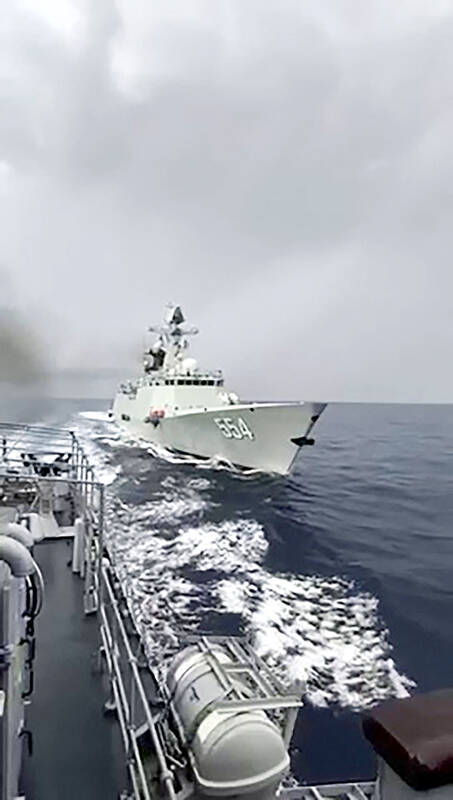
Photo: Armed Forces of the Philippines’ Public Affairs Office via AFP
Monday’s encounter took place approximately 11.8 nautical miles (22km) southeast” of the Scarborough Shoal, the Philippine military said, during ongoing US-Philippine military exercises that Beijing has criticized as destabilizing.
“The Chinese frigate BN 554 was documented tailing PS35 [BRP Emilio Jacinto] at close range, while BN 573 dangerously crossed its bow in a high-risk maneuver that created the danger of collision,” the military said in a statement, labeling the incident “threatening and provocative.”
China in response accused Manila of sending a ship to “intrude” into its territorial waters.
Its military said it had sent “naval and air forces to track, monitor, warn and drive away the Philippine boat in accordance with laws and regulations.”
“The relevant remarks of the Philippines side disregarded the facts, confused the public and attempted to mislead international cognition,” said Colonel Tian Junli (田軍里), spokesman for the Chinese People’s Liberation Army’s Southern Theater Command.
Philippine Rear Admiral Roy Vincent Trinidad said the last such encounter between warships from the two navies he could remember was on a resupply mission in the South China Sea two years ago.
Philippine Vice Admiral Alexander Lopez, spokesman for the National Maritime Council, said the Chinese vessel had been “dangerously close” to its Philippine counterpart.
The ship crossing the bow of the BRP Emilio Jacinto had come within about 180m, leaving “no room for any maneuver, for any emergency cases,” he said.
The Chinese vessel following alongside had been less than 100m away, he said.
China and the Philippines have engaged in months of confrontations in the South China Sea, which Beijing claims in nearly its entirety despite an international ruling its assertion has no merit.
The joint US-Philippine exercises known as Balikatan, which this year were to simulate a “full-scale battle scenario,” are set to end today.

The Tourism Administration yesterday announced that it would reward repeat international visitors with incentives of up to NT$8,000 to boost inbound tourism. The incentives are available to all international tourists, it said, adding that repeat visitors would be rewarded with NT$5,000 and would receive an additional NT$3,000 if they bring travel companions. The nation received 2,990,657 inbound visitors during the first quarter, marking a 3.8 percent increase from the same period last year, agency data showed. Japanese nationals are among groups visiting Taiwan the most. About 1.48 million Japanese tourists arrived last year, a year-on-year increase of more than 12
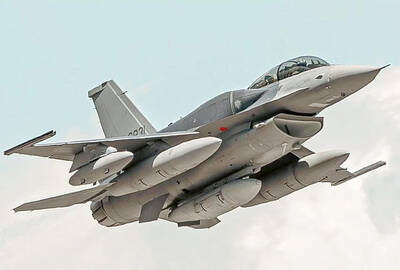
66 FIGHTER JETS: The aircraft is likely undergoing preparations for its transfer to Taiwan — a significant step forward in the nation’s modernization program, a lawmaker said The first of Taiwan’s order of F-16V Block 70 aircraft has been sighted in Texas ahead of delivery, Democratic Progressive Party (DPP) Legislator Wang Ting-yu (王定宇) said. Taiwan’s first F-16V Block 70 two-seat aircraft, tail number 6831, was seen flying from Lockheed Martin’s production facility in Greenville, South Carolina, to Naval Air Station Joint Reserve Base Fort Worth in Texas, Wang wrote on Facebook yesterday. The plane is likely undergoing preparations for its transfer to Taiwan, marking a significant step forward in the Republic of China Air Force’s modernization program, Wang said, citing military analysts. The F-16V Block 70 is a new-build version
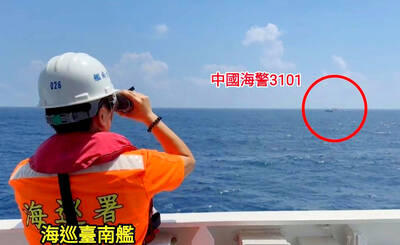
‘BRAZEN’: The holiday did not stop China from activities that infringe on Taiwan’s maritime jurisdiction, but the CGA is ready to defend the nation, Kuan Bi-ling said Beijing is intensifying maritime pressure on Taiwan, but the nation will never yield, Ocean Affairs Council Deputy Minister Sung Chen-en (宋承恩) said. The Coast Guard Administration (CGA) has adopted a “shadowing and monitoring” approach to avoid falling into a Chinese trap to escalate tensions and deepen the conflict, Sung said in an interview published yesterday in the Chinese-language Liberty Times (the Taipei Times’ sister newspaper). China Coast Guard formations patrolling waters east of Taiwan, as well as official Chinese vessels entering areas around Itu Aba Island (Taiping Island, 太平島) and Pratas Islands (Dongsha Islands, 東沙群島) show Beijing’s attempts to significantly step up
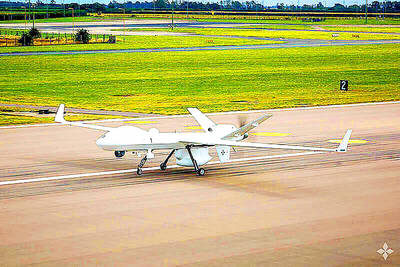
BOOST: By operating the same advanced systems as the US military, Taiwan would be better positioned to share and integrate intelligence with partners, an expert said The first batch of MQ-9B SkyGuardian drones has arrived in Taiwan, and is being assembled and tested by drone manufacturer General Atomics and the military ahead of flight trials as part of the air force’s acquisition to bolster its aerial surveillance capabilities, a source said yesterday. The air force allocated a budget of NT$21.7 billion (US$687 million) from 2022 to 2029 to procure four MQ-9B uncrewed aerial vehicles (UAVs) manufactured by General Atomics along with associated equipment such as ground control stations. The US has agreed to deliver the four MQ-9Bs to Taiwan in two batches this year and next


 RSS
RSS