


Freedom of speech does not allow comments by Chinese residents in Taiwan that compromise national security or social stability, the nation’s top officials said yesterday, after the National Immigration Agency (NIA) revoked the residency permit of a Chinese influencer who published videos advocating China annexing Taiwan by force.
Taiwan welcomes all foreigners to settle here and make families so long as they “love the land and people of Taiwan,” Premier Cho Jung-tai (卓榮泰) told lawmakers during a plenary session at the Legislative Yuan in Taipei.
The public power of the government must be asserted when necessary and the Ministry of the Interior had handled the incident according to the facts and regulations, he said.
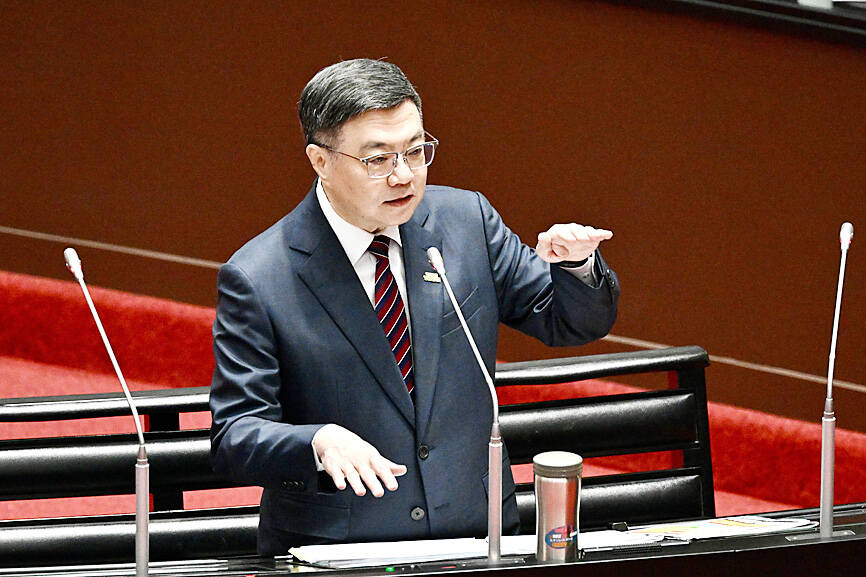
Photo: George Tsorng, Taipei Times
The remarks came a day after the influencer shared a video on Douyin (抖音), a Chinese social media platform.
The agency cited regulations governing the long-term residency of Chinese that authorized the government to refuse or rescind the permit of Chinese who “pose a danger to national security or social stability.”
The influencer, surnamed Liu (劉) — better known by her online channel name Yaya in Taiwan (亞亞在台灣) — had obtained permanent residency via marriage to a Taiwanese.
The agency is temporarily refraining from deporting Liu out of humanitarian concerns, sources said, citing that she needs time to settle affairs concerning her family.
Democratic Progressive Party (DPP) Legislator Lin Chun-hsien (林俊憲) had asked Cho to comment on the first-ever case of the NIA revoking the legal status of a Chinese residing in Taiwan.
The US and European nations can and do legally deport foreign residents for spreading extremist ideology, Lin said.
He called for stronger enforcement of rules governing Chinese spouses, saying Taiwan rarely deports Chinese for harming social stability or national security, despite having a legal mandate to do so.
The NIA made the decision to deport the influencer on strong evidence, Minister of the Interior Liu Shyh-fang (劉世芳) told reporters ahead of yesterday’s legislative session.
The influencer from May last year to January shared multiple videos on social media in which she claimed Taiwan is a part of China and the “inevitability” of the nation’s “reunification” by the latter, Liu Shyh-fang said.
Taiwanese know that freedom of speech was not a gift from the heavens or an excuse to promote ideas of annexation of Taiwan by force or military intimidation of the nation, she said.
The influencer’s comments and any similar inflammatory online statements would be dealt with according to the law, she added.
The Legislative Yuan is discussing a bill to shorten the waiting period for Chinese nationals with Taiwanese spouses to obtain Taiwanese citizenship from six years to four.
The bill is still under consideration and the Ministry of the Interior has advised legislators to exercise caution due to the increased risk posed by geopolitical tensions and the state of cross-strait relations, Liu Shyh-fang said.
The NIA in a news release on Tuesday evening said it received reports that Yaya made the statements on her Douyin account, which has about 400,000 followers.
Her comments in a self-recorded video were reported under suspicion of promoting “united front” tactics, and she was questioned, it said.
The agency said it revoked her permit according to the Act Governing Relations Between the People of the Taiwan Area and the Mainland Area (臺灣地區與大陸地區人民關係條例), it said.
China’s Taiwan Affairs Office in a news conference threatened Taiwanese Internet celebrity Pa Chiung (八炯) who according to Taiwanese media reported Yaya to the authorities.
Pa Chiung is “a piece of scum, a thief and an accomplice, and will be severely punished,” office spokesman Chen Binhua (陳斌華) said.
The Chinese influencer’s impending deportation is another incident of Taiwan harming their Chinese compatriots, he said.
The freedom of speech Taiwan touted is freedom only for pro-Taiwanese independence and anti-Chinese speech in a display of hypocrisy and double standards, he said.

‘NO SECURITY RISK’: The Railway Bureau reassured the public that the technicians’ activities were limited to technical guidance and did not involve sensitive systems The Railway Bureau yesterday said it had invited eight Chinese technicians to assist with an airport MRT construction project. The bureau issued the confirmation after an Internet user said Chinese nationals had entered the construction zone of Taiwan Taoyuan International Airport’s Terminal 3 project. They asked why “individuals from an enemy state” were allowed access to such a major national infrastructure project, which raised serious concerns over Taiwan’s industrial safety, sensitive systems and information security. The bureau’s Northern Region Engineering Branch Office said subcontractor Taiwan Handle Industrial Co (台灣手把工業) of the Taoyuan airport MRT’s “Contract No. CU05 Project A14 Station Civil, MEP &

A US uncrewed surface vessel (USV) encountered multiple Chinese warships during an autonomous transit of the Taiwan Strait, US defense company Seasats said in a statement on Wednesday. Seasats announced that a Lightfish USV had completed the first autonomous transit of the Taiwan Strait. Over five days, the USV traversed the entire length of the Strait while constantly monitoring surface vessel traffic, the company said. The Lightfish encountered multiple Chinese warships, one of which was a Chinese People’s Liberation Army Navy (PLAN) Type 056 corvette, it said. The Chinese vessels were operating “well within Taiwan’s exclusive economic zone without transmitting their identity via the
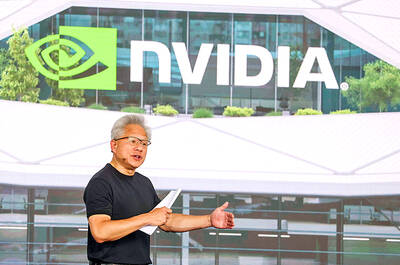
‘BOOMING’: ’ The number of partners we have here is incredible. You can see from their stock prices. They’re doing so well, they’re so happy,’ Jensen Huang said Nvidia Corp’s spending in Taiwan has ballooned to about US$150 billion a year, 10 times the US$10 billion to US$15 billion the company spent five years ago, Nvidia chief executive officer Jensen Huang (黃仁勳) said yesterday, suggesting Taiwan’s strategic importance in the global artificial intelligence (AI) supply chain. “Taiwan is the epicenter of the AI revolution. This is where the chips come, packaging comes. This is where the systems are made. This is where AI supercomputers were created,” Huang said at a meeting for the company’s employees in Beitou-Shilin Technology Park (北投士林科技園區) in Taipei, the planned site of Nvidia’s Taipei headquarters. “Taiwan
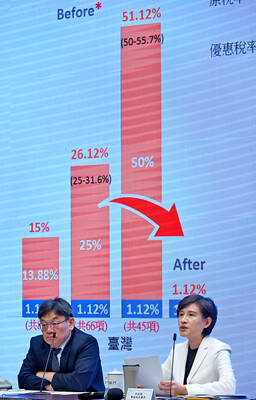
GREATER REACH? Auto parts and wood products would face tariffs of up to 15%, matching those targeting the EU, Japan and South Korea, Vice Premier said The US has announced that preferential tariff treatment for Taiwan’s non-semiconductor Section 232 goods would take effect retroactively from May 1, the Executive Yuan said yesterday. The US government yesterday posted a notice on the Federal Register’s public inspection Web site previewing tariff concessions for Taiwan under a memorandum of understanding (MOU) on Taiwan-US investment after two months of negotiations. The MOU signed on Jan. 15 stipulated three major preferential tariff arrangements: a 15 percent “reciprocal” tariff rate for Taiwan without stacking most-favored nation (MFN) rates; preferential Section 232 treatment for semiconductors and related products; and preferential Section 232 treatment for non-semiconductor


 RSS
RSS