


President William Lai (賴清德) today said that his administration would continue its efforts to accelerate the declassification of political archives, further implement transitional justice and prevent the recurrence of similar tragic events while speaking at the national commemoration of the 228 Incident in Taipei.
The ceremony for the 78th anniversary of the tragedy took place at the National 228 Memorial Museum in Taipei this morning.
It was Lai’s first time attending the national commemoration as president and he gave his speech entirely in Taiwanese Hoklo.
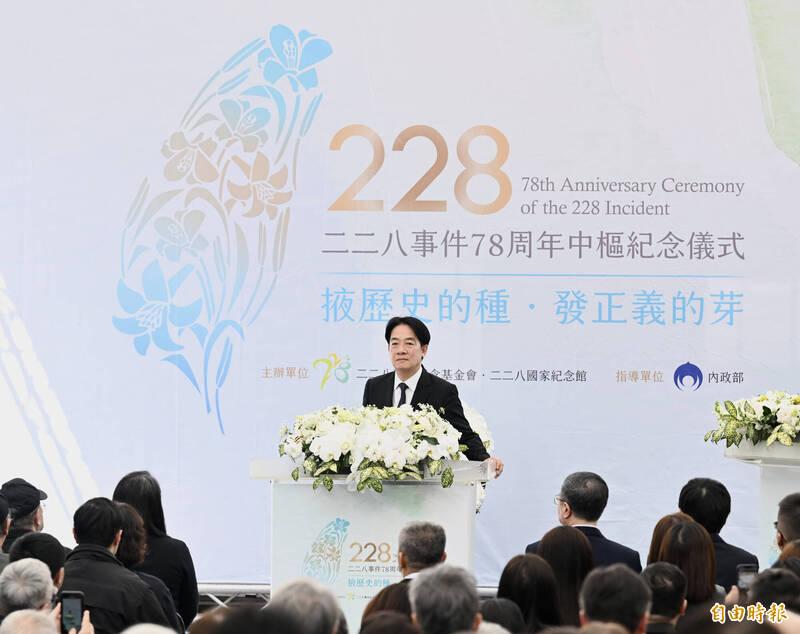
Photo: Lo Pei-te, Taipei Times
“My heart has always been with you,” Lai said, paying tribute to the victims of the 228 Incident.
Lai presented flowers to commemorate the victims and extended his condolences to their families.
The cause of the 228 Incident was not ethnic conflict, but troops from mainland China who committed grave crimes upon coming to Taiwan, Lai said.
“As the dictator Chiang Kai-shek (蔣介石) suffered continuous defeats on the mainland battlefield, he committed heinous crimes to secure his rule over Taiwan,” he said
Countless innocent people were arrested, imprisoned, beaten and killed, leaving families shattered, he said.
Many people fled overseas, and Taiwan lost an entire generation of talent, causing immeasurable damage to society, he added.
Many perpetrators remain unidentified, and this lack of accountability not only fails to provide full closure for the victims and their families, but also prevents true societal reconciliation, Lai said.
His administration would assist the Memorial Foundation of 228 in disclosing information regarding preparators and transitional justice so society can be fully informed, he said.
The National Security Bureau has been instructed to review over 1 million political archives from the martial law period to clarify the historical truth, Lai said.
The Ministry of Culture has begun reviewing places where human rights violations occurred to preserve more “sites with transitional justice significance,” he said.
The annual commemoration is not only to honor the victims, comfort their families and heal historical wounds, but also to ensure that such events never happen again, Lai said.
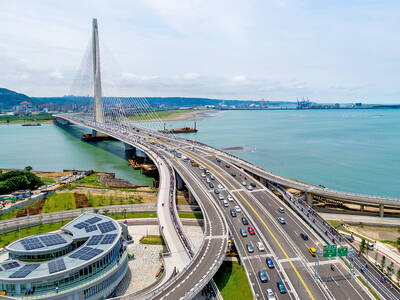
The Ministry of Transportation and Communications yesterday inaugurated the Danjiang Bridge across the Tamsui River in New Taipei City, saying that the structure would be an architectural icon and traffic artery for Taiwan. Feted as a major engineering achievement, the Danjiang Bridge is 920m long, 211m tall at the top of its pylon, and is the longest single-pylon asymmetric cable-stayed bridge in the world, the government’s Web site for the structure said. It was designed by late Iraqi-British architect Zaha Hadid. The structure, with a maximum deck of 70m, accommodates road and light rail traffic, and affords a 200m navigation channel for boats,

Taiwan Semiconductor Manufacturing Co (TSMC, 台積電), the world’s largest foundry service provider, yesterday said that global semiconductor revenue is projected to hit US$1.5 trillion in 2030, after the figure exceeds US$1 trillion this year, as artificial intelligence (AI) demand boosts consumption of token and compute power. “We are still at the beginning of the AI revolution, but we already see a significant impact across the whole semiconductor ecosystem,” TSMC deputy cochief operating officer Kevin Zhang (張曉強) said at the company’s annual technology symposium in Hsinchu City. “It is fair to say that in the past decade, smartphones and other mobile devices were
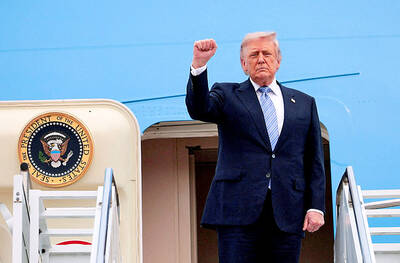
US-CHINA SUMMIT: MOFA welcomed US reassurance of no change in its Taiwan policy; Trump said he did not comment when Xi talked of opposing independence US President Donald Trump yesterday said he has not made a decision on whether to move forward with a major arms package for Taiwan after hearing concerns about it from Chinese President Xi Jinping (習近平). Trump’s comments on Taiwan came as he flew back to Washington after wrapping up critical talks in which both leaders said important progress was made in stabilizing US-China relations even as deep differences persist between the world’s two biggest powers on Iran and Taiwan. “I will make a determination,” Trump said, adding: “I’ll be making decisions. But, you know, I think the last thing we need right
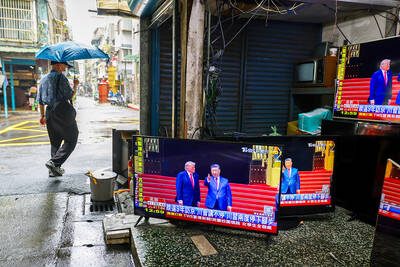
TAIWAN ISSUE: US treasury secretary Scott Bessent said on the first day of meetings that ‘it wouldn’t be a US-China summit without the Taiwan issue coming up’ There were no surprises on the first day of the summit between US President Donald Trump and Chinese President Xi Jinping (習近平), the Mainland Affairs Council (MAC) said yesterday, as the government reiterated that cross-strait stability is crucial to the Asia-Pacific region, as well as the world. As the two presidents met for a highly anticipated summit yesterday, Chinese state media reported that Xi warned Trump that missteps regarding Taiwan could push their two countries into “conflict.” Trump arrived in China with accolades for his host, calling Xi a “great leader” and “friend,” and extending an invitation to visit the White House


 RSS
RSS