


US Senator Marco Rubio, US president-elect Donald Trump’s nominee for secretary of state, on Wednesday said that a “dangerous” China cheated its way to superpower status, as he vowed to ramp up support to deter an invasion of Taiwan.
Rubio laid out his worldview to fellow senators at a confirmation hearing that took place just as Israel and Hamas agreed to a ceasefire in their 15-month war, a long-sought goal of US President Joe Biden’s outgoing administration.
Rubio, who is expected to secure confirmation easily, described China as “the most potent and dangerous near-peer adversary this nation has ever faced” and warned of drastic impacts if the US does not act.
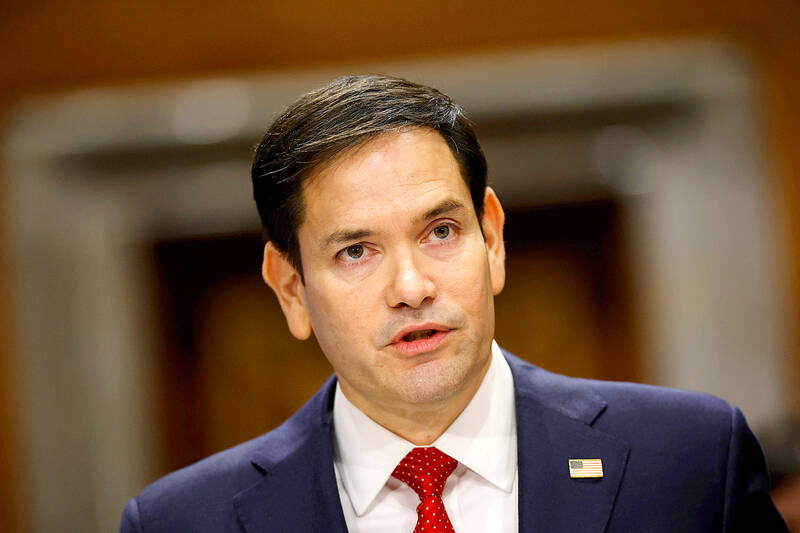
Photo: AFP
“If we stay on the road we’re on right now, in less than 10 years virtually everything that matters to us in life will depend on whether China will allow us to have it or not — everything from the blood pressure medicine we take to what movies we get to watch,” Rubio said.
He vowed to ramp up the defenses of Taiwan to prevent a “cataclysmic military intervention.”
“We need to wrap our head around the fact that unless something dramatic changes, like an equilibrium [between China and Taiwan], where they conclude that the costs of intervening in Taiwan are too high, we’re going to have to deal with this before the end of this decade,” Rubio said.
Trump had raised questions during his campaign over Taiwan by insisting it does not pay enough for its own defense — similar criticism he has made of NATO allies.
Rubio distanced himself from talk of exiting NATO, but said the US needed to ask whether to retain “the primary defense role” in the alliance or be a “backstop to aggression,” with Europeans taking more responsibility.
A staunch backer of Ukraine after its invasion by Russia nearly three years ago, Rubio has allied with Trump in promising “bold diplomacy” that would require concessions on both sides.
“This war has to end, and I think it should be the official policy of the United States that we want to see it end,” Rubio said, a shift from Biden’s approach of supporting Ukraine through victory.
Rubio also backed the diplomacy that reached the Gaza ceasefire, but made it clear that he would staunchly back Israel, after Biden’s occasional criticism of the toll to civilians.
“How can any nation-state on the planet coexist side by side with a group of savages like Hamas?” he said.
Rubio rejected a key tenet of Biden’s foreign policy — prioritizing a rules-based, US-led “liberal world order” — in favor of Trump’s belief in “America First.”
“The post-war global order is not just obsolete; it is now a weapon being used against us,” he said.
“We welcomed the Chinese Communist Party into this global order, and they took advantage of all its benefits, but they ignored all its obligations and responsibilities,” Rubio said.
“Instead, they have lied, cheated, hacked and stolen their way to global superpower status, at our expense,” he said.
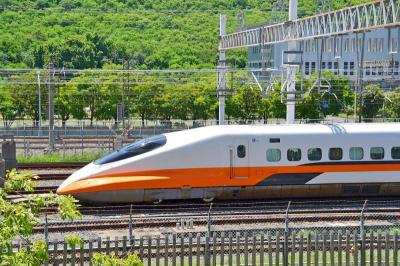
A signaling system malfunction disrupted high-speed rail (HSR) services beginning at 8am today, with trains temporarily reduced to three northbound and three southbound trains per hour as authorities conduct inspections. The malfunction occurred on a section of track in Miaoli County during pre-operation checks early this morning, forcing northbound and southbound trains to use a single track, the HSR operator said. The regular schedule has been replaced with three hourly trains offering only nonreserved seating in each direction, stopping at every station, it said, adding that business class cars would still have reserved seating. Departures from terminal stations are scheduled at the top
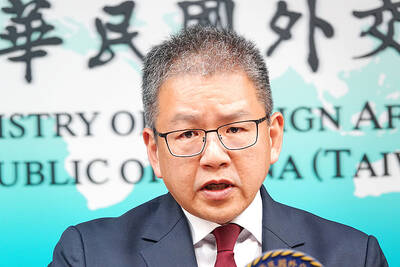
Taiwan is still in the process of assessing the possibility of recruiting workers from Eswatini, the Ministry of Foreign Affairs said yesterday, adding that its goal is to help Eswatini upgrade its vocational training centers. If there are plans to recruit workers from Eswatini, safeguarding national security, protecting public health and ensuring the employment rights of Taiwanese would be prerequisites, Department of West Asian and African Affairs Director-General Yen Chia-liang (顏嘉良) told a news conference. Key considerations would also include filling labor shortages in specific industries, and fostering bilateral professional and technical exchanges, he said. Yen was asked about the progress of labor

A US uncrewed surface vessel (USV) encountered multiple Chinese warships during an autonomous transit of the Taiwan Strait, US defense company Seasats said in a statement on Wednesday. Seasats announced that a Lightfish USV had completed the first autonomous transit of the Taiwan Strait. Over five days, the USV traversed the entire length of the Strait while constantly monitoring surface vessel traffic, the company said. The Lightfish encountered multiple Chinese warships, one of which was a Chinese People’s Liberation Army Navy (PLAN) Type 056 corvette, it said. The Chinese vessels were operating “well within Taiwan’s exclusive economic zone without transmitting their identity via the

VERBOSE VESSELS: A CGA cutter and a China Coast Guard exchanged verbal barbs for more than a day in Taiwanese-controlled waters before the Chinese vessel left The Taiwanese and Chinese coast guards had a standoff near the strategically located Pratas Islands (Dongsha Islands, 東沙群島) in the north of the South China Sea, the Coast Guard Administration (CGA) said yesterday. The two sides engaged in intense radio exchanges over sovereignty claims during the 33-hour standoff. China Coast Guard vessel 3501 eventually left the restricted waters, 26.6 nautical miles (49.2km) west of the Pratas Islands, at 5pm yesterday, the CGA said. Lying approximately between southern Taiwan and Hong Kong, the Taiwan-controlled Pratas are seen by some security experts as vulnerable to Chinese attack due to their distance — more than


 RSS
RSS