


US president-elect Donald Trump on Friday filed a brief urging the US Supreme Court to pause a law that would ban TikTok the day before his Jan. 20 inauguration if it is not sold by its Chinese owner ByteDance Ltd (字節跳動).
“In light of the novelty and difficulty of this case, the court should consider staying the statutory deadline to grant more breathing space to address these issues,” Trump’s legal team wrote, to give him “the opportunity to pursue a political resolution.”
Trump was fiercely opposed to TikTok during his first term from January 2017 to January 2021, and tried in vain to ban the video app on national security grounds.
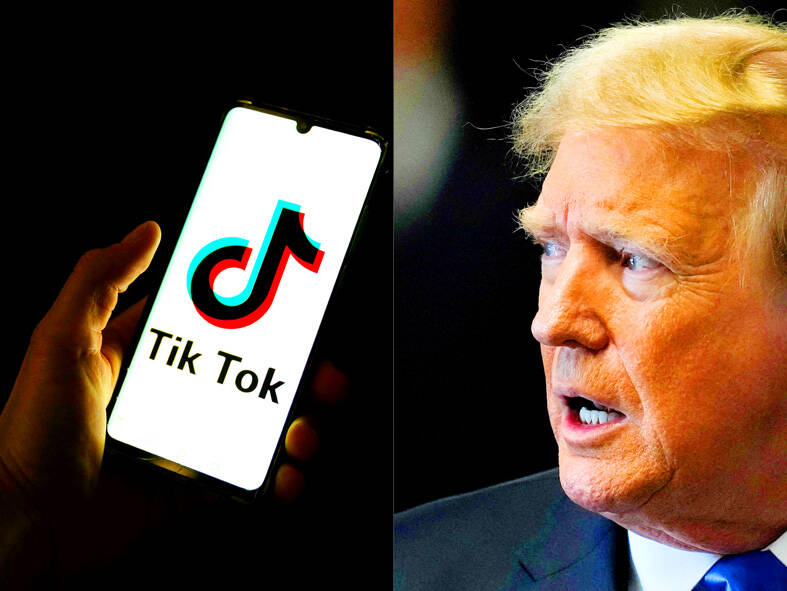
Photo: AFP
The Republican voiced concerns — echoed by political rivals — that the Chinese government might tap into US TikTok users’ data or manipulate what they see on the platform.
US officials had also voiced alarm over the popularity of the video-sharing app among young people, alleging that its parent company is subservient to Beijing and that the social media program is used to spread propaganda, claims denied by the company and the Chinese government.
Trump called for a US company to buy TikTok, with the government sharing in the sale price, and his successor, US President Joe Biden, went one step further — signing a law to ban the app for the same reasons.
Trump has now reversed course.
At a news conference last week, Trump said he has “a warm spot” for TikTok and that his administration would take a look at the app and the potential ban.
Earlier this month, the president-elect met with TikTok CEO Chew Shou Zi (周受資) at his Mar-a-Lago residence in Florida.
Recently, Trump told Bloomberg he had changed his mind about the app.
“Now [that] I’m thinking about it, I’m for TikTok, because you need competition,” he said. “If you don’t have TikTok, you have Facebook and Instagram — and that’s, you know, that’s Zuckerberg.”
Facebook, founded by Mark Zuckerberg and part of his Meta Platforms Inc empire, was among the social media networks that banned Trump after attacks by his supporters on the US Capitol on Jan. 6, 2021. The ban was driven by concerns that he would use the platform to promote more violence.
Those bans on major social media platforms were later lifted.
In the brief filed on Friday, Trump’s lawyer made it clear the president-elect did not take a position on the legal merits of the current case.
A coalition of free speech groups — including the American Civil Liberties Union — also filed a separate brief to the Supreme Court opposing enforcement of the law, citing censorship concerns.
“Such a ban is unprecedented in our country and, if it goes into effect, will cause a far-reaching disruption in Americans’ ability to engage with the content and audiences of their choice online,” the rights groups’ filing read, in part.
The US apex court agreed last week to hear TikTok’s appeal against Biden’s move to force its owner to divest from it or face a ban.
With oral arguments scheduled for Jan. 10, the case would have to be heard at a breakneck speed.
TikTok argues that the law, the Protecting Americans from Foreign Adversary Controlled Applications Act, contravenes its First Amendment free speech rights.
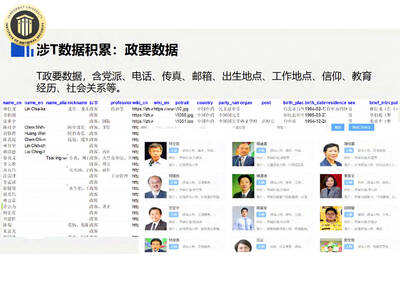
NETWORK-MAPPING PROJECT: The database contains 170 detailed files of Taiwanese politicians and about 23 million records of household registration data in Taiwan China has developed a network-mapping project targeting political figures and parties in Taiwan to monitor public opinion during elections and to craft tailored influence campaigns aimed at dividing Taiwanese society, according to documents leaked by Chinese technology firm GoLaxy (中科天璣). The documents, collected by Taipei-based Doublethink Lab, showed a database was specifically created to gather detailed information on Taiwanese political figures, including their political affiliations, job histories, birthplaces, residences, education, religion and a brief biography about them. Several notable Taiwanese politicians are in the database, including President William Lai (賴清德), former president Tsai Ing-wen (蔡英文), Minister of Foreign Affairs Lin Chia-lung (林佳龍),
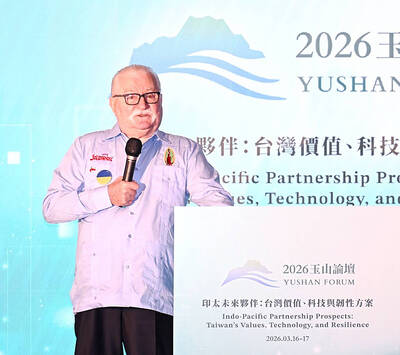
RECOGNITION: Former Fijian prime minister Mahendra Chaudhry said that Taiwan’s New Southbound Policy serves as a stabilizing force in the Indo-Pacific region Taiwan can lead the unification of the Chinese people, Nobel Peace Prize laureate and former Polish president Lech Walesa said in Taipei yesterday, adding that as the world order is changing, peaceful discussion would find good solutions, and that the use of force and coercion would always fail. Walesa made the remarks during his keynote address at a luncheon of the Yushan Forum in Taipei, titled “Indo-Pacific Partnership Prospects: Taiwan’s Values, Technology and Resilience,” organized by the Taiwan-Asia Exchange Foundation with the Ministry of Foreign Affairs. Walesa said that he had been at the forefront of a big peaceful revolution and “if

KEY INDUSTRY: The vice premier discussed a plan to create a non-red drone supply chain by next year, which has been allocated a budget of more than NT$7.2 billion The government has budgeted NT$44.2 billion (US$1.38 billion) to cultivate Taiwan’s uncrewed aerial vehicle (UAV) industry over the next five years, which would make the nation a major player in the industry’s democratic supply chain in the Asia-Pacific region, Premier Cho Jung-tai (卓榮泰) said yesterday. Cho made the remarks during a visit to the facilities of Cub Elecparts Inc (為升電裝). Democratic Progressive Party (DPP) Legislator Chen Su-yueh (陳素月) and Chinese Nationalist Party (KMT) Legislator Hsieh Yi-fong (謝依鳳) also participated in the trip. Cub Elecparts has transitioned from the automotive industry to the defense industry, which is the top priority among the nation’s
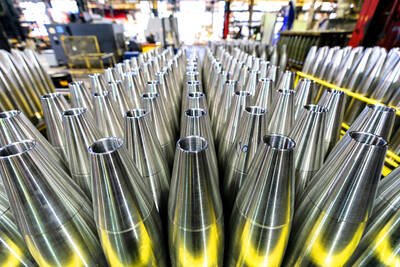
UPGRADED MISSILE: The Chungshan Institute of Science and Technology is reportedly to conduct a live-fire test of the Hsiung Feng III anti-ship missile on Thursday next week The US Army is planning to build new facilities to boost explosives production and strengthen its supply chain, a move aimed at addressing munitions shortages and supporting obligations to partners including Taiwan, Ukraine and Israel, Defense News reported. The army has issued a sources sought notice for a proposed Center of Excellence at the Blue Grass Army Depot in Kentucky, the report said. The facility would serve as a hub within the US industrial base for the production of key military explosives, including research department explosives (RDX) and high melting explosives (HMX), while also supporting research and development of next-generation materials. The proposed


 RSS
RSS