


Impeached and suspended South Korean President Yoon Suk-yeol authorized the military to fire their weapons if needed to enter South Korean National Assembly during his failed bid to impose martial law, a prosecutors’ report seen by Agence France-Presse yesterday showed.
The 10-page summary from former South Korean minister of defense Kim Yong-hyun’s prosecution indictment report, which was provided to the media, also says Yoon vowed on Dec. 3 to declare martial law three times if necessary.
Yoon, who was this month stripped of his duties by the National Assembly, is under investigation for his short-lived attempt to scrap civilian rule, which plunged the country into political turmoil and led to his impeachment.
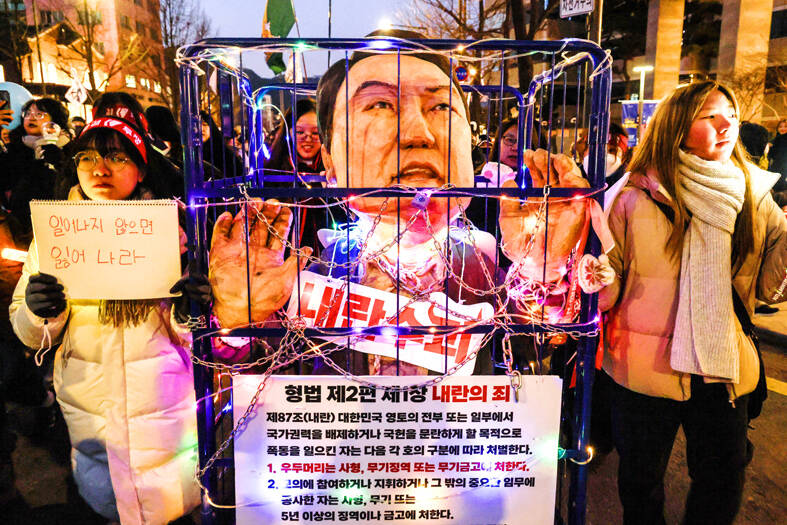
Photo: EPA-EFE
Yoon’s lawyer, Yoon Kab-keun dismissed the prosecutors’ report, saying that it was “a one-sided account that neither corresponds to objective circumstances nor common sense.”
As lawmakers rushed to the National Assembly on Dec. 3 to vote down Yoon’s martial law declaration, heavily armed troops stormed the building, scaling fences, smashing windows and landing by helicopter.
According to the prosecution indictment report, Yoon told the chief of the Capital Defense Command, Lee Jin-woo, that military forces could shoot if necessary to enter the National Assembly.
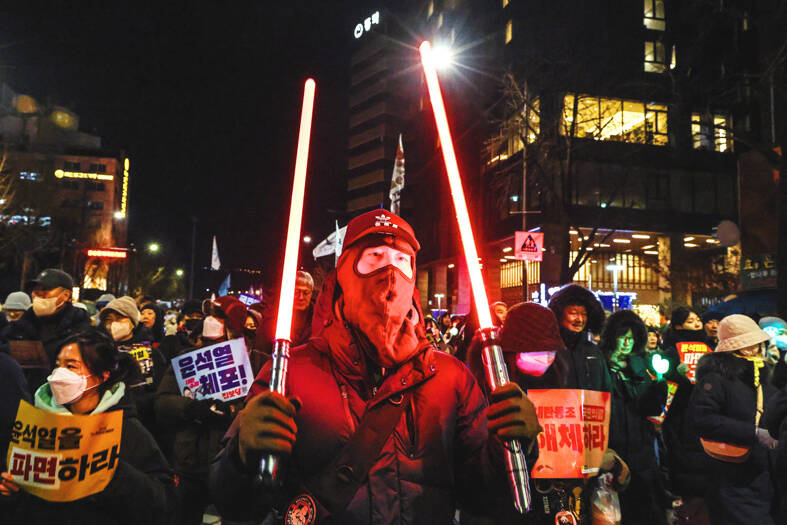
Photo: EPA-EFE
“Have you still not got in? What are you doing? Break down the door and drag them out, even if it means shooting,” Yoon told Lee, according to the report.
Yoon also allegedly told the head of the Defense Counterintelligence Command, General Kwak Jong-keun, to “quickly get inside” the National Assembly as the quorum for the martial law declaration to be lifted had not been met.
“So quickly get inside the National Assembly and bring out the people inside the chamber, and break down the doors with an axe if necessary and drag everyone out,” the report quotes Yoon as saying at the time.
After lawmakers rushed inside and voted 190-0 to nullify Yoon’s declaration in the early hours of Dec. 4, the report says Yoon told Lee: “Even if it’s lifted, I can declare martial law a second or third time, so just keep going.”
The report also included screenshots of senior defense officials’ messages from the day of the martial law declaration.
It said there was evidence that Yoon had been discussing declaring martial law with senior military officials as early as March. The declaration followed a budget tussle between Yoon’s party and the opposition.
Kim was arrested over his role in the failed martial law bid.
South Korea’s Constitutional Court held its first preliminary hearing on the validity of Yoon’s impeachment on Friday, and is also to decide the fate of Yoon’s replacement, Han Duck-soo, who was impeached on Friday.
Tens of thousands of Yoon supporters and opponents held rival mass rallies in Seoul yesterday.
An anti-Yoon crowd held signs such as: “A new leader for the new year” and “Arrest Yoon Suk-yeol,” with many singing along to K-pop songs and John Lennon’s Imagine.
“I felt so relieved when Han was impeached, he was also part of the insurrection,” Kwak Min-jeong, 25, said.
Holding a glow stick, Kwak added that she would keep protesting until “democracy was achieved.”
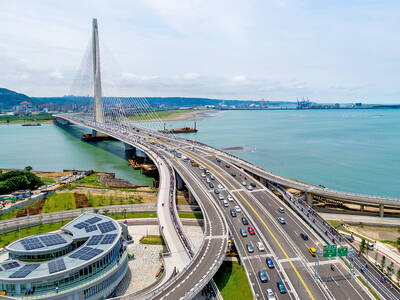
The Ministry of Transportation and Communications yesterday inaugurated the Danjiang Bridge across the Tamsui River in New Taipei City, saying that the structure would be an architectural icon and traffic artery for Taiwan. Feted as a major engineering achievement, the Danjiang Bridge is 920m long, 211m tall at the top of its pylon, and is the longest single-pylon asymmetric cable-stayed bridge in the world, the government’s Web site for the structure said. It was designed by late Iraqi-British architect Zaha Hadid. The structure, with a maximum deck of 70m, accommodates road and light rail traffic, and affords a 200m navigation channel for boats,
Taiwan Semiconductor Manufacturing Co (TSMC, 台積電), the world’s largest foundry service provider, yesterday said that global semiconductor revenue is projected to hit US$1.5 trillion in 2030, after the figure exceeds US$1 trillion this year, as artificial intelligence (AI) demand boosts consumption of token and compute power. “We are still at the beginning of the AI revolution, but we already see a significant impact across the whole semiconductor ecosystem,” TSMC deputy cochief operating officer Kevin Zhang (張曉強) said at the company’s annual technology symposium in Hsinchu City. “It is fair to say that in the past decade, smartphones and other mobile devices were
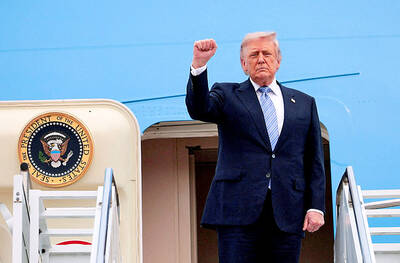
US-CHINA SUMMIT: MOFA welcomed US reassurance of no change in its Taiwan policy; Trump said he did not comment when Xi talked of opposing independence US President Donald Trump yesterday said he has not made a decision on whether to move forward with a major arms package for Taiwan after hearing concerns about it from Chinese President Xi Jinping (習近平). Trump’s comments on Taiwan came as he flew back to Washington after wrapping up critical talks in which both leaders said important progress was made in stabilizing US-China relations even as deep differences persist between the world’s two biggest powers on Iran and Taiwan. “I will make a determination,” Trump said, adding: “I’ll be making decisions. But, you know, I think the last thing we need right
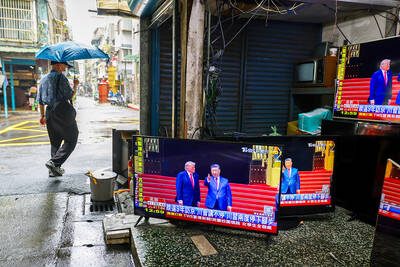
TAIWAN ISSUE: US treasury secretary Scott Bessent said on the first day of meetings that ‘it wouldn’t be a US-China summit without the Taiwan issue coming up’ There were no surprises on the first day of the summit between US President Donald Trump and Chinese President Xi Jinping (習近平), the Mainland Affairs Council (MAC) said yesterday, as the government reiterated that cross-strait stability is crucial to the Asia-Pacific region, as well as the world. As the two presidents met for a highly anticipated summit yesterday, Chinese state media reported that Xi warned Trump that missteps regarding Taiwan could push their two countries into “conflict.” Trump arrived in China with accolades for his host, calling Xi a “great leader” and “friend,” and extending an invitation to visit the White House


 RSS
RSS