


Taiwan will continue to strengthen its self-defense capabilities and cooperation with like-minded countries to defend the rules-based international order, the Presidential Office said yesterday after defense ministers from the US, Japan and Australia in a joint statement highlighted the importance of peace and stability across the Taiwan Strait.
The US, Japan and Australia issued the statement after Australian Deputy Prime Minister and Minister for Defense Richard Marles, Japanese Minister of Defense Gen Nakatani and US Secretary of Defense Lloyd Austin convened the 14th Trilateral Defense Ministers’ Meeting in Darwin, Australia, on Sunday.
“We emphasize the importance of peace and stability across the Taiwan Strait and call for the peaceful resolution of cross-strait issues,” the statement said.
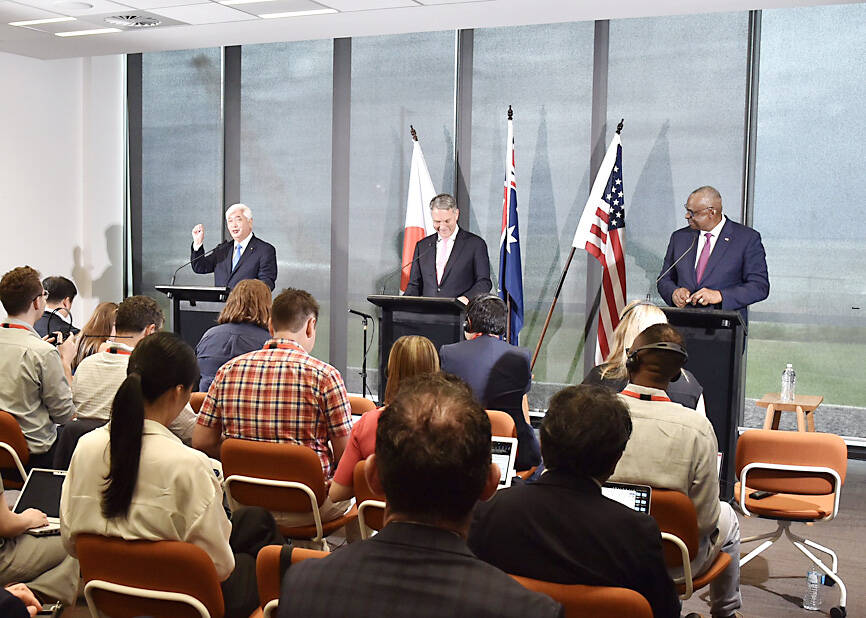
Photo: Screen grab from Japan Ministry of Defense’s X account
Taiwan thanks its international partners for placing attention and emphasis on the situation in the Taiwan Strait and the region at large, Presidential Office spokeswoman Karen Kuo (郭雅慧) said.
“The trilateral joint statement once again demonstrates that peace and stability in the Taiwan Strait is not only a critical regional issue, but also an essential element in global peace and prosperity,” she said.
The joint statement also reiterated strong opposition to any unilateral attempts to change the “status quo” in the Taiwan Strait by force or coercion, and showed concern for issues in the East and South China seas.
“We reiterate our serious concern about destabilizing actions in the East and South China seas,” the joint statement said.
“It is important that all states are free to exercise rights and freedoms consistent with international law, particularly the United Nations Convention on the Law of the Sea, including freedom of navigation and overflight and other lawful uses of the sea,” it added.
Kuo said Taiwan stands on the frontline of defense for democracy and is a responsible member of the region, as well as the international community.
“Facing an increasingly complex regional situation, Taiwan will continue to strengthen its self-defense capabilities and deepen its cooperative partnerships with the US, Japan, Australia and other like-minded countries to jointly defend the rules-based international order,” she added.
Additional reporting by Lee I-chia

The National Chungshan Institute of Science and Technology yesterday showcased its locally developed variants of the Vision 60 robotic patrol dog, which it plans to deploy on the nation’s outlying territories in the South China Sea. The variants were produced under the Joint Lab project — created by the institute and domestic companies — and assembled with domestically produced motors, lenses and artificial intelligence (AI) systems alongside licensed tech from the US, Missile and Rocket Systems Research Division deputy director Jen Kuo-kang (任國光) told the media event at a military base in Taipei’s Dazhi (大直) area. Taiwan has built up its strengths

RIGHT DIRECTION: Taiwan’s efforts to prevent forced labor include a proposal to ‘fully prohibit’ employers from withholding workers’ documents, an official said Taiwan is to establish a mechanism to restrict imports of goods linked to forced labor, the Executive Yuan said yesterday, after the US proposed imposing additional tariffs on Taiwanese goods over labor concerns. “The Ministry of Labor and the Ministry of Economic Affairs are to establish an interministerial review procedure,” Executive Yuan spokesperson Michelle Lee (李慧芝) said at a news briefing in Taipei. “The government is to use the Foreign Trade Act [貿易法] as the legal basis to restrict imports of goods produced with forced labor” and bring its supply chain governance more in line with international standards on human rights, resilience
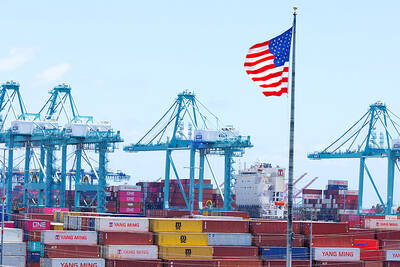
NOT IMMEDIATE: Taiwan has a chance to appeal the proposed 10 percent tariff before it starts, while other countries face a 12.5 percent tariff from the trade office Taiwan is among 60 economies determined by the US to have failed to impose or enforce a ban on the importation of goods produced with forced labor, according to a notice released on Tuesday by the Office of the US Trade Representative (USTR), which proposed imposing an additional 10 percent or more tariff on them. The USTR in a statement said that following an investigation, it had determined under Section 301 of the Trade Act of 1974 that the failure of the 60 economies to impose and effectively enforce a prohibition on the importation of goods produced with forced labor is
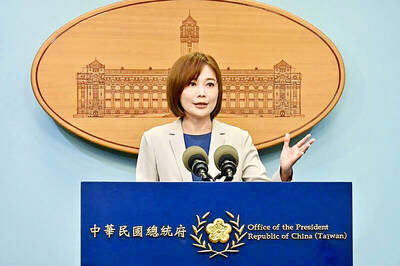
TIT-FOR-TAT: The US allegedly revoked the visa of a Chinese national working at Xinhua News Agency in the US in response to Beijing’s expulsion of Vivian Wang The Presidential Office yesterday condemned China for expelling a New York Times correspondent from Beijing following the newspaper’s interview with President William Lai (賴清德), saying the move highlighted Beijing’s suppression of press freedom and its threat to international news media. Taiwan has noted a series of recent incidents in which Beijing used similar tactics to “threaten and pressure international media outlets and journalists,” Presidential Office spokeswoman Karen Kuo (郭雅慧) said in a statement. “This concerns not only press freedom and freedom of expression, but also the safety of journalists, and Taiwan and relevant partners are paying close attention to the situation,” she


 RSS
RSS