


The US is to provide US$500 million in military funding to the Philippines, US Secretary of State Antony Blinken said yesterday, as Washington boosts ties with Manila in the face of China’s growing assertiveness.
Blinken was in Manila with US Secretary of Defense Lloyd Austin as part of an Asia-Pacific tour to strengthen Washington’s latticework of alliances aimed at countering Beijing.
“We’re now allocating an additional US$500 million in foreign military financing to the Philippines to boost security collaboration with our oldest treaty ally in this region,” Blinken told a news conference.
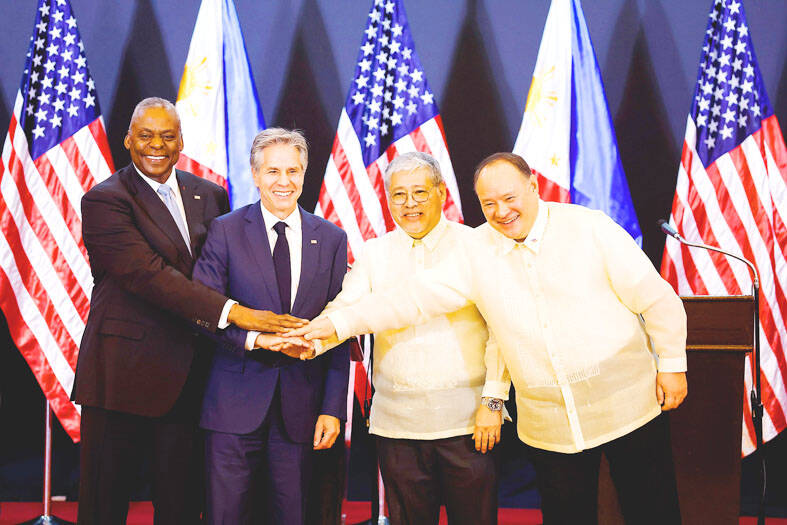
Photo: EPA-EFE
Blinken described it as a “once-in-a-generation investment” to help modernize the Philippine armed forces and coast guard.
“We’re building on a lot of progress the Philippines has already made to be better positioned to defend their sovereignty. That is what this is about,” he said.
Blinken and Austin earlier met with Philippine President Ferdinand Marcos Jr, who has taken a strong stand against Chinese actions in the South China Sea, before holding “2+2” talks with Philippine Secretary of Foreign Affairs Enrique Manalo and Philippine Secretary of National Defense Gilberto Teodoro.
The latest high-level US visit follows a series of escalating confrontations between Philippine and Chinese vessels in the disputed waterway that have raised concern that Washington could be dragged into a conflict due to its mutual defense treaty with Manila.
The additional funding is part of US$2 billion in foreign military financing approved by the US in April.
The Philippines began a modest modernization program more than a decade ago under former Philippine president Benigno Aquino to strengthen its armed forces, one of the weakest in Asia.
It has continued under Marcos, who has also ordered the military to increase their focus on external threats.
Teodoro said the US funds would be used to help secure the Philippines’ “credible deterrent posture,” as it seeks to boost its cybersecurity capabilities among other things.
There has been a revolving door of top US officials passing through the Philippines since Marcos took office in 2022 and adopted a more US-friendly foreign policy.
Marcos expanded an agreement giving US troops access to nine Philippine military bases, including in the far north of the nation, which has infuriated Chinese leaders.
The Enhanced Defense Cooperation Agreement (EDCA) allows US troops to rotate through the bases, and also store defense equipment and supplies at them.
Teodoro said Manila and Washington had agreed to “fully implement” EDCA projects and boost investment in the sites.
The Philippines’ proximity to the hotly contested South China Sea, as well as Taiwan, would make it a key partner for the US if a conflict were to break out in the region.
Beijing claims almost the entire South China Sea, despite an international ruling that its assertion has no legal basis.
Marcos told Austin and Blinken that he was “very happy” about the open lines of communication with the US, which helped Manila be “agile in terms of our responses” on issues including the South China Sea.
Blinken and Chinese Minister of Foreign Affairs Wang Yi (王毅) sparred on Saturday over the South China Sea when they met on the sidelines of the ASEAN foreign ministers meeting in Laos.
Wang told Blinken the US should “refrain from fanning the flames, stirring up trouble and undermining stability at sea,” according to a statement.
“The risks and challenges facing China-US relations are still rising,” he said.
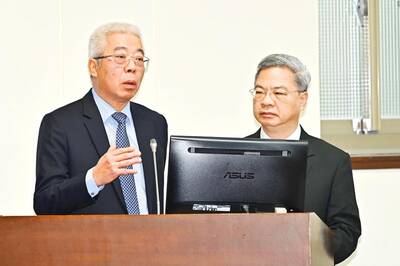
Taiwan has arranged for about 8 million barrels of crude oil, or about one-third of its monthly needs, to be shipped from the Red Sea this month to bypass the Strait of Hormuz and ease domestic supply pressures, CPC Corp, Taiwan (CPC, 台灣中油) said yesterday. The state-run oil company has worked with Middle Eastern suppliers to secure routes other than the Strait of Hormuz, through which about 20 percent of the world’s oil and liquefied natural gas typically passes, CPC chairman Fang Jeng-zen (方振仁) said at a meeting of the legislature’s Economics Committee in Taipei. Suppliers in Saudi Arabia have indicated they

South Korea has adjusted its electronic arrival card system to no longer list Taiwan as a part of China, a move that the Ministry of Foreign Affairs said would help facilitate exchanges between the two sides. South Korea previously listed “Taiwan” as “Taiwan (China)” in the drop-down menus of its online arrival card system, where people had to fill out where they came from and their next destination. The ministry had requested South Korea make a revision and said it would change South Korea’s name on Taiwan’s online immigration system from “Republic of Korea” to “Korea (South),” should the issue not be
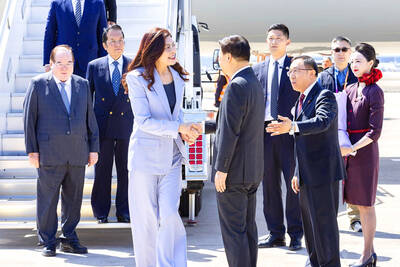
CCP ‘PAWN’? Beijing could use the KMT chairwoman’s visit to signal to the world that many people in Taiwan support the ‘one China’ principle, an academic said Chinese Nationalist Party (KMT) Chairwoman Cheng Li-wun (鄭麗文) yesterday arrived in China for a “peace” mission and potential meeting with Chinese President Xi Jinping (習近平), while a Taiwanese minister detailed the number of Chinese warships currently deployed around the nation. Cheng is visiting at a time of increased Chinese military pressure on Taiwan, as the opposition-dominated Legislative Yuan stalls a government plan for US$40 billion in extra defense spending. Speaking to reporters before going to the airport, Cheng said she was going on a “historic journey for peace,” but added that some people felt uneasy about her trip. “If you truly love Taiwan,
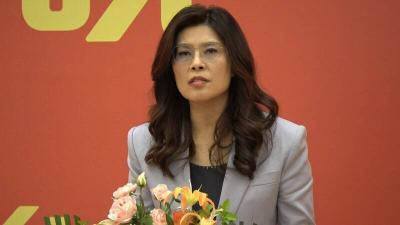
Both sides of the Taiwan Strait share a political foundation based on the “1992 consensus” and opposition to Taiwanese independence, Chinese Nationalist Party (KMT) Chairwoman Cheng Li-wun (鄭麗文) today said during her meeting with Chinese President Xi Jinping (習近平). Both sides of the Strait should plan and build institutionalized and sustainable mechanisms for dialogue and cooperation based on that foundation to make peaceful development across the Strait irreversible, she said. Peace is a shared moral value across the Strait, and both sides should move beyond political confrontation to seek institutionalized solutions to prevent war, she said. Mutually beneficial cross-strait relations are what the


 RSS
RSS