


The Legislative Yuan yesterday approved a series of bills to facilitate employment for middle-aged and older people, safe use of pesticides, restoration of historic sites and promotion of the national sports team’s welfare.
Amendments to the Labor Standards Act (勞動基準法), the Middle-aged and Elderly Employment Promotion Act (中高齡者及高齡者就業促進法), the Land Act (土地法) and the National Sports Act (國家體育法), and a draft bill of the plant therapist act (植物診療師法) all passed their third readings at the legislature.
The amendment to Article 54 of the Labor Standards Act stipulates that workers aged 65 or older can extend their retirement age via an agreement with their employer.
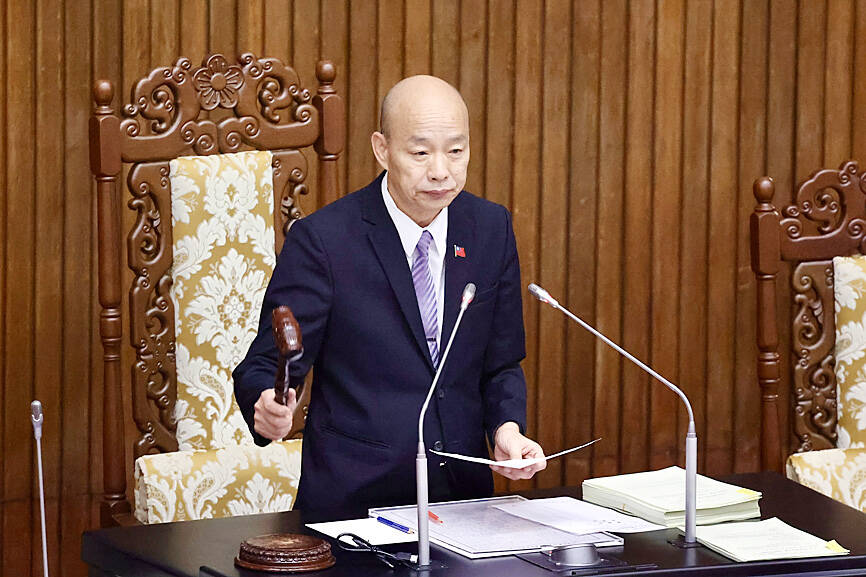
Photo: CNA
Although in practice, workers and employers could negotiate the retirement age under the original act, the amendment clarifies the ambiguity, former minister of labor Hsu Ming-chun (許銘春) said yesterday.
Amendments to the Middle-aged and Elderly Employment Promotion Act officially include an employment program for middle-aged and senior workers to ensure that both workers and employers understand the program.
A part-time work scheme, proposed by Democratic Progressive Party Legislator Lin Yueh-chin (林月琴) during the review, has been included as well to facilitate part-time employment of older people.
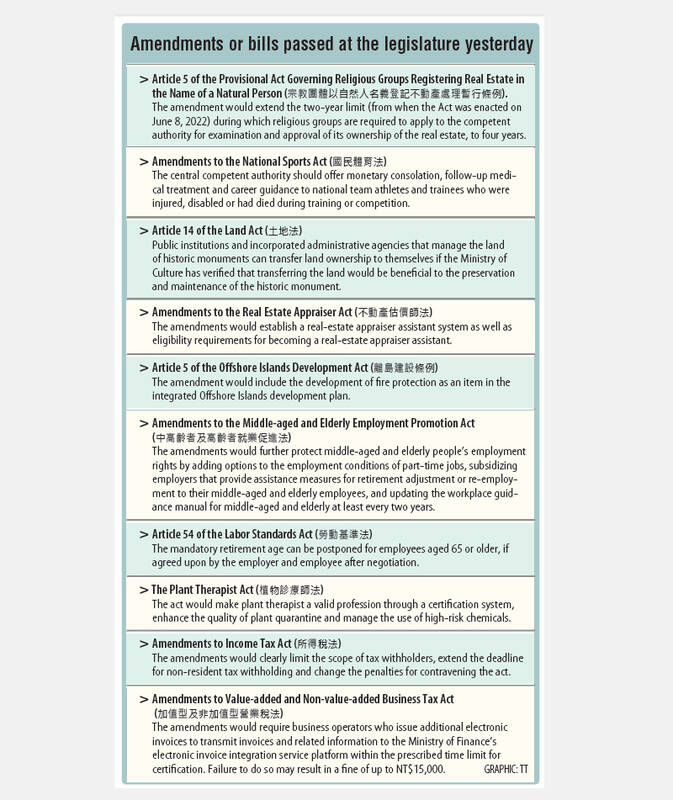
The amendments also stipulate that employers should assist with retirement adaptation and re-employment within two years of the voluntary or compulsory retirement ages defined by the Labor Standards Act, with subsidies from the central authorities.
The plant therapist act seeks to ensure food safety and sustainability of agricultural environments through the establishment of a professional plant therapist service system accredited by national examinations.
The act stipulates that plant therapists could teach farm workers about precision pesticide use without affecting the right of agricultural workers to use pest control diagnosis services from the Ministry of Agriculture.
Amendments to the National Sports Act were introduced in response to an insurance issue in February that affected the participation of the men’s national basketball team in a qualifying match for next year’s FIBA Asia Cup.
The amendments stipulate that central authorities should provide consolation money, medical care and career guidance for national team players and staff members who suffer from short-term physical dysfunctions, physical or mental disabilities, or death due to training or participation in games.
The base amount of consolation money has been raised to compensate for the differences not covered by commercial insurance schemes for national team players during their participation in games.
The amendment to Article 14 of the Land Act eases restrictions on the accessibility to the public land of historic sites by state-owned enterprises and public bodies.
That would help restore and maintain historic sites, as public land could not be transferred even though part of the historic buildings on which they stood belongs to a state-owned enterprise or public body.
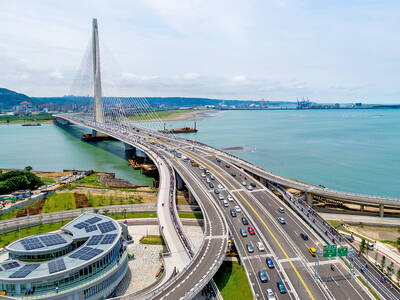
The Ministry of Transportation and Communications yesterday inaugurated the Danjiang Bridge across the Tamsui River in New Taipei City, saying that the structure would be an architectural icon and traffic artery for Taiwan. Feted as a major engineering achievement, the Danjiang Bridge is 920m long, 211m tall at the top of its pylon, and is the longest single-pylon asymmetric cable-stayed bridge in the world, the government’s Web site for the structure said. It was designed by late Iraqi-British architect Zaha Hadid. The structure, with a maximum deck of 70m, accommodates road and light rail traffic, and affords a 200m navigation channel for boats,
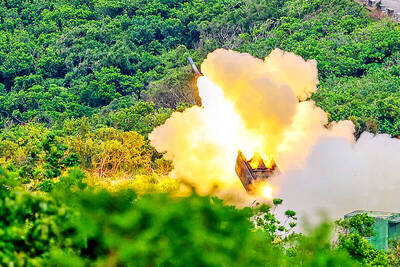
PRECISION STRIKES: The most significant reason to deploy HIMARS to outlying islands is to establish a ‘dead zone’ that the PLA would not dare enter, a source said A High Mobility Artillery Rocket System (HIMARS) would be deployed to Penghu County and Dongyin Island (東引) in Lienchiang County (Matsu) to force the Chinese military to retreat at least 100km from the coastline, a military source said yesterday. Taiwan has been procuring HIMARS and Army Tactical Missile Systems (ATACMS) from the US in batches. Once all batches have been delivered, Taiwan would possess 111 HIMARS units and 504 ATACMS, which have a range of 300km. Considering that “offense is the best defense,” the military plans to forward-deploy the systems to outlying islands such as Penghu and Dongyin so that

Taiwan Semiconductor Manufacturing Co (TSMC, 台積電), the world’s largest foundry service provider, yesterday said that global semiconductor revenue is projected to hit US$1.5 trillion in 2030, after the figure exceeds US$1 trillion this year, as artificial intelligence (AI) demand boosts consumption of token and compute power. “We are still at the beginning of the AI revolution, but we already see a significant impact across the whole semiconductor ecosystem,” TSMC deputy cochief operating officer Kevin Zhang (張曉強) said at the company’s annual technology symposium in Hsinchu City. “It is fair to say that in the past decade, smartphones and other mobile devices were
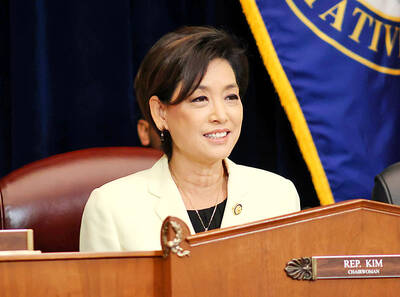
‘CLEAR MESSAGE’: The bill would set up an interagency ‘tiger team’ to review sanctions tools and other economic options to help deter any Chinese aggression toward Taiwan US Representative Young Kim has introduced a bill to deter Chinese aggression against Taiwan, calling for an interagency “tiger team” to preplan coordinated sanctions and economic measures in response to possible Chinese military or political action against Taiwan. “[Chinese President] Xi Jinping [習近平] has directed the People’s Liberation Army to be ready to invade Taiwan by 2027. China has a plan. America should have one too,” Kim said in a news release on Thursday last week. She introduced the “Deter PRC [People’s Republic of China] aggression against Taiwan act” to “ensure the US has a coordinated sanctions strategy ready should


 RSS
RSS