


US and Philippine forces yesterday launched their largest combat exercises in years in a show of allied firepower near the disputed South China Sea that has alarmed Beijing.
The annual exercises by the treaty allies are to run until May 10 and involve more than 16,000 of their military personnel, along with more than 250 French and Australian forces.
While the Philippine military maintains that the Balikatan, or “shoulder-to-shoulder,” exercises are not directed at a particular nation, some of their main conflict scenarios are set in or near the disputed South China Sea, where Chinese and Philippine coast guard and accompanying ships have figured in a series of increasingly tense territorial face-offs since last year.

Photo: Reuters
In encounters in disputed areas, Chinese coast guard vessels have resorted to water cannons, blocking and other dangerous maneuvers that have caused injuries to Philippine navy personnel and damaged supply boats.
The Philippine military said a key focus of this year’s drills is territorial defense.
“We’re dead serious about protecting our territory — that’s why we do these Balikatan exercises,” said Colonel Michael Logico, who speaks for the Philippine military on combat drills.
As the disputes between China and the Philippines have escalated, US President Joe Biden and his administration have repeatedly warned that the US is obligated to defend the Philippines, its oldest treaty ally in Asia, if it is attacked.
US Marine Lieutenant General William Jurney said at the opening ceremony that the large-scale military exercises would demonstrate that the 1951 Mutual Defense Treaty between the US and the Philippines “is no mere piece of paper.”
Washington lays no claim to the contested waters, but has declared that freedom of navigation and overflight and the peaceful resolution of the disputes are in its national interest.
Armed Force of the Philippines Chief of Staff General Romeo Brawner, who opened the exercises at the ceremony, said that as Pacific coastal nations, the US and the Philippines “understand the importance of maritime cooperation in addressing the complex challenges that threaten peace and security in our region.”
The combat drills are to include the sinking of a mock enemy ship by combined US and Philippine firepower, and the retaking of an occupied island off the northwestern Philippines, the Philippine military said.
China specifically opposed the transport of a US ground-launched missile system to the northern Philippines ahead of the exercises.
No missile is to be fired, but the aim is to build familiarity among military participants with the hi-tech weaponry in a tropical setting.
Chinese Ministry of Foreign Affairs spokesman Lin Jian (林劍) expressed Beijing’s grave concern over the deployment of the missile system “at China’s doorstep.”
“The US move exacerbates tensions in the region, and increases the risk of misjudgement and miscalculation,” he said a news briefing in Beijing last week. “The Philippines needs to think twice about being a cat’s paw for the US at the expense of its security interests and stop sliding down the wrong path.”
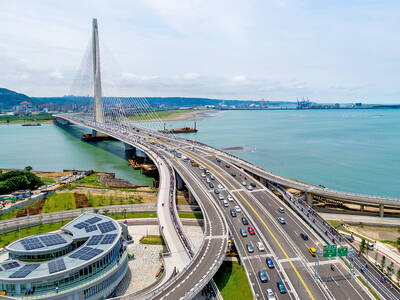
The Ministry of Transportation and Communications yesterday inaugurated the Danjiang Bridge across the Tamsui River in New Taipei City, saying that the structure would be an architectural icon and traffic artery for Taiwan. Feted as a major engineering achievement, the Danjiang Bridge is 920m long, 211m tall at the top of its pylon, and is the longest single-pylon asymmetric cable-stayed bridge in the world, the government’s Web site for the structure said. It was designed by late Iraqi-British architect Zaha Hadid. The structure, with a maximum deck of 70m, accommodates road and light rail traffic, and affords a 200m navigation channel for boats,
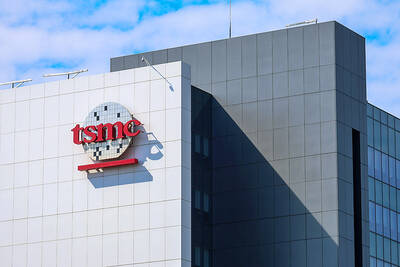
Taiwan Semiconductor Manufacturing Co (TSMC, 台積電), the world’s largest foundry service provider, yesterday said that global semiconductor revenue is projected to hit US$1.5 trillion in 2030, after the figure exceeds US$1 trillion this year, as artificial intelligence (AI) demand boosts consumption of token and compute power. “We are still at the beginning of the AI revolution, but we already see a significant impact across the whole semiconductor ecosystem,” TSMC deputy cochief operating officer Kevin Zhang (張曉強) said at the company’s annual technology symposium in Hsinchu City. “It is fair to say that in the past decade, smartphones and other mobile devices were
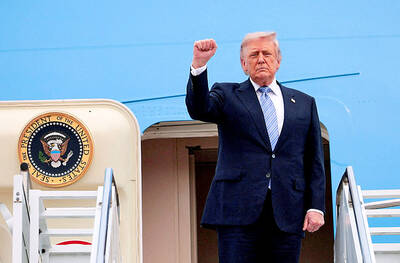
US-CHINA SUMMIT: MOFA welcomed US reassurance of no change in its Taiwan policy; Trump said he did not comment when Xi talked of opposing independence US President Donald Trump yesterday said he has not made a decision on whether to move forward with a major arms package for Taiwan after hearing concerns about it from Chinese President Xi Jinping (習近平). Trump’s comments on Taiwan came as he flew back to Washington after wrapping up critical talks in which both leaders said important progress was made in stabilizing US-China relations even as deep differences persist between the world’s two biggest powers on Iran and Taiwan. “I will make a determination,” Trump said, adding: “I’ll be making decisions. But, you know, I think the last thing we need right

TAIWAN ISSUE: US treasury secretary Scott Bessent said on the first day of meetings that ‘it wouldn’t be a US-China summit without the Taiwan issue coming up’ There were no surprises on the first day of the summit between US President Donald Trump and Chinese President Xi Jinping (習近平), the Mainland Affairs Council (MAC) said yesterday, as the government reiterated that cross-strait stability is crucial to the Asia-Pacific region, as well as the world. As the two presidents met for a highly anticipated summit yesterday, Chinese state media reported that Xi warned Trump that missteps regarding Taiwan could push their two countries into “conflict.” Trump arrived in China with accolades for his host, calling Xi a “great leader” and “friend,” and extending an invitation to visit the White House


 RSS
RSS