


In 2003, the literary critic Fredric Jameson famously observed that “it is easier to imagine the end of the world than the end of capitalism.” For the first time in two centuries, capitalism was viewed as both destructive and irreversible, he said. Waning faith in the possibility of a postcapitalist future has nurtured deep pessimism.
This prevailing despair evokes John Maynard Keynes’s 1930 essay “Economic Possibilities for Our Grandchildren,” in which he warned against the “two opposed errors of pessimism.” The first was the pessimism “of the revolutionaries who think that things are so bad that nothing can save us, but violent change.” The second was the pessimism of reactionaries who view economic and social structures as “so precarious that we must risk no experiments.”
In response to the pessimisms of his time, Keynes offered an alternative vision, predicting that technology would usher in an era of unprecedented abundance. Within a century, continuous technological progress would elevate living standards — at least in the “civilized” world — to four to eight times what they were in the 1920s, he said. This would enable his generation’s grandchildren to work a fraction of the hours their ancestors did.
Illustration: Mountain People
The short-term employment theory for which Keynes is widely known was part of this larger vision of technological utopia. In his view, running the economy at full capacity was the quickest route from necessity to freedom. Once we achieve this goal, the economic “dentistry” that preoccupied Keynes would become redundant. Our attention could then shift to “our real problems,” those of “life and of human relations, creation, behavior and religion.”
Although Keynes found Karl Marx’s ideas incomprehensible, his vision of a postcapitalist future resembled that of Marx in The German Ideology. Marx regarded capitalism as a means to address the problem of production, while communism was viewed as a way to manage distribution, thereby eliminating the need for a division of labor.
Much like Keynes, Marx’s vision championed the cultivated amateur, a role traditionally reserved for the aristocracy. Marx envisioned a society where one could “hunt in the morning, fish in the afternoon, rear cattle in the evening” and “criticize after dinner” without being confined to the role of hunter, fisher, shepherd or critic. Like Keynes, he saw capitalism as an ordeal humanity had to endure so that the good life could be democratized.
Although Keynes and Marx viewed capitalism as a necessary evil, both opposed hasty efforts to abolish it or meddle too forcefully in its workings. Keynes warned against prematurely dismantling the capitalist system through wealth and income redistribution, while Marx believed that reformist attempts to humanize capitalism would merely delay the revolution. These rigid stances ultimately proved too extreme for the Keynesians and socialists who sought to establish Keynesian social democracies in the mid-20th century.
However, despite their utopian visions of a postcapitalist world, Keynes and Marx had fundamentally different views on how to overcome the capitalist “monster,” stemming from their distinct interpretations of the system. For Keynes, capitalism was a spiritual deformation that had spread through Western civilization on the vector of Puritanism and would naturally perish once it was no longer needed.
In an era of abundance, “the love of money as a possession — as distinguished from the love of money as a means to the enjoyments and realities of life — will be recognized for what it is,” a “somewhat disgusting morbidity” that one “hands over with a shudder to the specialists in mental disease.”
By contrast, Marx did not view capitalism as a psychological affliction. Instead, he saw it as a political and social system wherein the capitalist class monopolized ownership and control of land and capital. This dominance enabled capitalists to extract surplus value from workers, whose only saleable commodity was their labor power. Capitalism would not simply wither away, Marx said. It had to be overthrown, but not before its creative potential had been fully realized.
Marx’s portrayal of capitalism as a creative force was rooted in German philosopher Georg Wilhelm Friedrich Hegel’s dialectic and significantly influenced by Mary Shelley’s 1818 novel Frankenstein; or, The Modern Prometheus. Another source of inspiration was Johann Wolfgang von Goethe’s Faust, in which Mephistopheles is depicted as a diligent executor of God’s plan for human redemption.
In many respects, today’s pessimism is more profound than the one Keynes identified in 1930. Leftist revolutionaries still long for capitalism’s downfall, yet they have failed to provide a viable political alternative since the collapse of Soviet communism. Meanwhile, conservatism has evolved into the “radical right,” characterized by resentment and chauvinism, but lacking a coherent vision for a harmonious future. Neither side seems to offer a light at the end of the tunnel.
It is the absence of a redemptive vision that sustains, and partly defines, today’s prevailing pessimism. While Keynes and Marx believed in the emancipatory power of machines, technology is now widely viewed as a menace, even as our future remains deeply intertwined with it.
Similarly, Keynes and Marx assumed that capitalism would collapse long before nature rebelled against its exploitation. We now face the existential threat of climate change, with little hope of a successful global effort to combat it. Most alarmingly, public trust in the ability of democratic systems to deliver meaningful progress is rapidly eroding.
Faced with a choice between parasitic capitalism and emerging neofascism, pessimism is reasonable, but given that neither the end of the world nor the end of capitalism seems imminent, the question remains: Where do we go from here?
Robert Skidelsky, a member of the British House of Lords, is professor emeritus of political economy at the University of Warwick. He is the author of an award-winning biography of John Maynard Keynes and The Machine Age: An Idea, a History, a Warning.
Copyright: Project Syndicate
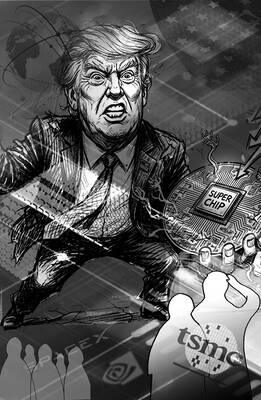
The White House’s decision to take a 9.9 percent stake in Intel Corp is looking like very shrewd business indeed. Since the government bought in at US$20.47 a share last August, the US chipmaker’s surging stock price has delivered the US a US$43 billion return. One of the reasons the investment has so far proved so sound is that the White House has made sure of it. According to The Wall Street Journal, Howard personally pushed deals on Intel’s behalf with some of the most lucrative clients imaginable. They include Nvidia Corp, the company at the heart of the AI
A single photograph can cut through a lot of noise, but it can also be used to misrepresent the truth. At the very least, it can concentrate the mind on something that requires further investigation. On Monday last week, Ma Ying-jeou Foundation CEO Tai Hsia-ling (戴遐齡) and former National Security Council secretary-general King Pu-tsung (金溥聰) held a news conference in which they showed a photograph of former foundation CEO Hsiao Hsu-tsen (蕭旭岑), now Chinese Nationalist Party (KMT) deputy chairman. In the image Hsiao is seated next to Xiamen Taiwan Businessmen Association chairman Han Ying-huan (韓螢煥). The two men were holding
I first met Professor Ray Jiing (井迎瑞) as a film and documentary student at Shih Hsin University’s (SHU) Department of Radio Television and Film in 1988. The following year, he went on to become the director of the Chinese Taipei Film Archive — forerunner of the Taiwan Film and Audiovisual Institute (TFAI). Over his eight-year tenure, Jiing rescued and restored over 200 classic Taiwanese films. In 1997, he established the Graduate Institute of Studies in Documentary and Film Archiving at Tainan National University of the Arts (TNNUA), and I joined the program in his third cohort of students. Beyond a
A recent report concerning a student who is suing his teacher posed the question in its headline: Does failing a student in two subjects constitute bullying? The college student in Chiayi County apparently sought NT$2 million (US$63,603) in state compensation, but a court dismissed the case. The first reaction of many might have been to ask: What has happened to students nowadays? Some say that teachers have lost their authority, while others say students are overindulged. Some even start reminiscing over the days when “whatever the teacher says goes.” However, the real issue might be overlooked if emotional reactions like that are the


 RSS
RSS