


A Chinese tech security firm was able to breach foreign governments, infiltrate social media accounts and hack personal computers, a massive data leak analyzed by experts this week revealed.
The trove of documents from I-Soon (上海安洵信息), a private company that competed for Chinese government contracts, shows that its hackers compromised more than a dozen governments, cybersecurity firms SentinelLabs and Malwarebytes said.
I-Soon also breached “democracy organizations” in Hong Kong, universities and the NATO military alliance, SentinelLabs researchers wrote in a blog post on Wednesday.
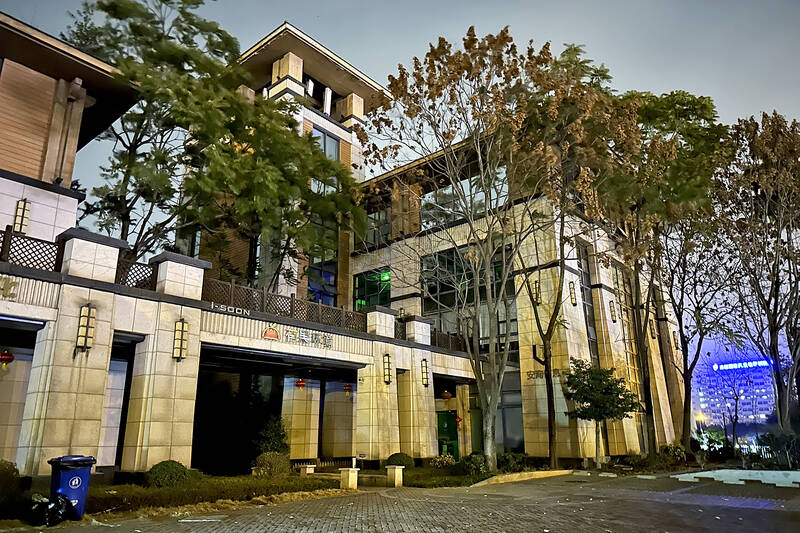
Photo: AP
The leaked data, the contents of which Agence France-Presse (AFP) was unable to immediately verify, was posted last week on the online software repository GitHub by an unknown individual.
“The leak provides some of the most concrete details seen publicly to date, revealing the maturing nature of China’s cyberespionage ecosystem,” SentinelLabs analysts said.
I-Soon was able to breach government offices in India, Thailand, Vietnam and South Korea, among others, Malwarebytes said in a separate post on Wednesday.
I-Soon’s Web site was not available yesterday morning, although an Internet archive snapshot of the site from Tuesday says it is based in Shanghai, with subsidiaries and offices in Beijing, Sichuan, Jiangsu and Zhejiang.
The firm did not reply to a request for comment.
Asked whether Beijing contracted hackers, the Chinese Ministry of Foreign Affairs told AFP it was “not aware” of the case.
The leak contains hundreds of files showing chatlogs, presentations and lists of targets.
AFP found what appeared to be lists of Thai and UK government departments among the leaks, as well as screenshots of attempts to log into an individual’s Facebook account.
Other screenshots showed arguments between an employee and a supervisor over salaries, as well as a document describing software aimed at accessing a target’s Outlook e-mails.
“As demonstrated by the leaked documents, third-party contractors play a significant role in facilitating and executing many of China’s offensive operations in the cyber domain,” SentinelLabs analysts said.
In one screenshot of a chat app conversation, someone describes a client request for exclusive access to the “foreign secretary’s office, foreign ministry’s ASEAN office, prime minister’s office national intelligence agency” and other government departments of an unnamed country.
Analysts who examined the files said the company also offered potential clients the ability to break into accounts of individuals on social media platform X — monitoring their activity, reading their private messages and sending posts.
It also laid out how the firm’s hackers could access and take over a person’s computer remotely, allowing them to execute commands and monitor what they type.
Other services included ways to breach Apple’s iPhone and other smartphone operating systems, as well as custom hardware — including a powerbank that can extract data from a device and send it to the hackers.
Analysts said the leak also showed I-Soon bidding for contracts in Xinjiang, where Beijing stands accused of detaining hundreds of thousands of mostly Muslim people as part of a campaign against alleged extremism.
“The company listed other terrorism-related targets the company had hacked previously as evidence of their ability to perform these tasks, including targeting counterterrorism centers in Pakistan and Afghanistan,” SentinelLabs analysts said.

The nation’s fastest supercomputer, Nano 4 (晶創26), is scheduled to be launched in the third quarter, and would be used to train large language models in finance and national defense sectors, the National Center for High-Performance Computing (NCHC) said. The supercomputer, which would operate at about 86.05 petaflops, is being tested at a new cloud computing center in the Southern Taiwan Science Park in Tainan. The exterior of the server cabinet features chip circuitry patterns overlaid with a map of Taiwan, highlighting the nation’s central position in the semiconductor industry. The center also houses Taiwania 2, Taiwania 3, Forerunner 1 and
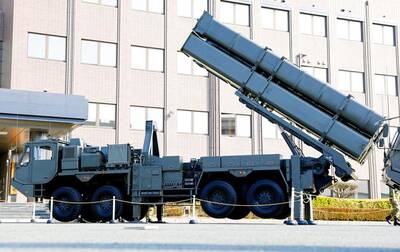
Japan has deployed long-range missiles in a southwestern region near China, the Japanese defense minister said yesterday, at a time when ties with Beijing are at their lowest in recent years. The missiles were installed in Kumamoto in the southern region of Kyushu, as Japan is attempting to shore up its military capacity as China steps up naval activity in the East China Sea. “Standoff defense capabilities enable us to counter the threat of enemy forces attempting to invade our country ... while ensuring the safety of our personnel,” Japanese Minister of Defense Shinjiro Koizumi said. “This is an extremely important initiative for
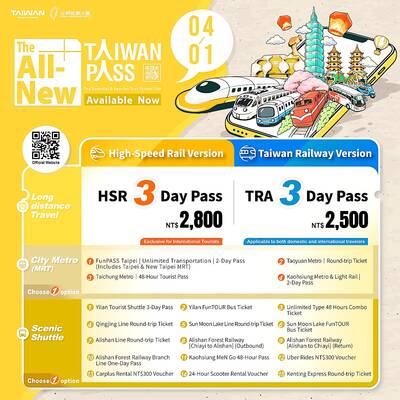
MORE POPULAR: Taiwan Pass sales increased by 59 percent during the first quarter compared with the same period last year, the Tourism Administration said The Tourism Administration yesterday said that it has streamlined the Taiwan Pass, with two versions available for purchase beginning today. The tourism agency has made the pass available to international tourists since 2024, allowing them to access the high-speed rail, Taiwan Railway Corp services, four MRT systems and four Taiwan Tourist Shuttles. Previously, five types of Taiwan Pass were available, but some tourists have said that the offerings were too complicated. The agency said only two types of Taiwan Pass would be available, starting from a three-day pass with the high-speed rail and a three-day pass with Taiwan Railway Corp. The former costs NT$2,800

FIRST TRIAL: Ko’s lawyers sought reduced bail and other concessions, as did other defendants, but the bail judge denied their requests, citing the severity of the sentences Former Taipei mayor Ko Wen-je (柯文哲) was yesterday sentenced to 17 years in prison and had his civil rights suspended for six years over corruption, embezzlement and other charges. Taipei prosecutors in December last year asked the Taipei District Court for a combined 28-year, six-month sentence for the four cases against Ko, who founded the Taiwan People’s Party (TPP). The cases were linked to the Core Pacific City (京華城購物中心) redevelopment project and the mismanagement of political donations. Other defendants convicted on separate charges included Chinese Nationalist Party (KMT) Taipei City Councilor Angela Ying (應曉薇), who was handed a 15-year, six-month sentence; Core Pacific


 RSS
RSS