


The UN Security Council was yesterday to vote on a new draft resolution calling for an immediate ceasefire in Gaza, despite threat of a third US veto on such a text.
The document, prepared by Algeria, “demands an immediate humanitarian ceasefire that must be respected by all parties.”
The vote comes as Israel prepares to move into the southern Gaza Strip city of Rafah, where about 1.4 million people have fled, as part of its mission to destroy Hamas.

Photo: Reuters
However, it is facing increased pressure to hold off, including from its closest ally, the US.
The draft resolution opposes the “forced displacement of the Palestinian civilian population.”
It also demands the release of all Hamas hostages.
Similarly to other previous drafts spurned by the US and Israel, the new text does not condemn Hamas’ Oct. 7 assault. That attack left about 1,160 people dead in southern Israel, mostly civilians, according to an Agence France-Presse tally of official Israeli figures.
Israel’s retaliatory campaign has killed more than 29,000 people in Gaza, mostly women and children, according to the latest count by the Hamas-run territory’s health ministry.
The US warned over the weekend that Algeria’s text was not acceptable, threatening to veto it.
“We don’t believe that this council product will help the situation on the ground,” US Deputy Ambassador to the UN Robert Wood said on Monday. “If this resolution does come to a vote, it will not go forward.”
The passage of such a ceasefire resolution would endanger ongoing delicate diplomatic negotiations, which could see the release of hostages from Gaza, Wood said.
The US instead began circulating an alternate draft on Monday. While that text does include the word “ceasefire” — which the US has previously avoided, vetoing two drafts in October and December which used the term — it does not call for the end of hostilities to happen immediately.
Echoing recent comments by US President Joe Biden, the US draft supports a “temporary ceasefire in Gaza as soon as practicable, based on the formula of all hostages being released.”
It also mentions concern for Rafah, stating that “a major ground offensive should not proceed under current circumstances.”
There is no “deadline” for a vote on the US draft, a senior US official said, adding that there would be no “rush.”
However, even if there is no hurry, the US text “as it is ... cannot pass,” one diplomatic source said, citing several issues around the phrasing of “ceasefire” and the risk that any text introduced to the 15-member body by the US might face a veto from Russia.
In any case, the mere fact the US has introduced a counter-resolution is likely to “make Israel nervous,” International Crisis Group analyst Richard Gowan said.
“The US is finally using the Security Council as a platform to signal the limits of its patience with the Israeli campaign,” Gowan said.
Despite the specter of a US veto, Permanent Observer of Palestine to the UN Riyad Mansour had insisted on a vote days ago, saying that the Arab Group had been “more than generous to give our colleagues additional time.”

Japan has deployed long-range missiles in a southwestern region near China, the Japanese defense minister said yesterday, at a time when ties with Beijing are at their lowest in recent years. The missiles were installed in Kumamoto in the southern region of Kyushu, as Japan is attempting to shore up its military capacity as China steps up naval activity in the East China Sea. “Standoff defense capabilities enable us to counter the threat of enemy forces attempting to invade our country ... while ensuring the safety of our personnel,” Japanese Minister of Defense Shinjiro Koizumi said. “This is an extremely important initiative for

The nation’s fastest supercomputer, Nano 4 (晶創26), is scheduled to be launched in the third quarter, and would be used to train large language models in finance and national defense sectors, the National Center for High-Performance Computing (NCHC) said. The supercomputer, which would operate at about 86.05 petaflops, is being tested at a new cloud computing center in the Southern Taiwan Science Park in Tainan. The exterior of the server cabinet features chip circuitry patterns overlaid with a map of Taiwan, highlighting the nation’s central position in the semiconductor industry. The center also houses Taiwania 2, Taiwania 3, Forerunner 1 and

MORE POPULAR: Taiwan Pass sales increased by 59 percent during the first quarter compared with the same period last year, the Tourism Administration said The Tourism Administration yesterday said that it has streamlined the Taiwan Pass, with two versions available for purchase beginning today. The tourism agency has made the pass available to international tourists since 2024, allowing them to access the high-speed rail, Taiwan Railway Corp services, four MRT systems and four Taiwan Tourist Shuttles. Previously, five types of Taiwan Pass were available, but some tourists have said that the offerings were too complicated. The agency said only two types of Taiwan Pass would be available, starting from a three-day pass with the high-speed rail and a three-day pass with Taiwan Railway Corp. The former costs NT$2,800
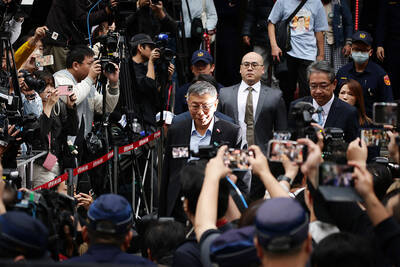
FIRST TRIAL: Ko’s lawyers sought reduced bail and other concessions, as did other defendants, but the bail judge denied their requests, citing the severity of the sentences Former Taipei mayor Ko Wen-je (柯文哲) was yesterday sentenced to 17 years in prison and had his civil rights suspended for six years over corruption, embezzlement and other charges. Taipei prosecutors in December last year asked the Taipei District Court for a combined 28-year, six-month sentence for the four cases against Ko, who founded the Taiwan People’s Party (TPP). The cases were linked to the Core Pacific City (京華城購物中心) redevelopment project and the mismanagement of political donations. Other defendants convicted on separate charges included Chinese Nationalist Party (KMT) Taipei City Councilor Angela Ying (應曉薇), who was handed a 15-year, six-month sentence; Core Pacific


 RSS
RSS