


The Formosa Club — a coalition of Taiwan friendship groups — on Tuesday congratulated Vice President William Lai (賴清德) on his victory in Saturday’s presidential election and voiced concern over apparent Chinese involvement in Nauru severing diplomatic ties with Taiwan.
Nauru switched recognition to China two days after Taiwan’s presidential and legislative elections, which the Formosa Club said in a statement was based on Beijing’s claim that Taiwan is part of China, a misinterpretation of UN Resolution 2758.
The incident “highlights the fact that China has utilized the distorted interpretation of this resolution to isolate Taiwan internationally,” wrote 25 cochairs of the club, which comprises cross-party European and Canadian legislators.
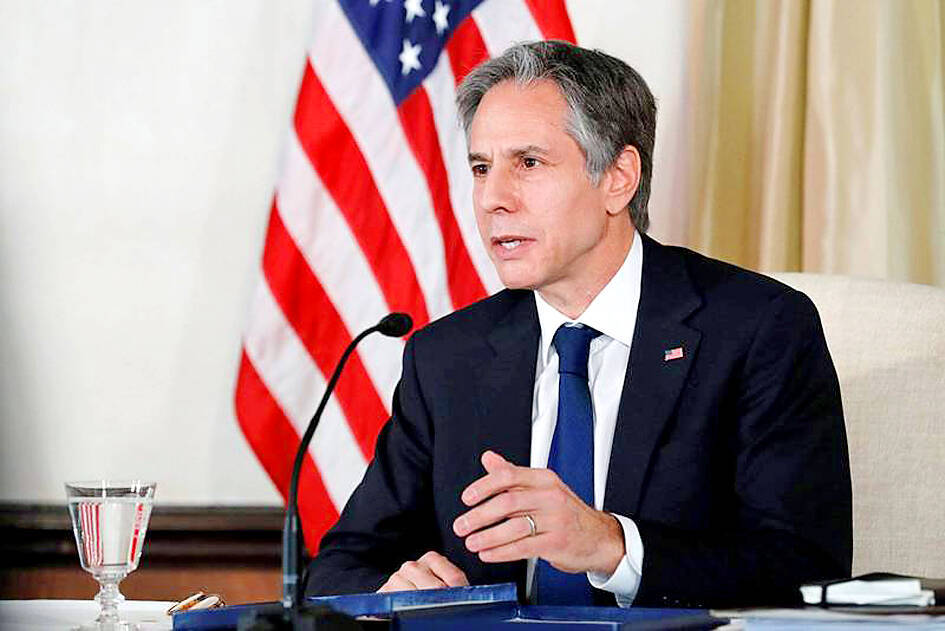
Photo: Reuters
“We express grave concern over China’s manipulation and weaponization of UN resolutions to advance its expansionist agenda,” they wrote.
The timing of Nauru’s decision shows “China’s deliberate suppression and intimidation against Taiwan’s democratic process,” and threatens the regional stability and international order, they said.
The statement condemned Beijing’s use of “methods contrary to the principles of the rule of law and good governance” to expand its influence.
It called for vigilance against any negative effects.
“In solidarity with the people of Taiwan, we commend their courage and unwavering commitment to upholding democracy on the front line,” the statement said.
In Taipei, the Ministry of Foreign Affairs yesterday thanked the club for supporting the nation with concrete actions, adding that “democratic Taiwan is not afraid of suppression.”
In other news, US Secretary of State Antony Blinken on Tuesday told CNBC that China’s increasingly aggressive strategy to suppress Taiwan in the past few years is against its own interests.
Blinken reiterated the importance of maintaining cross-strait peace and stability.
Beijing’s attempts to exert economic, military and diplomatic pressure on Taiwan have “actually been totally counterproductive to their interests,” Blinken told CNBC’s Squawk on the Street program in Davos, Switzerland, during a trip to attend the World Economic Forum.
Through Saturday’s elections, Taiwan has set a “great example” of a robust democracy “not just for the region, but for the entire world,” he said.
After his congratulatory statement to Lai was met with strong criticism from China, Blinken “made very clear” to a senior Chinese official in Washington that the US has long maintained its “one China” policy and is “standing resolutely for maintaining the status quo,” he said.
“China has to make decisions about what it will do and what it won’t do,” he added.
The US and its allies around the world have been pursuing clear objectives of the situation across the Taiwan Strait — maintaining peace and stability, opposing changes to the “status quo” and calling for the peaceful resolution of any dispute, he said.
“There’s a reason that that matters,” namely that 50 percent of the world’s commerce passes through the Taiwan Strait every day and “the semiconductors made in Taiwan are powering the world in every conceivable way,” he said.
Any disruption to this would have “repercussions for everyone around the world,” he said.
Blinken said that he is “not going to speculate” about whether China would pursue a takeover of Taiwan, adding that the US has been clear with both sides across the strait that “maintaining peace and stability” is its priority.
Although he might not meet with the Chinese delegation in Davos, Blinken said that the US and China have “ongoing, high-level communication” following the positive outcome achieved by the meeting of their presidents in San Francisco in November last year.
The US is to keep up with the efforts to avoid miscalculations and miscommunication, he added.
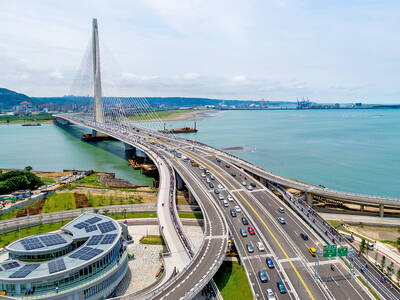
The Ministry of Transportation and Communications yesterday inaugurated the Danjiang Bridge across the Tamsui River in New Taipei City, saying that the structure would be an architectural icon and traffic artery for Taiwan. Feted as a major engineering achievement, the Danjiang Bridge is 920m long, 211m tall at the top of its pylon, and is the longest single-pylon asymmetric cable-stayed bridge in the world, the government’s Web site for the structure said. It was designed by late Iraqi-British architect Zaha Hadid. The structure, with a maximum deck of 70m, accommodates road and light rail traffic, and affords a 200m navigation channel for boats,
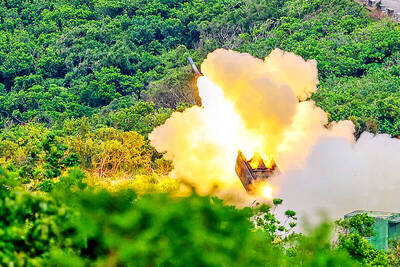
PRECISION STRIKES: The most significant reason to deploy HIMARS to outlying islands is to establish a ‘dead zone’ that the PLA would not dare enter, a source said A High Mobility Artillery Rocket System (HIMARS) would be deployed to Penghu County and Dongyin Island (東引) in Lienchiang County (Matsu) to force the Chinese military to retreat at least 100km from the coastline, a military source said yesterday. Taiwan has been procuring HIMARS and Army Tactical Missile Systems (ATACMS) from the US in batches. Once all batches have been delivered, Taiwan would possess 111 HIMARS units and 504 ATACMS, which have a range of 300km. Considering that “offense is the best defense,” the military plans to forward-deploy the systems to outlying islands such as Penghu and Dongyin so that

WHAT WAS ALL THAT FOR? Jaw Shaw-kong said that Cheng Li-wen had pushed for more drastic cuts and attacked him, just for the outcome to be nearly identical to his bill The legislature yesterday passed a supplementary budget bill to fund the purchase of separate packages of US military equipment, with the combined amount of spending capped at NT$780 billion (US$24.8 billion). The Chinese Nationalist Party (KMT) and Taiwan People’s Party (TPP) used their legislative majority to pass the bill, which runs until 2033 and has two main funding provisions. One was for NT$300 billion of arms sales already approved by the US for Taiwan on Dec. 17 last year, the other was for NT$480 billion for another arms package expected to be announced by Washington. The bill, which fell short of the NT$1.25
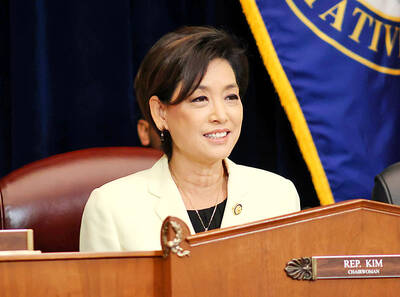
‘CLEAR MESSAGE’: The bill would set up an interagency ‘tiger team’ to review sanctions tools and other economic options to help deter any Chinese aggression toward Taiwan US Representative Young Kim has introduced a bill to deter Chinese aggression against Taiwan, calling for an interagency “tiger team” to preplan coordinated sanctions and economic measures in response to possible Chinese military or political action against Taiwan. “[Chinese President] Xi Jinping [習近平] has directed the People’s Liberation Army to be ready to invade Taiwan by 2027. China has a plan. America should have one too,” Kim said in a news release on Thursday last week. She introduced the “Deter PRC [People’s Republic of China] aggression against Taiwan act” to “ensure the US has a coordinated sanctions strategy ready should


 RSS
RSS