


The US, Japan and South Korea underlined the importance of peace and stability in the Taiwan Strait in a joint statement issued a day after the three governments held the first trilateral Indo-Pacific Dialogue in Washington on Friday.
US Assistant Secretary of State for East Asian and Pacific Affairs Daniel Kritenbrink, Japanese Foreign Policy Bureau Deputy Minister and Director-General Yasuhiro Kobe and South Korean Deputy Minister of Foreign Affairs Chung Byung-won met to discuss each country’s Indo-Pacific approach and opportunities for cooperation, the US Department of State said in a news release on Saturday.
The three representatives “reaffirmed the importance of peace and stability across the Taiwan Strait as indispensable to security and prosperity in the international community,” it said.
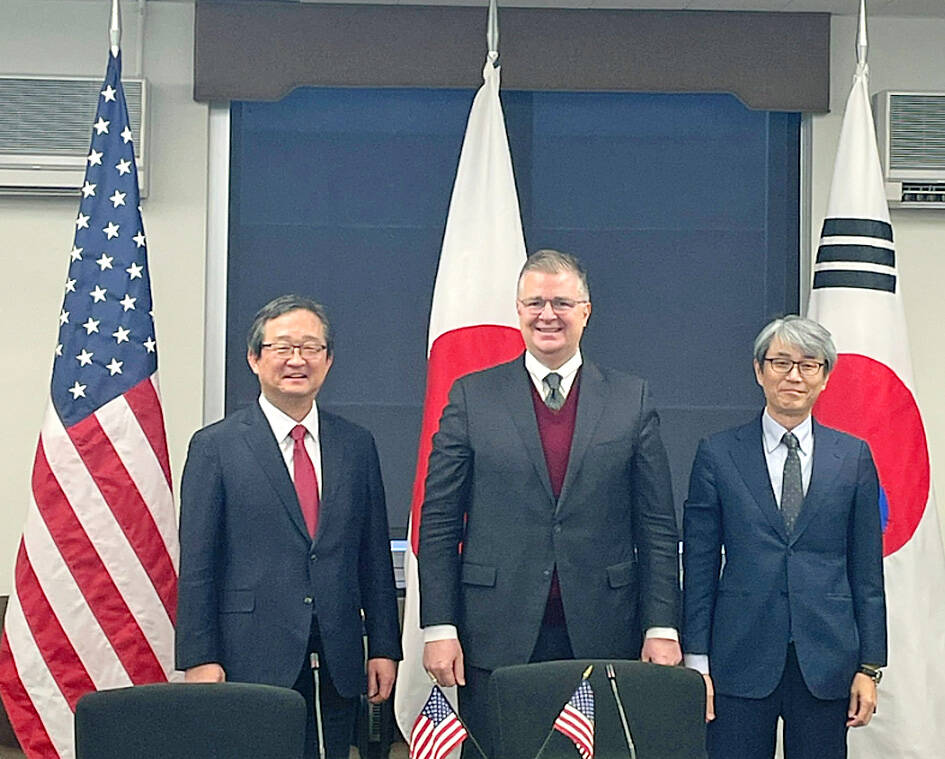
Photo: Screengrab from X page of the US Department Of State Bureau of East Asian and Pacific Affairs
Regarding China’s “dangerous and escalatory behavior supporting unlawful maritime claims” in the South China Sea, the three urged countries to follow international law, the statement said.
They “opposed any unilateral attempts to change the status quo by force or coercion anywhere in the waters of the Indo-Pacific,” it said.
In Taipei, the Ministry of Foreign Affairs welcomed the statement and thanked the three countries for reiterating their stance on the Taiwan Strait issue.
The statement followed the concern voiced by US President Joe Biden, Japanese Prime Minister Fumio Kishida and South Korean President Yoon Suk-yeol during their summit in August last year, the ministry said in a news release yesterday.
Beijing’s recent deployment of balloons across the Taiwan Strait’s median line, suspension of tariff cuts on imports of certain Taiwanese products and cognitive warfare campaign were clear attempts to influence Taiwan’s presidential and legislative elections on Saturday, the ministry said.
The importance of cross-strait peace and stability is a global consensus, it said, adding that Taiwan would continue working with like-minded partners to promote peace, stability and prosperity in the Indo-Pacific region.
Separately, Japan and South Korea could consider Taiwan a common strategic issue, which would improve security in the Indo-Pacific region, a Taiwanese researcher said in the Annual Assessment of the Security Environment in the Indo-Pacific Region report.
The report was published on Wednesday last week by the Institute for National Defense and Security Research.
If Japan and South Korea are willing to cooperate with each other and even with Taipei to deter China from invading Taiwan, a “Taiwan contingency” could be prevented, institute associate research fellow Wang Tsun-yen (王尊彥) said.
Japan’s stance regarding the issue — “a Taiwan contingency is a Japan contingency” — is known, while South Korea has begun voicing concerns about the cross-strait situation in the second half of the administration of former South Korean president Moon Jae-in, he said.
Ensuring peace and stability across the Taiwan Strait is in the two countries’ interests, as a cross-strait conflict would inevitably affect Japan and the Strait is a crucial gateway to Southeast Asia and South Asia, according to South Korea’s New Southern Policy, he said.
Growing ties between Japan and South Korea in the past year have “great strategic significance in terms of the Indo-Pacific region’s security,” he added.
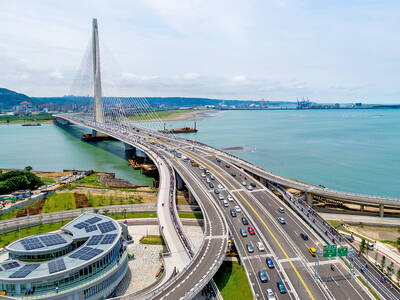
The Ministry of Transportation and Communications yesterday inaugurated the Danjiang Bridge across the Tamsui River in New Taipei City, saying that the structure would be an architectural icon and traffic artery for Taiwan. Feted as a major engineering achievement, the Danjiang Bridge is 920m long, 211m tall at the top of its pylon, and is the longest single-pylon asymmetric cable-stayed bridge in the world, the government’s Web site for the structure said. It was designed by late Iraqi-British architect Zaha Hadid. The structure, with a maximum deck of 70m, accommodates road and light rail traffic, and affords a 200m navigation channel for boats,
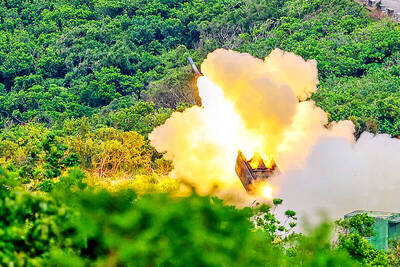
PRECISION STRIKES: The most significant reason to deploy HIMARS to outlying islands is to establish a ‘dead zone’ that the PLA would not dare enter, a source said A High Mobility Artillery Rocket System (HIMARS) would be deployed to Penghu County and Dongyin Island (東引) in Lienchiang County (Matsu) to force the Chinese military to retreat at least 100km from the coastline, a military source said yesterday. Taiwan has been procuring HIMARS and Army Tactical Missile Systems (ATACMS) from the US in batches. Once all batches have been delivered, Taiwan would possess 111 HIMARS units and 504 ATACMS, which have a range of 300km. Considering that “offense is the best defense,” the military plans to forward-deploy the systems to outlying islands such as Penghu and Dongyin so that
Taiwan Semiconductor Manufacturing Co (TSMC, 台積電), the world’s largest foundry service provider, yesterday said that global semiconductor revenue is projected to hit US$1.5 trillion in 2030, after the figure exceeds US$1 trillion this year, as artificial intelligence (AI) demand boosts consumption of token and compute power. “We are still at the beginning of the AI revolution, but we already see a significant impact across the whole semiconductor ecosystem,” TSMC deputy cochief operating officer Kevin Zhang (張曉強) said at the company’s annual technology symposium in Hsinchu City. “It is fair to say that in the past decade, smartphones and other mobile devices were
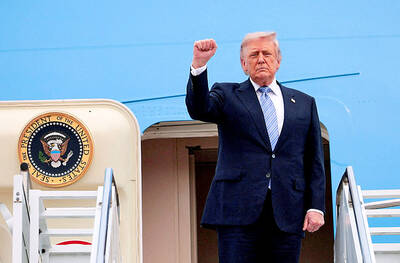
US-CHINA SUMMIT: MOFA welcomed US reassurance of no change in its Taiwan policy; Trump said he did not comment when Xi talked of opposing independence US President Donald Trump yesterday said he has not made a decision on whether to move forward with a major arms package for Taiwan after hearing concerns about it from Chinese President Xi Jinping (習近平). Trump’s comments on Taiwan came as he flew back to Washington after wrapping up critical talks in which both leaders said important progress was made in stabilizing US-China relations even as deep differences persist between the world’s two biggest powers on Iran and Taiwan. “I will make a determination,” Trump said, adding: “I’ll be making decisions. But, you know, I think the last thing we need right


 RSS
RSS