


Unlike most 27-year-olds, Chung Ching Kwong does not want any of her life shared on social media.
Both her and her loved ones’ safety and freedom are at stake, said Kwong, who left Hong Kong in 2020 to avoid arrest for her pro-democracy work after China imposed a sweeping national security law that year.
With hundreds of thousands of residents leaving the city since 2020, rights groups say the government is shifting its online monitoring to Hong Kongers abroad in an attempt to stifle their activism.
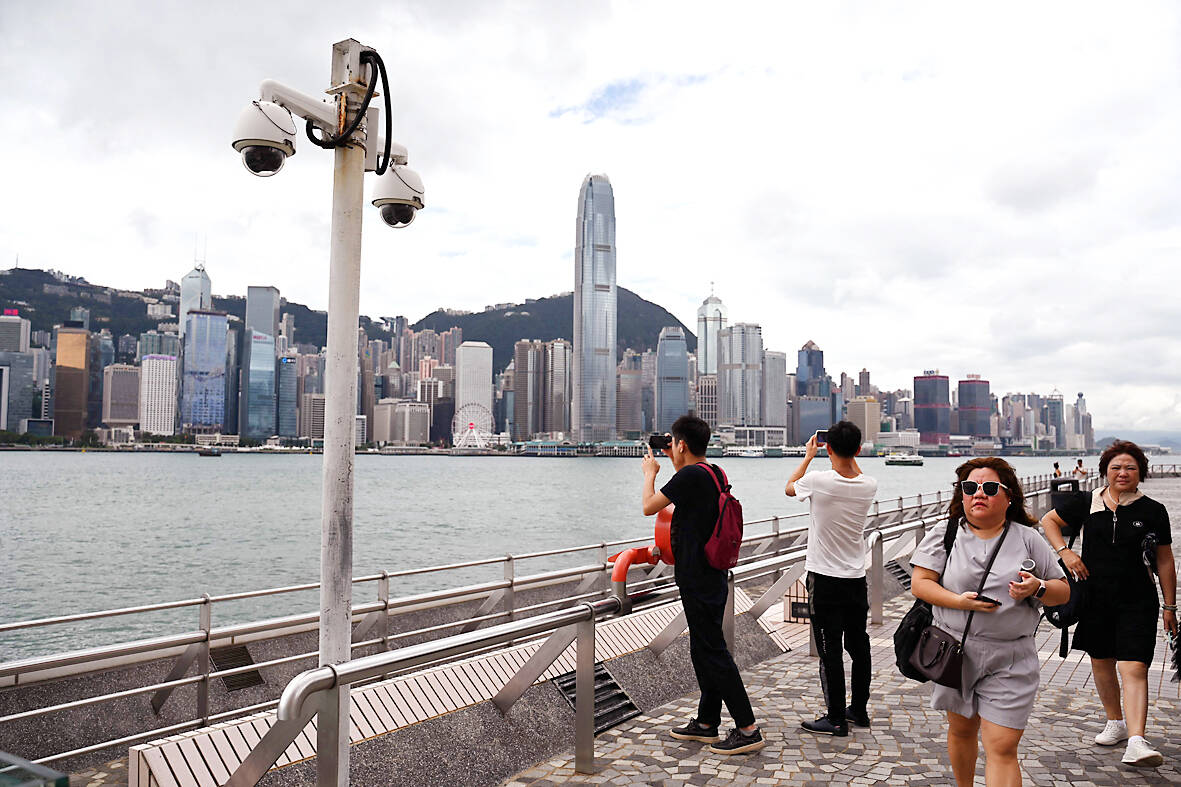
Photo: AFP
In July, Hong Kong police ramped up pressure on eight dissidents — some of whom are now residing in Australia, Britain and the US —issuing arrest warrants for alleged national security violations and offering bounties of HK$1 million (US$127,876) for each arrest.
Activists overseas said they — and those around them — are increasingly having to tighten their digital security and self-censor by limiting their social media use and avoiding public appearances online or offline to protect themselves and their loved ones.
“It’s quite exhausting ... ‘Okay what do they know? What should I avoid talking about on social media or online?’ You become quite paranoid about what they can deduce from whatever you post online,” said Kwong, who now lives in Europe.
Kwong said she has been doxxed — her phone number leaked online — and threatened several times while working on pro-democracy campaigns in Europe in 2020.
She worries about repercussions for her family back home and has cut contact with relatives after one of them was questioned by police last year about Kwong’s work.
“It makes me feel quite bad. It feels like you’re putting people around you in danger even though they have nothing to do with your work,” said Kwong, who works for the Inter-Parliamentary Alliance on China, a global group of legislators.
A spokesperson for the Hong Kong police said that “in conducting any operation, Police will act on the basis of actual circumstances and according to the law.”
The government did not respond to requests for comment.
BOUNTY
Until last year, Anna Kwok was largely unknown to her fellow Hong Kongers and the city’s police.
Now the Hong Kong native is one of eight overseas-based activists with a bounty for her arrest, targeted for calling out human rights violations in the global financial hub after China implemented its national security law.
“After the bounty was announced, I received private messages from Hong Kongers telling me they cannot like or share my posts anymore. They know the regime is paying attention so they did not want to leave any traces.”
The 26-year-old last year became the executive director of the Hong Kong Democracy Council, a US-based pro-democracy group that has called for sanctions against Hong Kong government officials, among other campaigns.
Since the bounty was announced, Kwok — who is the youngest and only woman on the list — said online harassment, threats of sexual violence and hacking attempts have skyrocketed.
“There are a lot of different kinds of threats. People would even send me messages saying that they wanted to rape me,” said Kwok, who left the harbor city in 2020.
After cutting contact with relatives for security reasons, Kwok saw in news reports that her parents in Hong Kong were also recently taken in by police for questioning.
INCREASED ONLINE ATTENTION
Maya Wang, associate Asia director at Human Rights Watch, said the authorities are “using any means” to suppress pro-democracy activism in the diaspora.
Wang said that “(Hong Kongers) are feeling the increased attention by the authorities. People have always been very careful about revealing information about themselves ... but their level of sensitivity and fear has increased.”
“The authorities are using any means to get to them through intimidating families that are still (in Hong Kong), as well as observing the networks of people and surveilling conversations within the diaspora,” she added.
Beijing has used similar tactics to track young Uighurs living overseas who are increasingly using social media to campaign against forced labor in China’s northwestern Xinjiang province, home to the Uyghur Muslim minority.
Hong Kong was once considered a bastion of freedoms on China’s doorstep, enjoying a separate and independent judicial system from China under a “one country, two systems” arrangement when it returned from British to Chinese rule in 1997.
China says Hong Kong’s 2020 national security law was needed to restore order after months of pro-democracy protests rocked the city in 2019. Since then, most of the democratic opposition has been jailed or exiled.
Hong Kong authorities say the security law has brought stability, and that the eight “absconders” including Kwok, by asking foreign powers to impose sanctions on Hong Kong among other activities, continue to endanger national security.
‘TRANSNATIONAL REPRESSION’
Kwok said she is most concerned about the majority of ordinary Hong Kongers inside and outside of the city who no longer feel safe to even repost, share or like pro-democracy messages because of the security law.
“We used to be able to gauge how many supporters we had, what kind of strategies would be effective,” she said. “But now, we don’t have that indicator anymore because people do not dare to even like a post. I think it really hinders our ability to correctly and accurately assess the current situation in Hong Kong and what the masses are really thinking about.”
For Hong Kong researcher Michael, nearly every decision he makes — from the institutions he is associated with, public appearances to online posts — is calculated and stems from the “real risk” that he is being watched and tracked, even though he lives overseas in Europe.
“This is why self-censorship is sort of annoying and very real. We don’t know where the line is, we have to figure it out for ourselves,” said Michael, who used a pseudonym to protect his identity. “That is part of transnational repression.”
“It’s like trying to dodge infrared, you can’t see it. Repression is not just the ‘in your face’ kind of repression. Much of it is invisible and that does not change when you’re abroad.”

The Portuguese never established a presence on Taiwan, but they must have traded with the indigenous people because later traders reported that the locals referred to parts of deer using Portuguese words. What goods might the Portuguese have offered their indigenous trade partners? Among them must have been slaves, for the Portuguese dealt slaves across Asia. Though we often speak of “Portuguese” ships, imagining them as picturesque vessels manned by pointy-bearded Iberians, in Asia Portuguese shipping between local destinations was crewed by Asian seamen, with a handful of white or Eurasian officers. “Even the great carracks of 1,000-2,000 tons which plied

It’s only half the size of its more famous counterpart in Taipei, but the Botanical Garden of the National Museum of Nature Science (NMNS, 國立自然科學博物館植物園) is surely one of urban Taiwan’s most inviting green spaces. Covering 4.5 hectares immediately northeast of the government-run museum in Taichung’s North District (北區), the garden features more than 700 plant species, many of which are labeled in Chinese but not in English. Since its establishment in 1999, the site’s managers have done their best to replicate a number of native ecosystems, dividing the site into eight areas. The name of the Coral Atoll Zone might

On Monday morning, in quick succession, the Chinese Communist Party (CCP) and the Chinese Nationalist Party (KMT) released statements announcing “that the Central Committee of the Communist Party of China and General Secretary Xi Jinping (習近平) have invited KMT Chairwoman Cheng Li-wun (鄭麗文) to lead a delegation on a visit to the mainland” as the KMT’s press release worded it. The KMT’s press release added “Chairwoman Cheng expressed her gratitude for the invitation and has gladly accepted it.” Beijing’s official Xinhua news release described Song Tao (宋濤), head of the Taiwan Work Office of the CCP Central Committee, as
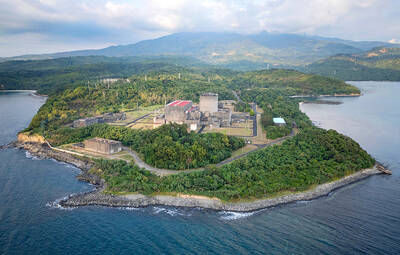
Nuclear power is getting a second look in Southeast Asia as countries prepare to meet surging energy demand as they vie for artificial intelligence-focused data centers. Several Southeast Asian nations are reviving mothballed nuclear plans and setting ambitious targets and nearly half of the region could, if they pursue those goals, have nuclear energy in the 2030s. Even countries without current plans have signaled their interest. Southeast Asia has never produced a single watt of nuclear energy, despite long-held atomic ambitions. But that may soon change as pressure mounts to reduce emissions that contribute to climate change, while meeting growing power needs. The


 RSS
RSS