


Taiwanese yesterday dominated the women’s artistic single free roller skating at the Asian Games in Hangzhou, China, with Hung Hsiao-ching (洪筱晴) and Chang Chih-ju (張緻如) winning the gold and bronze medals respectively, while Taiwan also won silvers in baseball, soft tennis and karate.
The 19-year-old Hung won with scores of 38.76 (short program) and 55.62 (long program) to finish with 94.38 points, while Chang, also 19, took bronze with an overall score of 79.51. Japan’s Miki Fujikura won silver.
Hung’s first-place finish gave Taiwan its 18th gold medal at the Games, surpassing the country’s 17 gold medals won at the previous edition in Jakarta in 2018.
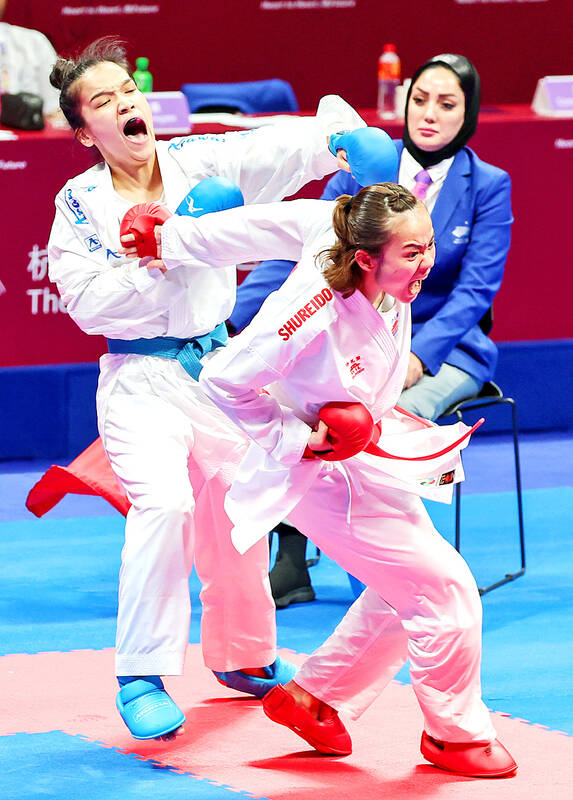
Photo: CNA
Hung dedicated her medal to her late father, who she said she wished was alive to see her achievement.
In soft tennis, Taiwan’s Chang Yu-sung (張祐菘) took home a silver medal in the men’s singles, while compatriot Chen Yu-hsun (陳郁勳) won bronze after exiting in the semi-final.
Chang — who played his round-of-16 match, quarter-final, semi-final and final on the same day — defeated South Korean Yoon Hyoung-wook 4-3 in their semi-final, but lost to Japan’s Toshiki Uematsu 4-0 in the final.

Photo: Chen Chih-chu, Taipei Times
Chen battled past Thailand’s Kawin Yannarit before reaching the semi-final, where Uematsu beat him 4-3 in a close game.
On Wednesday, Chang won the silver medal in the men’s team event.
Taiwanese female karateka Ku Tsui-ping (辜翠萍) yesterday finished her Asian Games campaign with a silver medal in the women’s under-55kg kumite, falling 9-1 to Uzbekistan’s Sevinch Rakhimova in a one-sided match that lasted 2 minutes, 9 seconds.

Photo: Reuters
Winning the silver medal marked Ku’s return to the Games following her 2014 gold-medal-winning debut in Incheon, South Korea, where she won a gold in the women’s kumite, while fighting in the under-50kg category in 2014.
In men’s baseball, Taiwan won silver after losing 2-0 to South Korea in Shaoxing.
After South Korea’s Moon Bo-gyeon and Kim Hyung-jun scored in the second inning, Taiwan was unable to get on the board, but held their opponents to just two runs.
In the bronze-medal game, Japan pipped China 4-3.
Taiwan’s Wu Shao-Hsuan (吳少璿) won a bronze medal in the men’s kayak final, with a time of 97.12 seconds and no penalties.
That run initially placed him second behind Yuuki Tanaka of Japan.
However, Wu had to settle for bronze after the final competitor of the event, China’s Quan Xin (全鑫), finished in 89.24 seconds with no penalties.
Wu’s bronze is Taiwan’s third in kayaking and canoeing events at this year’s Asian Games.
On Friday, Taiwan’s first-ever Olympian kayaker, Chang Chu-han (張筑涵), won gold in the women’s kayak final, while Lai Kuan-chieh (賴冠傑) also topped the podium in the men’s canoe single 1,000m final.
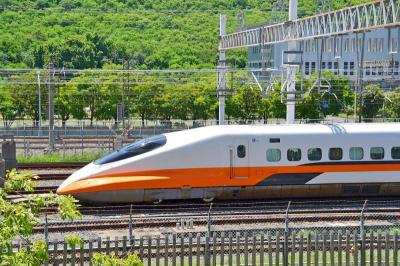
A signaling system malfunction disrupted high-speed rail (HSR) services beginning at 8am today, with trains temporarily reduced to three northbound and three southbound trains per hour as authorities conduct inspections. The malfunction occurred on a section of track in Miaoli County during pre-operation checks early this morning, forcing northbound and southbound trains to use a single track, the HSR operator said. The regular schedule has been replaced with three hourly trains offering only nonreserved seating in each direction, stopping at every station, it said, adding that business class cars would still have reserved seating. Departures from terminal stations are scheduled at the top
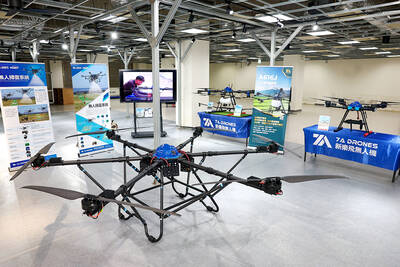
DRONE CENTRAL: Taiwan aims to become Asia’s democratic hub for drones, with most exports focused on high-quality military-grade models, an official said Taiwan’s drone industry is expected to expand significantly by 2030, producing 100,000 units per month and exporting half of them, the Ministry of Economic Affairs said yesterday. Current drone production capacity is about 15,000 units per month, but the industry can quickly scale up as demand increases, Industrial Development Administration Director-General Chiou Chyou-huey (邱求慧) told a news conference in Taipei. Taiwan’s drone output grew 2.5-fold last year to NT$12.9 billion (US$408.3 million) under a government program to develop the uncrewed vehicle sector, he said. The Executive Yuan in October last year approved plans to invest NT$44.2 billion into domestic production of uncrewed aerial
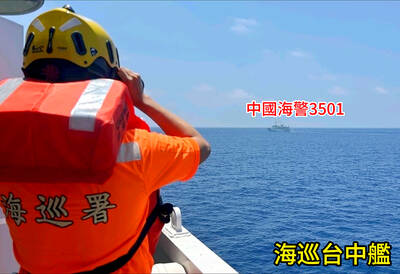
VERBOSE VESSELS: A CGA cutter and a China Coast Guard exchanged verbal barbs for more than a day in Taiwanese-controlled waters before the Chinese vessel left The Taiwanese and Chinese coast guards had a standoff near the strategically located Pratas Islands (Dongsha Islands, 東沙群島) in the north of the South China Sea, the Coast Guard Administration (CGA) said yesterday. The two sides engaged in intense radio exchanges over sovereignty claims during the 33-hour standoff. China Coast Guard vessel 3501 eventually left the restricted waters, 26.6 nautical miles (49.2km) west of the Pratas Islands, at 5pm yesterday, the CGA said. Lying approximately between southern Taiwan and Hong Kong, the Taiwan-controlled Pratas are seen by some security experts as vulnerable to Chinese attack due to their distance — more than
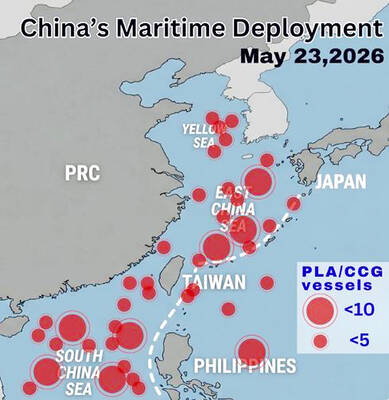
WARNING: China should stop engaging in actions that undermine regional peace and stability, as it would only build resentment among people across the Strait, the CGA said China has deployed more than 100 navy, coast guard and other vessels in waters from the Yellow Sea to the South China Sea and the western Pacific since US President Donald Trump and Chinese President Xi Jinping (習近平) met in Beijing, National Security Council Secretary-General Joseph Wu (吳釗燮) said yesterday. “In this part of the world, #China is the one & only PROBLEM wrecking the #StatusQuo & threatening regional peace & stability,” Wu wrote on X. In a separate post, he said Beijing was coercing Taiwan’s maritime domain, calling it illegal and provocative, after the Coast Guard Administration (CGA) expelled a


 RSS
RSS