


Taiwanese companies in 2021 accelerated research and development (R&D) investment to an all-time high of NT$820.6 billion (US$25.7 billion), driven mostly by expenditure by semiconductor companies, the Ministry of Economic Affairs said in a statement yesterday.
The spending was up 14.2 percent from NT$718.8 billion a year earlier, the fastest pace on record, the ministry said.
In the 10-year period from 2012, local companies have expanded R&D spending expand at an annual compound growth rate of 7 percent, it said.
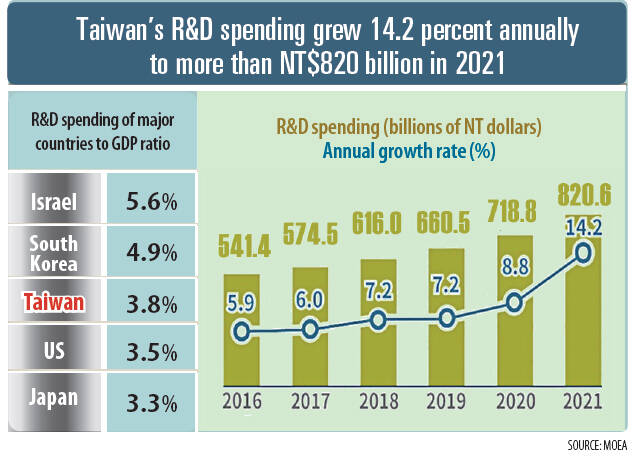
The spending was 3.8 percent of national GDP in 2021, up 0.2 percentage points from 2020 and the highest on record, it said.
That helped Taiwan defend its position as the third-largest R&D spender among the world’s major economies in 2021, surpassing 3.5 percent in the US, Japan’s 3.3 percent and Germany’s 3.1 percent, the ministry said, citing Organisation for Economic Co-operation and Development (OECD) statistics.
Israel was No. 1, with R&D investment being 5.7 percent of its GDP, the OECD data showed.
South Korea was second in 2021, with R&D spending totaling 4.6 percent of GDP, the data showed.
Like most heavy R&D spenders, 92 percent of spending in Taiwan was in the manufacturing sector, the ministry said.
In 2021, local manufacturers invested NT$639.26 billion on R&D, up 17 percent from the previous year, the statement said.
Manufacturers of computers, other electronics and optical products, including semiconductors, in 2021 contributed about 78 percent to the nation’s total R&D expenditure, it said.
Those firms increased spending by 19 percent annually to NT$540.39 billion in 2021, it said.
Taiwan Semiconductor Manufacturing Co (台積電), the world’s largest chipmaker, boosted R&D spending by about 20 percent to US$4.46 billion from US$3.72 billion in 2020, primarily to develop next-generation chips, the company’s annual reports showed.
Last year, the chipmaker increased spending on R&D efforts to US$5.47 billion, mostly to develop 3-nanometer technology, the company’s annual report released this year said.
The local machine and equipment manufacturing sector replaced the chemical sector to become the second-biggest R&D spender in 2021, the ministry said.
R&D spending by machine and equipment manufacturers made up 2.4 percent of the total, it said, adding that the result was due to uptake of smart manufacturing.
The service sector contributed 7.3 percent to total R&D spending in 2021, it added.

SILENCING CRITICS: In addition to blocking Taiwan, China aimed to prevent rights activists from speaking out against authoritarian states, a Cabinet department said The Ministry of Foreign Affairs (MOFA) yesterday condemned transnational repression by Beijing after RightsCon, a major digital human rights conference scheduled to be held in Zambia this week, was abruptly canceled due to Chinese pressure over Taiwanese participation. This year’s RightsCon, the world’s largest conference discussing issues “at the intersection of human rights and technology,” was scheduled to take place from tomorrow to Friday in Lusaka, and expected to draw 2,600 in-person attendees from 150 countries, along with 1,100 online participants. However, organizers were forced to cancel the event due to behind-the-scenes pressure from China, the ministry said, expressing its “strongest condemnation”
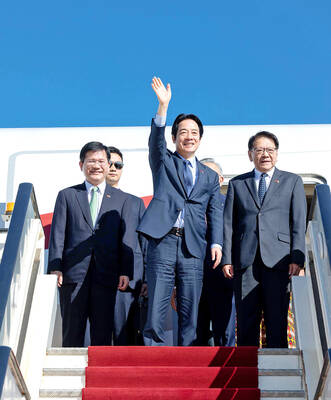
DELAYED BUT DETERMINED: The president’s visit highlights Taiwan’s right to international engagement amid regional pressure from China President Willaim Lai (賴清德) yesterday arrived in Eswatini, more than a week after his planned visit to Taiwan’s sole African ally was suspended because of revoked overflight permits. “The visit, originally scheduled for April 22, was postponed due to unforeseen external factors,” Lai wrote on social media. “After several days of careful arrangements by our diplomatic and national security teams, we successfully arrived today.” Lai said he looked forward to further deepening Taiwan-Eswatini relations through closer cooperation in the economy, agriculture, culture and education, as well as advancing the nation’s international partnerships. The president was initially scheduled to arrive in time to celebrate
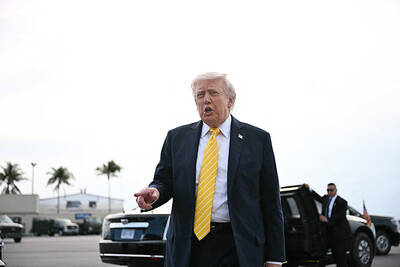
Iran’s Islamic Revolutionary Guard Corp (IRGC) yesterday said the US faced a choice between an “impossible” military operation or a “bad deal” with Tehran, after US President Donald Trump disparaged Iran’s latest peace proposal. Negotiations between the two countries have been deadlocked since a ceasefire came into effect on April 8, with only one round of direct peace talks held so far. Iran’s Tasnim and Fars news agencies reported that Tehran had submitted a 14-point proposal to mediator Pakistan, but Trump was quick to cast doubt on it. “I will soon be reviewing the plan that Iran has just sent to us, but

A group affiliated with indicted Chinese immigrant Xu Chunying (徐春鶯) is to be dissolved for monitoring Chinese immigrants in Taiwan, a source said yesterday. Xu, the secretary-general of the Cross-Strait Marriage and Family Service Alliance, was indicted on March 24 on charges of violating the Anti-Infiltration Act (反滲透法). The alliance “illegally monitored" Chinese immigrants living in Taiwan on behalf of the Chinese Communist Party (CCP) and the Ministry of the Interior is expected to dissolve the organization in the coming days under provisions of the Civil Associations Act (人民團體法), the source said. Xu, who married a Taiwanese in 1993 and became a Republic


 RSS
RSS