


Business tycoon Terry Gou (郭台銘) has resigned from his position as a member of Hon Hai Precision Industry Co’s (鴻海精密) board of directors, the company announced on Saturday.
Hon Hai, also known as Foxconn Technology Group (富士康科技集團) globally, said in a statement that Gou resigned from his post for “personal reasons.”
Since founding the company 49 years ago, Gou led it to become one of the world’s most prestigious tech conglomerates, Hon Hai said, adding that the company owes its founder a debt of gratitude for his contributions.
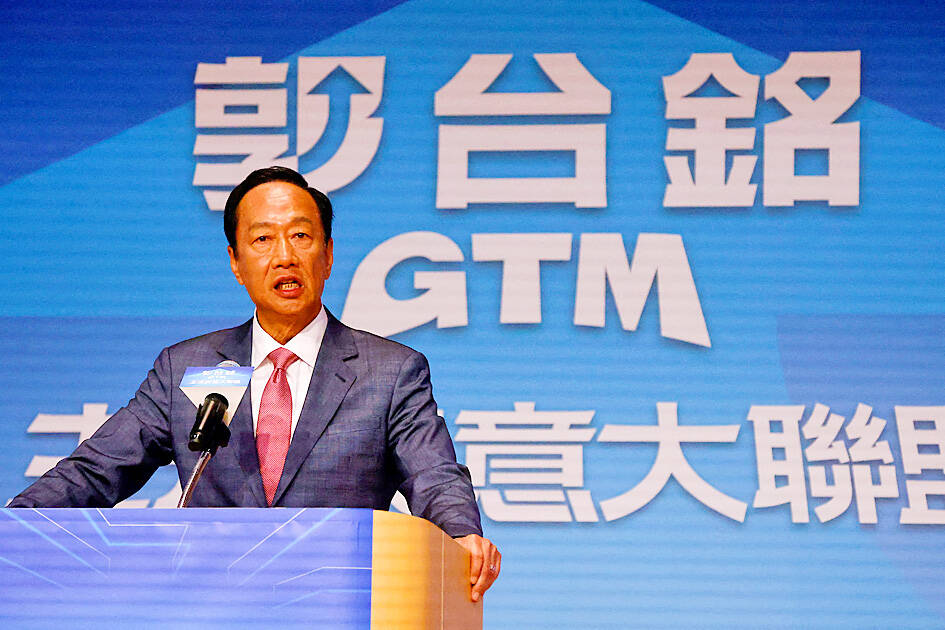
Photo: Ann Wang, Reuters
As its nine-member board already has five independent directors, the resignation of Gou would not require an immediate by-election to swear in a new member, the company added.
On Monday last week, Gou told a news conference that he would run for president next year’s election on an independent ticket.
Asked what he would do as a potential national leader if China exerted pressure on him using his position as a major shareholder in Hon Hai, Gou said that if sacrificing his personal wealth could prevent the Chinese Communist Party from attacking Taiwan, he would be willing to bear such a burden.
Gou now has to collect about 290,000 signatures, or a number equivalent to at least 1.5 percent of the electorate in the previous presidential election, within 45 days of his formal application to run as an independent candidate.
Should his presidential bid prove successful, Gou would face off against New Taipei City Mayor Hou You-yi (侯友宜) of the Chinese Nationalist Party (KMT), Vice President William Lai (賴清德), who chairs the Democratic Progressive Party (DPP), and Taiwan People’s Party (TPP) Chairman Ko Wen-je (柯文哲) in the presidential election on Jan. 13 next year.
Separately, Hon Hai on Friday said that about 1,000 people were employed at its Mount Pleasant, Wisconsin facility, after the Washington Post reported that the site was “largely empty.”
The iPhone assembler said that the complex in Wisconsin’s Racine County was “not idle,” and was producing photovoltaic inverters and servers.
Hon Hai said that a glass dome at the center of the Mount Pleasant campus — which locals interviewed by the Washington Post described as showing “few signs of life” — was being used as a high-performance computing and Internet communications control center.
In response to a Yahoo Finance report on Tuesday stating that Hon Hai had put two buildings up for sale “after years of neglected promises to bring thousands of jobs to Eau Claire and Green Bay” in Wisconsin, the company said that the properties were not relevant to production in Mount Pleasant.
Hon Hai said the property sale plan had the support of the government in Wisconsin, and that it was unlikely to affect the Mount Pleasant campus’ production and operations.

The nation’s fastest supercomputer, Nano 4 (晶創26), is scheduled to be launched in the third quarter, and would be used to train large language models in finance and national defense sectors, the National Center for High-Performance Computing (NCHC) said. The supercomputer, which would operate at about 86.05 petaflops, is being tested at a new cloud computing center in the Southern Taiwan Science Park in Tainan. The exterior of the server cabinet features chip circuitry patterns overlaid with a map of Taiwan, highlighting the nation’s central position in the semiconductor industry. The center also houses Taiwania 2, Taiwania 3, Forerunner 1 and
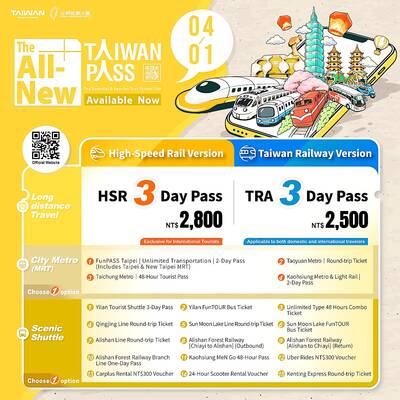
MORE POPULAR: Taiwan Pass sales increased by 59 percent during the first quarter compared with the same period last year, the Tourism Administration said The Tourism Administration yesterday said that it has streamlined the Taiwan Pass, with two versions available for purchase beginning today. The tourism agency has made the pass available to international tourists since 2024, allowing them to access the high-speed rail, Taiwan Railway Corp services, four MRT systems and four Taiwan Tourist Shuttles. Previously, five types of Taiwan Pass were available, but some tourists have said that the offerings were too complicated. The agency said only two types of Taiwan Pass would be available, starting from a three-day pass with the high-speed rail and a three-day pass with Taiwan Railway Corp. The former costs NT$2,800
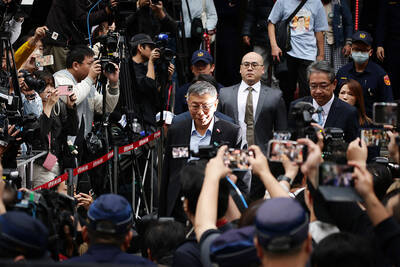
FIRST TRIAL: Ko’s lawyers sought reduced bail and other concessions, as did other defendants, but the bail judge denied their requests, citing the severity of the sentences Former Taipei mayor Ko Wen-je (柯文哲) was yesterday sentenced to 17 years in prison and had his civil rights suspended for six years over corruption, embezzlement and other charges. Taipei prosecutors in December last year asked the Taipei District Court for a combined 28-year, six-month sentence for the four cases against Ko, who founded the Taiwan People’s Party (TPP). The cases were linked to the Core Pacific City (京華城購物中心) redevelopment project and the mismanagement of political donations. Other defendants convicted on separate charges included Chinese Nationalist Party (KMT) Taipei City Councilor Angela Ying (應曉薇), who was handed a 15-year, six-month sentence; Core Pacific
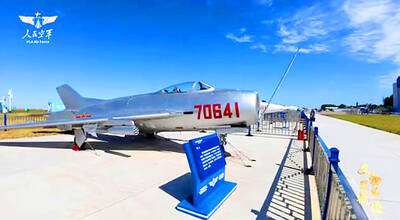
J-6 REMODEL: The converted drones are part of Beijing’s expanding mix of airpower weapons, including bombers with stand-off missiles and UAV swarms, the report said China has stationed obsolete supersonic fighters converted to attack drones at six air bases close to the Taiwan Strait, a report published this month by the Arlington, Virginia-based Mitchell Institute for Aerospace Studies said. Satellite imagery of the airfields from the institute’s “China Airpower Tracker” shows what appear to be lines of stubby, swept-winged aircraft matching the shape of J-6 fighters that first flew with the Chinese People’s Liberation Army (PLA) Air Force in the 1960s. Since their conversion to drones, the aircraft have been identified at five bases in China’s Fujian Province and one in Guangdong Province, the report said. J.


 RSS
RSS