


The US and Taiwan should increase cooperation in manufacturing and innovation to benefit the world, a visiting US delegation said after meeting with Taiwan Semiconductor Manufacturing Co (TSMC, 台積電) founder Morris Chang (張忠謀) yesterday.
US representatives Ro Khanna, Jake Auchincloss, Jonathan Jackson and Tony Gonzales arrived in Taiwan on Sunday and are scheduled to depart on Thursday.
The delegation also met with Legislative Speaker You Si-kun (游錫堃) at the Legislative Yuan in Taipei yesterday.
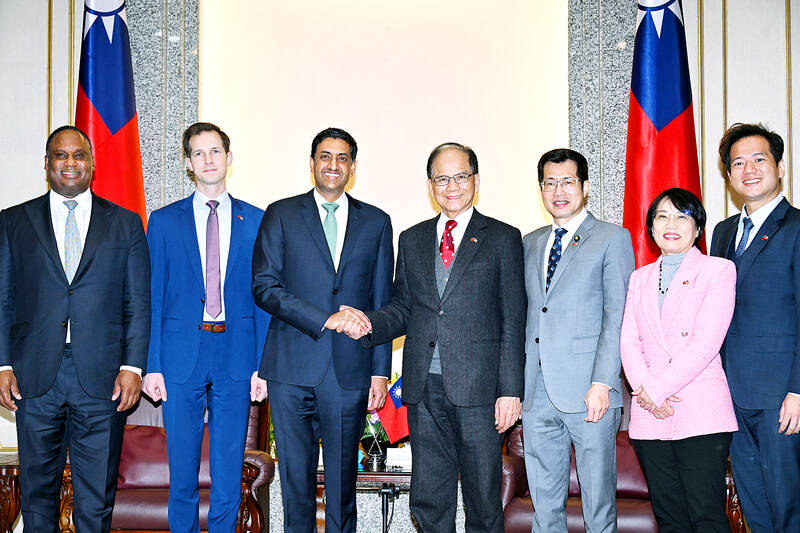
Photo: Fang Pin-chao, Taipei Times
Khanna, whose California district includes Silicon Valley, said at the legislature that he was honored to meet with Chang.
Visiting Taiwan is consistent with US President Joe Biden’s foreign policy and “in no way provocative of China,” Khanna said.
The US recognizes the importance of the relationship with Taiwan and is seeking peace in the region, he said.
The delegation plans to hold talks with legislators across the political spectrum during the visit with the intent of deepening economic and political cooperation, he said.
Khanna also mentioned that former US president Jimmy Carter, who over the weekend began to receive end-of-life hospice care, signed the Taiwan Relations Act in 1979.
Carter visited Taiwan in 1999, saying at the time that “Taiwan has made itself a model for many other countries by its development.”
You thanked the US delegation for its country’s continued support for Taiwan, adding that the US is an essential trade partner and a pillar of peace and stability across the Taiwan Strait.
He thanked Khanna and other members of the US Congress for proposing to establish a “US-Taiwan Infectious Disease Monitoring Center” by introducing the US-Taiwan Public Health Protection Act in 2021.
The bill has been incorporated into the 2023 National Defense Authorization Act, which was passed at the end of last year.
Khanna and Auchincloss signed a petition to support Taiwan’s participation in the Indo-Pacific Economic Framework last year, You said.
Democratic allies must work together to ensure peace, stability and development around the world, You said, adding that he looks forward to further cooperation between Taiwan and the US.
Separately, Gonzales and US Representative Mikie Sherrill introduced the US-Taiwan Advanced Research Partnership Act “in response to an increased number of cyberattacks against the US and our allies,” Gonzales wrote on Twitter on Saturday.
The bill is “to strengthen Taiwanese and US homeland security, and bolster cybersecurity,” he said.
Gonzales, a former navy cryptologist, visited Taiwan in 2021 with a delegation led by US Senator John Cornyn.
Sherrill, who also has a naval background, signed the petition for the Taiwan Democracy Defense Lend-Lease Act, which would authorize the expedited lending or leasing of defense equipment to Taiwan, and has voiced support for Taiwan’s participation in the World Health Assembly.
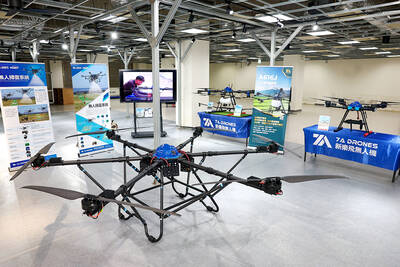
DRONE CENTRAL: Taiwan aims to become Asia’s democratic hub for drones, with most exports focused on high-quality military-grade models, an official said Taiwan’s drone industry is expected to expand significantly by 2030, producing 100,000 units per month and exporting half of them, the Ministry of Economic Affairs said yesterday. Current drone production capacity is about 15,000 units per month, but the industry can quickly scale up as demand increases, Industrial Development Administration Director-General Chiou Chyou-huey (邱求慧) told a news conference in Taipei. Taiwan’s drone output grew 2.5-fold last year to NT$12.9 billion (US$408.3 million) under a government program to develop the uncrewed vehicle sector, he said. The Executive Yuan in October last year approved plans to invest NT$44.2 billion into domestic production of uncrewed aerial
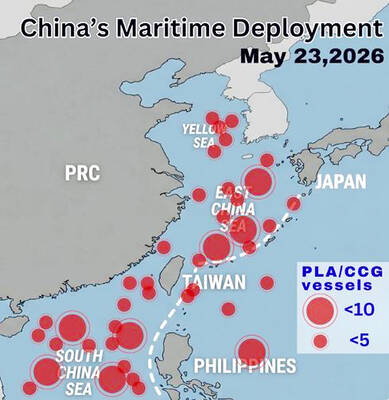
WARNING: China should stop engaging in actions that undermine regional peace and stability, as it would only build resentment among people across the Strait, the CGA said China has deployed more than 100 navy, coast guard and other vessels in waters from the Yellow Sea to the South China Sea and the western Pacific since US President Donald Trump and Chinese President Xi Jinping (習近平) met in Beijing, National Security Council Secretary-General Joseph Wu (吳釗燮) said yesterday. “In this part of the world, #China is the one & only PROBLEM wrecking the #StatusQuo & threatening regional peace & stability,” Wu wrote on X. In a separate post, he said Beijing was coercing Taiwan’s maritime domain, calling it illegal and provocative, after the Coast Guard Administration (CGA) expelled a

VERBOSE VESSELS: A CGA cutter and a China Coast Guard exchanged verbal barbs for more than a day in Taiwanese-controlled waters before the Chinese vessel left The Taiwanese and Chinese coast guards had a standoff near the strategically located Pratas Islands (Dongsha Islands, 東沙群島) in the north of the South China Sea, the Coast Guard Administration (CGA) said yesterday. The two sides engaged in intense radio exchanges over sovereignty claims during the 33-hour standoff. China Coast Guard vessel 3501 eventually left the restricted waters, 26.6 nautical miles (49.2km) west of the Pratas Islands, at 5pm yesterday, the CGA said. Lying approximately between southern Taiwan and Hong Kong, the Taiwan-controlled Pratas are seen by some security experts as vulnerable to Chinese attack due to their distance — more than
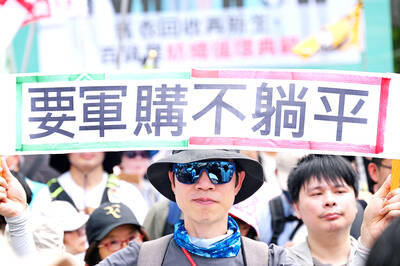
More than 8,000 people took part in a rally in Taipei yesterday to express support for more defense spending, after the opposition slashed the Cabinet’s proposed NT$1.25 trillion (US$39.6 billion) special defense budget and capped it at NT$780 billion. The demonstrators urged the Cabinet to propose another bill. Taiwan Economic Democracy Union convener Lai Chung-chiang (賴中強) said the main problem of the passed budget plan is the removal of funding for critical items, not just that the total amount is smaller. Critical budget items included purchasing or developing uncrewed vehicles, Strong Bow (強弓) missile systems, additional ammunition, artificial intelligence-powered combat systems and Taiwan-US


 RSS
RSS