


A Japanese official blasted China’s claims that Japanese Prime Minister Sanae Takaichi has altered Japan’s position on a Taiwan crisis as “entirely baseless,” calling for more dialogue to stop ties between Asia’s top economies from spiraling.
China vowed to take resolute self-defense against Japan if it “dared to intervene militarily in the Taiwan Strait” in a letter delivered Friday to the UN.
“I’m aware of this letter,” said Maki Kobayashi, a senior Japanese government spokeswoman.
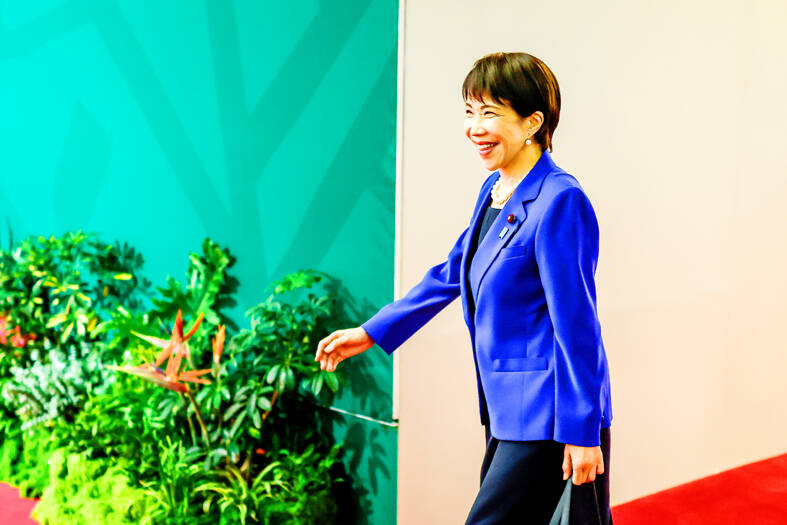
Photo: Pool Photo via AP
“The claim our country has altered its position is entirely baseless,” she said on the sidelines of the G20 summit in Johannesburg on Saturday.
The Chinese Ministry of Foreign Affairs did not immediately reply to a request for comment made outside working hours.
A crucial sticking point is the fundamental mismatch between how both sides understand Takaichi’s remarks. For China, her comments publicly linking a Taiwan Strait crisis with the possible deployment of Japanese troops deviated from decades of strategic ambiguity. Tokyo maintains her response to a hypothetical question did not change its stance.
“We’ve repeatedly explained to the Chinese side the gist of the remarks and our consistent position,” Kobayashi said, adding Tokyo was “committed to dialogue” with its neighbor.
The G20 would not be the venue for that. China said there are no plans for Takaichi to meet Chinese Premier Li Qiang (李強), who is representing his country at the gathering, although on Saturday they were stood just three people apart for a group photo.
Underscoring the acrimony, Chinese state media pointed out Takaichi was “about an hour late” to the summit, after she missed the red carpet arrivals.
China has also reportedly canceled a trilateral meeting with the culture ministers of South Korea and Japan that was scheduled for this month.
In the absence of diplomacy, the war of words is intensifying. On Friday, the Chinese embassy in Japan wrote on social media that China would have the right to carry out “direct military action” without needing authorization from the UN Security Council if Japan took any step toward renewed aggression. That post cited UN Charter clauses regarding “enemy states” during World War II, without further elaboration.
It is unclear where the off-ramp lies in a fallout that has already seen some Chinese tourists cancel trips to Japan, and Beijing impose curbs on seafood imports from its neighbor. While Takaichi has said she has learned her lesson and would refrain from specifying a possible scenario in which Japan could deploy troops in future, she has refused to recant.
China is Japan’s biggest trade partner.
“China is an important source of importation of rare earths,” Kobayashi said, adding that Tokyo has worked to decrease that reliance.
“Peace and stability across the Taiwan Strait are vital for national security,” he added.

A signaling system malfunction disrupted high-speed rail (HSR) services beginning at 8am today, with trains temporarily reduced to three northbound and three southbound trains per hour as authorities conduct inspections. The malfunction occurred on a section of track in Miaoli County during pre-operation checks early this morning, forcing northbound and southbound trains to use a single track, the HSR operator said. The regular schedule has been replaced with three hourly trains offering only nonreserved seating in each direction, stopping at every station, it said, adding that business class cars would still have reserved seating. Departures from terminal stations are scheduled at the top

Taiwan is still in the process of assessing the possibility of recruiting workers from Eswatini, the Ministry of Foreign Affairs said yesterday, adding that its goal is to help Eswatini upgrade its vocational training centers. If there are plans to recruit workers from Eswatini, safeguarding national security, protecting public health and ensuring the employment rights of Taiwanese would be prerequisites, Department of West Asian and African Affairs Director-General Yen Chia-liang (顏嘉良) told a news conference. Key considerations would also include filling labor shortages in specific industries, and fostering bilateral professional and technical exchanges, he said. Yen was asked about the progress of labor

A US uncrewed surface vessel (USV) encountered multiple Chinese warships during an autonomous transit of the Taiwan Strait, US defense company Seasats said in a statement on Wednesday. Seasats announced that a Lightfish USV had completed the first autonomous transit of the Taiwan Strait. Over five days, the USV traversed the entire length of the Strait while constantly monitoring surface vessel traffic, the company said. The Lightfish encountered multiple Chinese warships, one of which was a Chinese People’s Liberation Army Navy (PLAN) Type 056 corvette, it said. The Chinese vessels were operating “well within Taiwan’s exclusive economic zone without transmitting their identity via the

VERBOSE VESSELS: A CGA cutter and a China Coast Guard exchanged verbal barbs for more than a day in Taiwanese-controlled waters before the Chinese vessel left The Taiwanese and Chinese coast guards had a standoff near the strategically located Pratas Islands (Dongsha Islands, 東沙群島) in the north of the South China Sea, the Coast Guard Administration (CGA) said yesterday. The two sides engaged in intense radio exchanges over sovereignty claims during the 33-hour standoff. China Coast Guard vessel 3501 eventually left the restricted waters, 26.6 nautical miles (49.2km) west of the Pratas Islands, at 5pm yesterday, the CGA said. Lying approximately between southern Taiwan and Hong Kong, the Taiwan-controlled Pratas are seen by some security experts as vulnerable to Chinese attack due to their distance — more than


 RSS
RSS