


The UN’s massive annual summit yesterday returned in person to a world divided by multiple crises starting with Ukraine.
After two years of COVID-19 pandemic restrictions and video addresses, the UN General Assembly asked leaders to come in person if they wish to speak — with a sole exception made for Ukrainian President Volodymyr Zelenskiy.
However, the death of Queen Elizabeth II disrupted the summit anew. US President Joe Biden, by tradition the second speaker on the first day, would instead speak today.
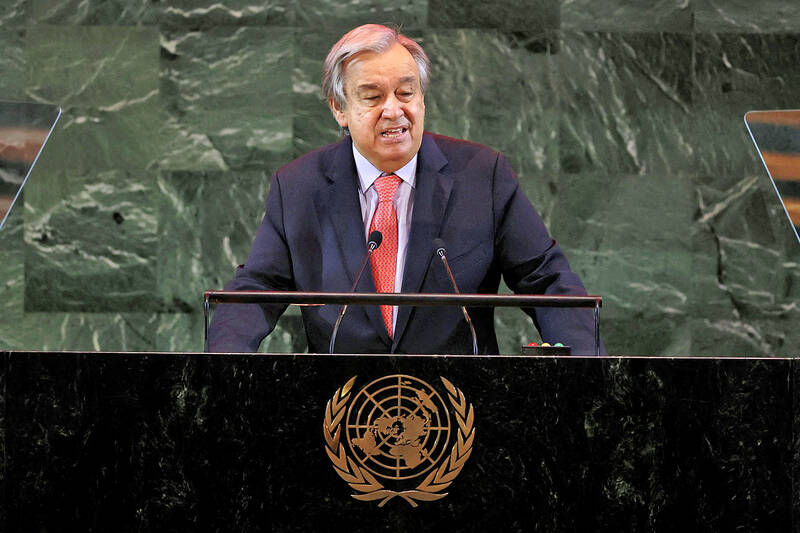
Photo: Reuters
The first day was to feature French President Emmanuel Macron and German Chancellor Olaf Scholz, the leaders of the two largest economies of the EU, which has mobilized to impose tough sanctions over Russia’s invasion of Ukraine.
“This year, Ukraine will be very high on the agenda. It will be unavoidable,” EU High Representative for Foreign Affairs and Security Policy Josep Borrell told reporters in New York.
“There are many other problems, we know, but the war in Ukraine has been sending shock waves around the world,” he said.
German Minister of Foreign Affairs Annalena Baerbock yesterday vowed to support countries hardest hit by the fallout from the war as she headed to the General Assembly.
“The brutality of Russia’s war of aggression and its threat to the peace order in Europe have not blinded us to the fact that its dramatic effects are also clearly being felt in many other regions of the world,” Baerbock said.
Meanwhile, UN Secretary-General Antonio Guterres has been urging leaders not to forget other priorities, such as education, the topic of a special summit on Monday.
“Education is in a deep crisis. Instead of being the great enabler, education is fast becoming the great divide,” Guterres told the summit.
He warned that the COVID-19 pandemic has had a devastating impact on learning, with poor students lacking technology at a particular disadvantage, and conflicts further disrupting schools.
Other leaders scheduled to speak yesterday included Turkish President Recep Tayyip Erdogan, who has staked out ground as a broker between Russia and Ukraine, including through a deal to ship out badly needed grain to the world.
In the type of last-minute diplomacy common at previous UN sessions, US Secretary of State Antony Blinken convened a first meeting of the foreign ministers of Azerbaijan and Armenia since a flare-up in fighting.
“Strong, sustainable diplomatic engagement is the best path for everyone,” Blinken told them.
Russian Minister of Foreign Affairs Sergei Lavrov was visiting, despite a hostile reaction from the US.
He met on Monday with his French counterpart, Catherine Colonna, who urged Russia to allow a security zone outside the Zaporizhzhia nuclear plant, whose occupation by Moscow has raised mounting concerns.
Also high on the agenda for the UN week would be Tehran, with Iranian President Ebrahim Raisi joining the General Assembly for the first time and expected to meet yesterday with French President Emmanuel Macron.

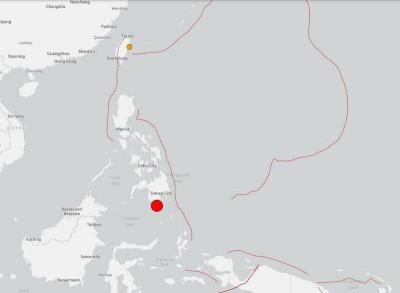
A magnitude 7.8 earthquake struck off the southern coast of Mindanao in the Philippines at 7:38am today, prompting the US Tsunami Warning System to issue an alert for neighboring countries, including Taiwan. The system issued a purple alert indicating a "tsunami threat." The potential threat zone includes Taiwan, the Philippines, Papua New Guinea, Yap and Palau. Philippine authorities were assessing the damage from the quake, with the office of civil defense seeking to verifying initial reports that 15 people had been killed and 129 injured in the region, mostly from falling debris. Arlene Hollero, disaster chief of Maasim town in the Philippines' Sarangani Province,

RESILIENCE: Taiwan plays a key role in semiconductors, energy, information infrastructure and advanced manufacturing, AIT Director Raymond Greene said Taiwan’s continued investment in deterrence and resilience remains vital, especially in uncrewed systems and other emerging technologies, American Institute in Taiwan (AIT) Director Raymond Greene said yesterday. Greene made the remarks at the annual National Strategic Summit on Supply Chain Resilience held by the Research Institute for Democracy, Society and Emerging Technology (DSET), a government-backed think tank. As Taiwan last year became the US’ fourth-largest trading partner and supply chain security is becoming more important, cooperation in emerging technologies continues to deepen between the two countries, he said. The US is committed to accelerating innovation, building key infrastructure, strengthening cooperation

The National Chungshan Institute of Science and Technology yesterday showcased its locally developed variants of the Vision 60 robotic patrol dog, which it plans to deploy on the nation’s outlying territories in the South China Sea. The variants were produced under the Joint Lab project — created by the institute and domestic companies — and assembled with domestically produced motors, lenses and artificial intelligence (AI) systems alongside licensed tech from the US, Missile and Rocket Systems Research Division deputy director Jen Kuo-kang (任國光) told the media event at a military base in Taipei’s Dazhi (大直) area. Taiwan has built up its strengths
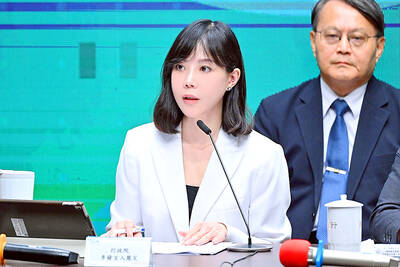
RIGHT DIRECTION: Taiwan’s efforts to prevent forced labor include a proposal to ‘fully prohibit’ employers from withholding workers’ documents, an official said Taiwan is to establish a mechanism to restrict imports of goods linked to forced labor, the Executive Yuan said yesterday, after the US proposed imposing additional tariffs on Taiwanese goods over labor concerns. “The Ministry of Labor and the Ministry of Economic Affairs are to establish an interministerial review procedure,” Executive Yuan spokesperson Michelle Lee (李慧芝) said at a news briefing in Taipei. “The government is to use the Foreign Trade Act [貿易法] as the legal basis to restrict imports of goods produced with forced labor” and bring its supply chain governance more in line with international standards on human rights, resilience


 RSS
RSS