


A Hong Kong court yesterday sentenced two young men to jail terms over a violent clash during the territory’s political unrest in 2019 that killed an elderly man.
Luo Chang-qing (羅長清), a 70-year-old cleaner, died from a blow to the head during a confrontation near the mainland China border where democracy protesters and government loyalists hurled bricks at each other.
Luo was one of the only fatalities directly linked to Hong Kong’s political turmoil in 2019, and his case remains a source of outrage for Hong Kong government supporters.
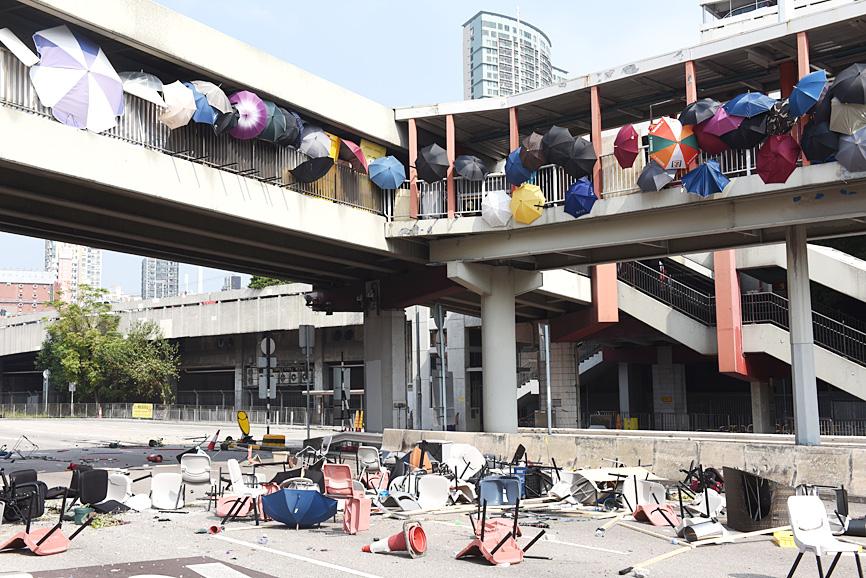
Photo:EPA-EFE
Kelvin Lau (劉子龍), 19, and Chan Yin-ting (陳彥廷), 18, were each sentenced to five-and-a-half years in jail for rioting.
The duo faced additional manslaughter and wounding charges, but a jury last month cleared them of responsibility in Luo’s death.
The judge yesterday said that the defendants — who were underage at the time of the clashes — were among a group that instigated the violence that escalated into a “very serious riot.”
“Things devolved into mayhem which led to very tragic consequences,” the judge said.
The skirmish, which took place in the Sheung Shui neighborhood in November 2019, was one among dozens that broke out between ideological opponents at the height of Hong Kong’s massive pro-democracy protests.
The defendants made plans to protest together on the day, which showed some level of premeditation, the judge said.
Earlier media accounts of the clashes placed blame on both sides, but the judge praised the government loyalists as “unsung heroes” who acted selflessly and courageously when they stood up to the protesters.
Separately, Hong Kong censors have banned an award-winning animated film from being shown over a one-second scene depicting the 2014 democracy protests in the territory, local media reported, in the latest sign of free speech curbs in Hong Kong.
Losing Sight of a Longed Place, an eight-minute film about a young gay man’s struggles in Hong Kong, was scheduled to screen tomorrow at a local film show organized by the Ground Up Film Society.
The filmmakers on Wednesday said that the movie was pulled from the line-up after they refused to submit an edited version, without specifying which scene censors asked them to remove.
The film in its entirety was rejected by the Hong Kong Office for Film, Newspaper and Article Administration, they said on Facebook.
The South China Morning Post and other local media reported that the filmmakers were asked to remove a scene showing 2014’s “illegal occupation,” citing a phrase the government uses to describe the “Umbrella movement,” when thousands of peaceful protesters occupied part of the territory’s central business district to demand broader voting rights.
Last year, authorities passed a film censorship law banning content that runs contrary to the interests of the Beijing-imposed National Security Law, with penalties as high as three years in prison for those who screen non-approved content.
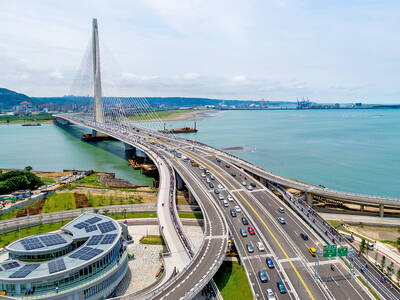
The Ministry of Transportation and Communications yesterday inaugurated the Danjiang Bridge across the Tamsui River in New Taipei City, saying that the structure would be an architectural icon and traffic artery for Taiwan. Feted as a major engineering achievement, the Danjiang Bridge is 920m long, 211m tall at the top of its pylon, and is the longest single-pylon asymmetric cable-stayed bridge in the world, the government’s Web site for the structure said. It was designed by late Iraqi-British architect Zaha Hadid. The structure, with a maximum deck of 70m, accommodates road and light rail traffic, and affords a 200m navigation channel for boats,
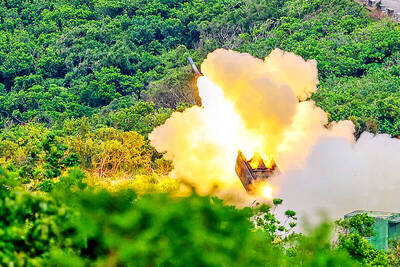
PRECISION STRIKES: The most significant reason to deploy HIMARS to outlying islands is to establish a ‘dead zone’ that the PLA would not dare enter, a source said A High Mobility Artillery Rocket System (HIMARS) would be deployed to Penghu County and Dongyin Island (東引) in Lienchiang County (Matsu) to force the Chinese military to retreat at least 100km from the coastline, a military source said yesterday. Taiwan has been procuring HIMARS and Army Tactical Missile Systems (ATACMS) from the US in batches. Once all batches have been delivered, Taiwan would possess 111 HIMARS units and 504 ATACMS, which have a range of 300km. Considering that “offense is the best defense,” the military plans to forward-deploy the systems to outlying islands such as Penghu and Dongyin so that

WHAT WAS ALL THAT FOR? Jaw Shaw-kong said that Cheng Li-wen had pushed for more drastic cuts and attacked him, just for the outcome to be nearly identical to his bill The legislature yesterday passed a supplementary budget bill to fund the purchase of separate packages of US military equipment, with the combined amount of spending capped at NT$780 billion (US$24.8 billion). The Chinese Nationalist Party (KMT) and Taiwan People’s Party (TPP) used their legislative majority to pass the bill, which runs until 2033 and has two main funding provisions. One was for NT$300 billion of arms sales already approved by the US for Taiwan on Dec. 17 last year, the other was for NT$480 billion for another arms package expected to be announced by Washington. The bill, which fell short of the NT$1.25

‘CLEAR MESSAGE’: The bill would set up an interagency ‘tiger team’ to review sanctions tools and other economic options to help deter any Chinese aggression toward Taiwan US Representative Young Kim has introduced a bill to deter Chinese aggression against Taiwan, calling for an interagency “tiger team” to preplan coordinated sanctions and economic measures in response to possible Chinese military or political action against Taiwan. “[Chinese President] Xi Jinping [習近平] has directed the People’s Liberation Army to be ready to invade Taiwan by 2027. China has a plan. America should have one too,” Kim said in a news release on Thursday last week. She introduced the “Deter PRC [People’s Republic of China] aggression against Taiwan act” to “ensure the US has a coordinated sanctions strategy ready should


 RSS
RSS