


Boosted by a new election mandate, Japanese Prime Minister Fumio Kishida yesterday called for party unity for political stability, and to achieve assassinated former prime minister Shinzo Abe’s unfinished goals of strengthening the military and revising the war-renouncing constitution.
Kishida’s governing Liberal Democratic Party (LDP) and its junior coalition partner Komeito secured a solid majority of seats in the parliament’s upper house in elections on Sunday that were imbued with meaning after Abe was shot to death while campaigning on Friday.
Kishida welcomed the victory, but also acknowledged that unifying the party would be a hard task without Abe, who even after resigning as prime minister in 2020 had led a powerful party faction.
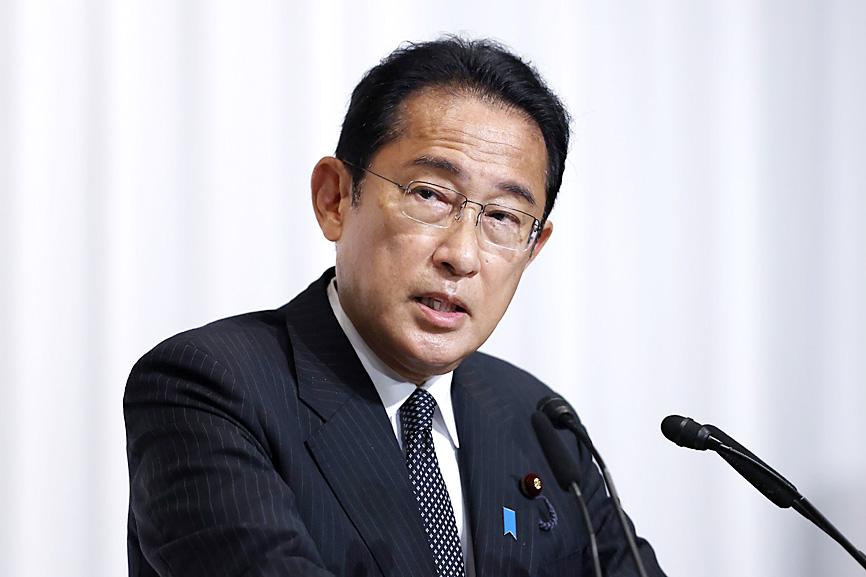
Photo: Bloomberg
“Because we’ve lost a great leader, undeniably we could be affected in many ways,” Kishida said. “Our party must unite as we face difficult issues.”
Amid security and economic challenges in and outside Japan, Abe’s death is most regrettable, Kishida said.
“We will inherit his will and tackle the issues he had to leave unachieved,” including an amendment to the US-drafted postwar pacifist constitution.
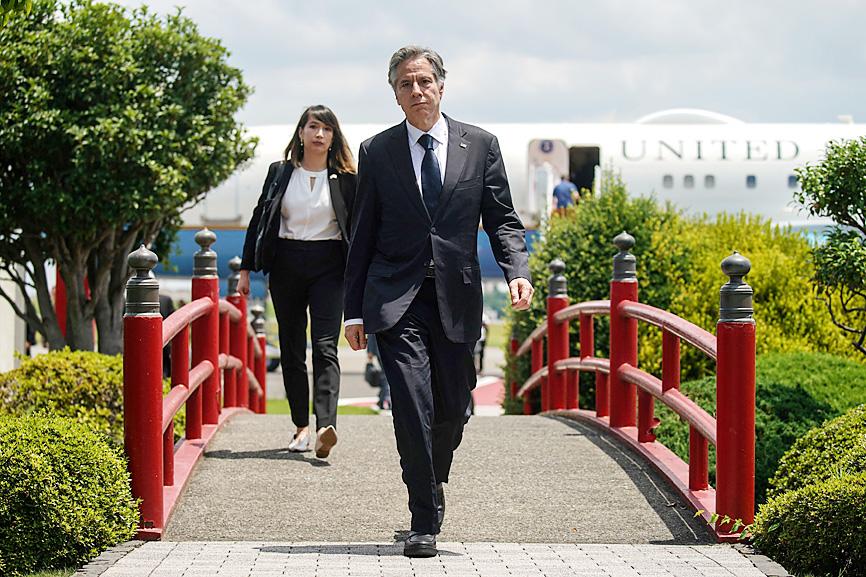
Photo: Reuters
Sunday’s vote gave the LDP-led coalition 146 seats in the 248-seat upper chamber, the less powerful of the Japanese Diet’s two houses. The result means Kishida could rule uninterrupted until a scheduled election in 2025 and allows him to work on long-term policies.
Advancement on amending the constitution is now a realistic possibility. With the help of two opposition parties supportive of a charter change, the governing bloc now has two-thirds majority in the upper chamber needed to propose an amendment.
The governing bloc already had the needed support in the lower house.
Earlier yesterday, US Secretary of State Antony Blinken met with Kishida to offer condolences and deliver a letter from US President Joe Biden to Abe’s family.
“We simply want them to know that we deeply feel the loss on the personal level as well,” Blinken told Kishida. “Mostly I’m here because the United States and Japan are more than allies — we are friends.”
Blinken said Abe “did more than anyone to elevate the relationship between the United States and Japan to new heights.”
Blinken was the highest-ranking US official to visit Japan in the aftermath of Abe’s death.
US Secretary of the Treasury Janet Yellen was also among hundreds attending Abe’s wake.
“There is a profound sense of sorrow at his loss,” Yellen told reporters outside the temple, where she placed incense in Abe’s honor and greeted his family.
“Prime minister Abe was a visionary leader and he strengthened Japan. And I know that his legacy will live on and result in a more prosperous Japan,” she added.
Abe, 67, stepped down as prime minister two years ago, citing health reasons. He said he regretted leaving many of his goals unfinished, including revising a constitution that some conservatives consider a humiliation.
He was the grandson of another prime minister and became Japan’s youngest prime minister in 2006, at age 52. The overly nationalistic stint in office abruptly ended a year later, also because of his health, prompting six years of annual leadership change.
He returned to the prime ministry in 2012, vowing to revitalize the nation and get its economy out of its deflationary doldrums with his “Abenomics” formula, which combines fiscal stimulus, monetary easing and structural reforms.
He won six national elections and built a rock-solid grip on power.
On Sunday, the suspect accused of his murder was transferred to a local prosecutors’ office for further investigation, and a top regional police official acknowledged possible security lapses allowed the gunman to get close to Abe.
Additional reporting by Reuters

CREDIT-GRABBER: China said its coast guard rescued the crew of a fishing vessel that caught fire, who were actually rescued by a nearby Taiwanese boat and the CGA Maritime search and rescue operations do not have borders, and China should not use a shipwreck to infringe upon Taiwanese sovereignty, the Coast Guard Administration (CGA) said yesterday. The coast guard made the statement in response to the China Coast Guard (CCG) saying it saved a Taiwanese fishing boat. The Chuan Yu No. 6 (全漁6號), a fishing vessel registered in Keelung, on Thursday caught fire and sank in waters northeast of Diaoyutai Islands (釣魚台). The vessel left Keelung’s Badouzih Fishing Harbor (八斗子漁港) at 3:35pm on Sunday last week, with seven people on board — a 62-year-old Taiwanese captain surnamed Chang (張) and six
RISKY BUSINESS: The ‘incentives’ include initiatives that get suspended for no reason, creating uncertainty and resulting in considerable losses for Taiwanese, the MAC said China’s “incentives” failed to sway sentiment in Taiwan, as willingness to work in China hit a record low of 1.6 percent, a Ministry of Labor survey showed. The Directorate-General of Budget, Accounting and Statistics (DGBAS) also reported that the number of Taiwanese workers in China has nearly halved from a peak of 430,000 in 2012 to an estimated 231,000 in 2024. That marked a new low in the proportion of Taiwanese going abroad to work. The ministry’s annual survey on “Labor Life and Employment Status” includes questions respondents’ willingness to seek employment overseas. Willingness to work in China has steadily declined from

LEVERAGE: China did not ‘need to fire a shot’ to deny Taiwan airspace over Africa when it owns ‘half the continent’s debt,’ a US official said, calling it economic warfare The EU has raised concerns about overflight rights following the delay of President William Lai’s (賴清德) planned state visit to the Kingdom of Eswatini after three African nations denied overflight clearance for his charter at the last minute. Taiwanese allies Paraguay and Saint Kitts and Nevis, as well as several US lawmakers and the Inter-Parliamentary Alliance on China (IPAC) condemned China for allegedly pressuring the countries. Lai was scheduled to fly directly to Taiwan’s only African ally from yesterday to Sunday to celebrate the 40th anniversary of King Mswati III’s accession and his 58th birthday, but Seychelles, Mauritius and Madagascar suddenly revoked

The number of pet cats in Taiwan surpassed that of pet dogs for the first time last year, reaching 1,742,033, a 32.8 percent increase from 2023, the Ministry of Agriculture said yesterday, citing a survey. By contrast, the number of pet dogs declined slightly by 1.2 percent over the same period to 1,462,528, the ministry said. Despite the shift, households with dogs still slightly outnumber those with cats by 1.2 percent. However, while the number of households with multiple dogs has remained relatively stable, households keeping more than two cats have increased, contributing to the overall rise in the feline population. The trend


 RSS
RSS