


A shorter home quarantine period for international travelers and an initial cap of 25,000 inbound travelers per week are being discussed, the government said yesterday, as it considers the first stages of reopening Taiwan’s borders.
Premier Su Tseng-chang (蘇貞昌) in a meeting yesterday morning instructed the Central Epidemic Command Center (CECC) and related ministries to plan for the easing of border controls, as long as the nation can maintain adequate healthcare capacity.
Minister of Health and Welfare Chen Shih-chung (陳時中), who heads the center, said that quarantine requirements would not yet be scrapped, but that the home quarantine period for international travelers might be shortened.
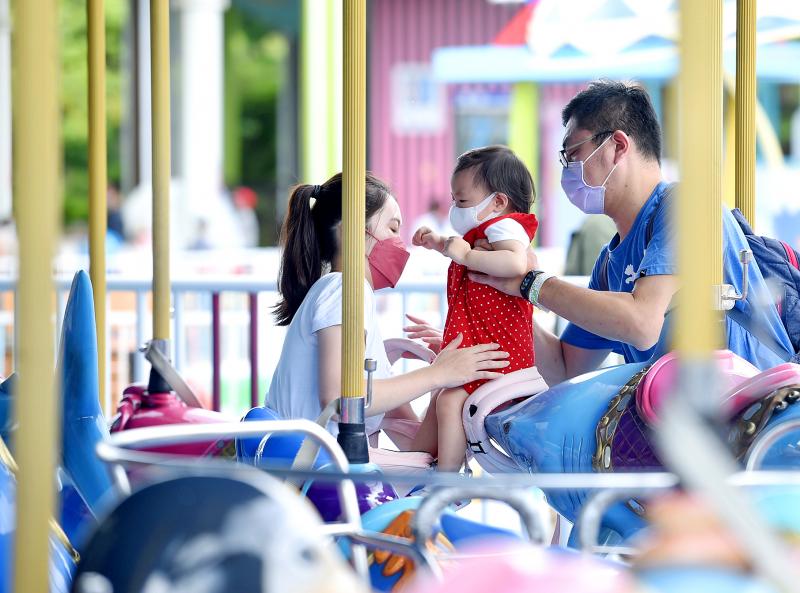
Photo: Peter Lo, Taipei Times
The polymerase chain reaction (PCR) test required of airport arrivals from certain countries might be switched from a nasal swab test to a saliva-based test, he said.
Separately, Minister of Transportation and Communications Wang Kwo-tsai (王國材) yesterday said that the government is considering capping the number of inbound travelers at 25,000 per week in the initial stages of reopening the borders.
“We are still in the plateau phase of a COVID-19 outbreak, and we now have about 17,000 travelers entering the country per week. Once the borders are reopened, the number of inbound travelers is likely to be capped at 25,000 per week during the initial stages,” he said.
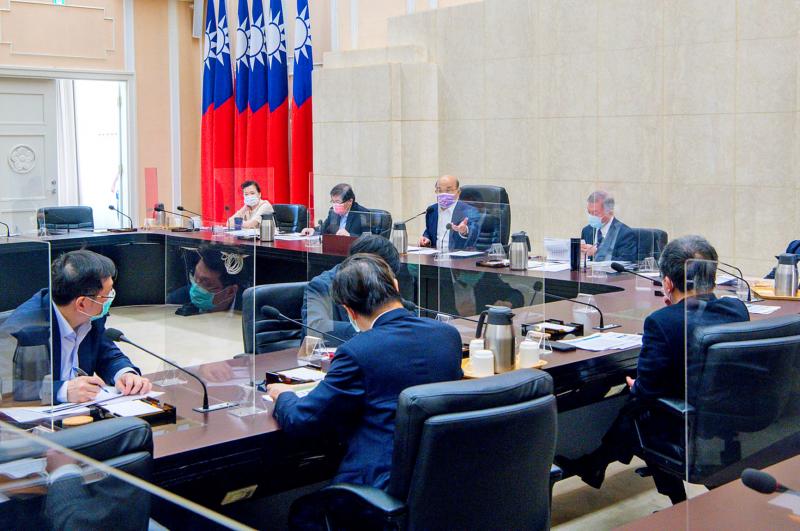
Photo: Lu Yi-hsuan, Taipei Times
The Civil Aeronautics Administration is working with airlines to increase flights, he added.
Meanwhile, the CECC yesterday announced that mask regulations and other disease prevention measures would remain in effect until June 30.
People must wear a mask at all times when not at home, even when singing, but they can temporarily remove their mask when eating or drinking, as well as in certain circumstances, including when exercising, having their picture taken, and driving alone in a private vehicle or in a vehicle with family members living in the same household.
Other exceptions include taking part in a live broadcast, being filmed, hosting a broadcast or reporting on a broadcast; giving a speech, a lecture or some other type of public oration; doing outdoor activities related to agriculture, forestry, animal husbandry or aquaculture; and visiting forest recreation areas, beaches or water venues, such as cold or hot springs, spas, saunas or steam rooms.
However, if someone has COVID-19-related symptoms or cannot practice social distancing in an environment with strangers, they are advised to wear a mask, the CECC said.
Taiwan yesterday reported 60,042 new local infections, 61 imported cases and 109 deaths.
Centers for Disease Control (CDC) Director-General Chou Jih-haw (周志浩), head of the CECC’s disease surveillance division, said the numbers were slightly lower, but that it might have been due to lower reporting over the weekend.
CDC Deputy Director-General Philip Lo (羅一鈞), deputy head of the CECC’s medical response division, said that of the new local infections, 468 were cases with moderate or severe symptoms.
As of Sunday, 3,706 people had moderate symptoms, or 0.2 percent of total cases this year, while 1,579 people had severe symptoms, or 0.08 percent, CECC data showed.
Of yesterday’s deaths, 106 people had underlying health conditions, 42 people were unvaccinated and 71 had not received a booster shot, although 38 of them had received a booster, Lo said.
Taiwan’s booster vaccination rate is nearly 70 percent of the total population, while unvaccinated people only account for about 10 percent of the population, he said.
Three of those with severe symptoms are young children: a one-year-old girl with a urologic disease has suspected encephalitis, while a four-year-old boy and a five-year-old boy who did not have a chronic disease had encephalitis, he said.
The boys’ condition improved after treatment and they were discharged, Lo added.
Additional reporting by Shelley Shan
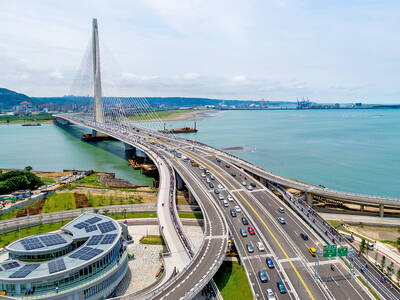
The Ministry of Transportation and Communications yesterday inaugurated the Danjiang Bridge across the Tamsui River in New Taipei City, saying that the structure would be an architectural icon and traffic artery for Taiwan. Feted as a major engineering achievement, the Danjiang Bridge is 920m long, 211m tall at the top of its pylon, and is the longest single-pylon asymmetric cable-stayed bridge in the world, the government’s Web site for the structure said. It was designed by late Iraqi-British architect Zaha Hadid. The structure, with a maximum deck of 70m, accommodates road and light rail traffic, and affords a 200m navigation channel for boats,
Taiwan Semiconductor Manufacturing Co (TSMC, 台積電), the world’s largest foundry service provider, yesterday said that global semiconductor revenue is projected to hit US$1.5 trillion in 2030, after the figure exceeds US$1 trillion this year, as artificial intelligence (AI) demand boosts consumption of token and compute power. “We are still at the beginning of the AI revolution, but we already see a significant impact across the whole semiconductor ecosystem,” TSMC deputy cochief operating officer Kevin Zhang (張曉強) said at the company’s annual technology symposium in Hsinchu City. “It is fair to say that in the past decade, smartphones and other mobile devices were
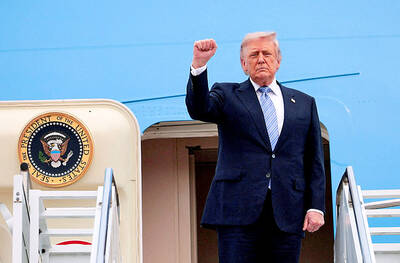
US-CHINA SUMMIT: MOFA welcomed US reassurance of no change in its Taiwan policy; Trump said he did not comment when Xi talked of opposing independence US President Donald Trump yesterday said he has not made a decision on whether to move forward with a major arms package for Taiwan after hearing concerns about it from Chinese President Xi Jinping (習近平). Trump’s comments on Taiwan came as he flew back to Washington after wrapping up critical talks in which both leaders said important progress was made in stabilizing US-China relations even as deep differences persist between the world’s two biggest powers on Iran and Taiwan. “I will make a determination,” Trump said, adding: “I’ll be making decisions. But, you know, I think the last thing we need right

TAIWAN ISSUE: US treasury secretary Scott Bessent said on the first day of meetings that ‘it wouldn’t be a US-China summit without the Taiwan issue coming up’ There were no surprises on the first day of the summit between US President Donald Trump and Chinese President Xi Jinping (習近平), the Mainland Affairs Council (MAC) said yesterday, as the government reiterated that cross-strait stability is crucial to the Asia-Pacific region, as well as the world. As the two presidents met for a highly anticipated summit yesterday, Chinese state media reported that Xi warned Trump that missteps regarding Taiwan could push their two countries into “conflict.” Trump arrived in China with accolades for his host, calling Xi a “great leader” and “friend,” and extending an invitation to visit the White House


 RSS
RSS