


US President Joe Biden was yesterday set to call for an end of normal trade relations with Russia, clearing the way for increased tariffs on Russian imports, people familiar with the matter said.
His announcement to revoke the trade privileges was to come alongside similar measures by G7 nations and EU leaders, the people said.
The president cannot unilaterally change Russia’s trade status because that authority lies with the US Congress, where Democratic and Republican lawmakers have called for the revocation.
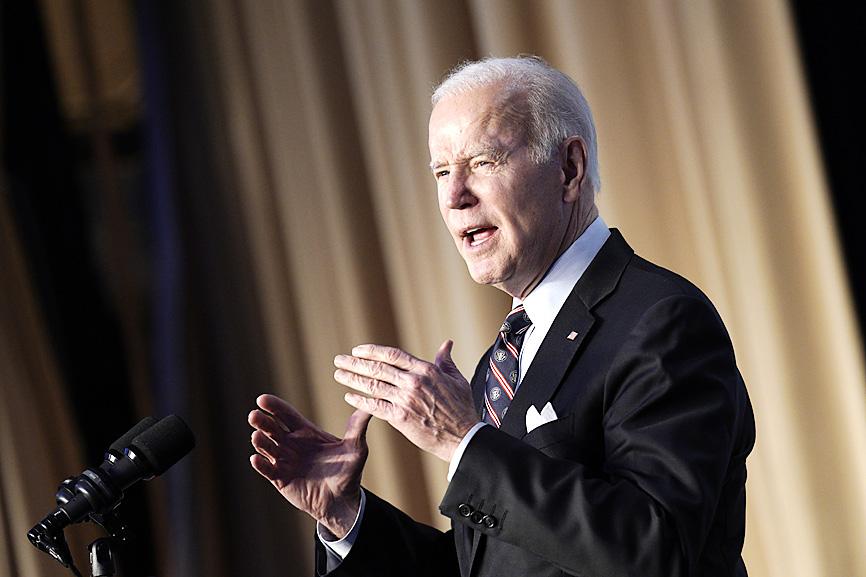
Photo: Bloomberg
Suspending normal trade relations with the US, which other countries call “most favored nation status,” would put Russia in the company of countries such as Cuba and North Korea.
It would allow the US to hit Russia with significantly higher tariffs than it applies to other WTO members, which has as a core principle of non-discrimination among members and treating all members equally.
Just like the US, the other countries calling for the repeal over Russia’s invasion of Ukraine go through their own processes, the people said.
Russia is far more dependent on the EU than the US, selling about one-third of its exports to the bloc, versus just 5 percent to the US in 2020, IMF data showed.
The EU last week said that it was seeking to remove Russia’s most-favored nation status, and Canada withdrew the designation from Russia.
Leaders in the US House of Representatives and Senate have pushed for the repeal of preferential trade relations, but earlier this week, the provision was removed from a bill banning Russian energy imports.
Lawmakers criticized the White House for asking that the provision be struck as talks with allies were ongoing.
On Thursday night, US Senator Rob Portman said that he has a bill with US Senator Ben Cardin to revoke Russia’s trade status, adding that it is important that Biden also has allies following suit.
“It’s much more effective if they all do it,” Portman said in an interview at the Capitol. “For us it’s not a big deal, but for Europe it’s huge, and it’s the right thing to do. Access to our market is a privilege, not a right.”
The UK yesterday slapped a fresh wave of sanctions on Moscow, targeting 386 members of Russia’s parliament who supported Russian President Vladimir Putin’s invasion of Ukraine.
The new sanctions against members of the Duma ban them from traveling to the UK, as well as accessing any assets they hold in Britain.
The lawmakers were sanctioned after they voted last month to recognize the breakaway republics of Lugansk and Donetsk in eastern Ukraine, providing a pretext for the war, the British Foreign, Commonwealth and Development Office said.
“We’re targeting those complicit in Putin’s illegal invasion of Ukraine and those who support this barbaric war,” British Secretary of State for Foreign, Commonwealth and Development Affairs Liz Truss said.
“We will not let up the pressure and will continue to tighten the screw on the Russian economy through sanctions,” she said.
Additional reporting by Reuters
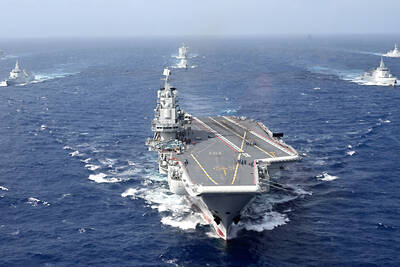
PROVOCATIVE: Chinese Deputy Ambassador to the UN Sun Lei accused Japan of sending military vessels to deliberately provoke tensions in the Taiwan Strait China denounced remarks by Japan and the EU about the South China Sea at a UN Security Council meeting on Monday, and accused Tokyo of provocative behavior in the Taiwan Strait and planning military expansion. Ayano Kunimitsu, a Japanese vice foreign minister, told the Council meeting on maritime security that Tokyo was seriously concerned about the situation in the East China and South China seas, and reiterated Japan’s opposition to any attempt to change the “status quo” by force, and obstruction of freedom of navigation and overflight. Stavros Lambrinidis, head of the EU delegation to the UN, also highlighted South China Sea
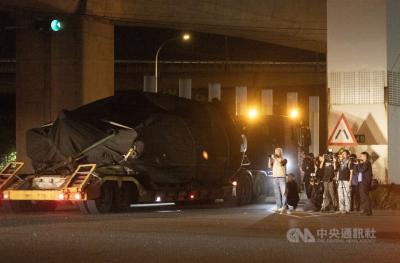
The final batch of 28 M1A2T Abrams tanks purchased from the US arrived at Taipei Port last night and were transported to the Armor Training Command in Hsinchu County’s Hukou Township (湖口), completing the military’s multi-year procurement of 108 of the tanks. Starting at 12:10am today, reporters observed more than a dozen civilian flatbed trailers departing from Taipei Port, each carrying an M1A2T tank covered with black waterproof tarps. Escorted by military vehicles, the convoy traveled via the West Coast Expressway to the Armor Training Command, with police implementing traffic control. The army operates about 1,000 tanks, including CM-11 Brave Tiger
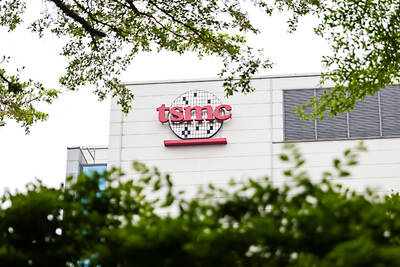
Taiwan Semiconductor Manufacturing Co (TSMC, 台積電), the world’s largest contract chipmaker, said it expects its 2-nanometer (2nm) chip capacity to grow at a compound annual rate of 70 percent from this year to 2028. The projection comes as five fabs begin volume production of 2-nanometer chips this year — two in Hsinchu and three in Kaohsiung — TSMC senior vice president and deputy cochief operating officer Cliff Hou (侯永清) said at the company’s annual technology symposium in Silicon Valley, California, last week. Output in the first year of 2-nanometer production, which began in the fourth quarter of last year, is expected to
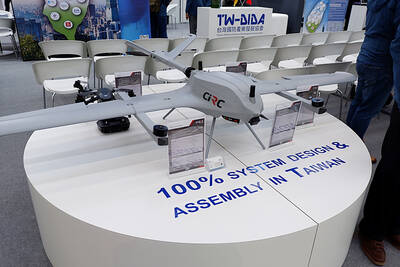
Taiwan’s drone exports surged past US$100 million in the first quarter, exceeding last year’s full-year total, with the Czech Republic emerging as the largest buyer, the Ministry of Economic Affairs said. Exports of complete drones reached US$115.85 million in the period, about 1.2 times the total recorded for all of last year, the ministry said in a report. Exports to the Czech Republic accounted for about US$100 million, far outpacing other markets. Poland, last year’s top destination, recorded about US$11.75 million in the first quarter. Taiwan’s drone exports have expanded rapidly in the past few years, with last year’s total


 RSS
RSS