

The US Senate on Tuesday passed a sweeping industrial policy bill aimed at countering the surging economic threat from China, overcoming partisan divisions to support pumping more than US$170 billion into research and development.
The measure cleared the chamber on a 68-32 vote, one of the most significant bipartisan achievements in the US Congress since US President Joe Biden took office in January.
It also represents the largest investment in scientific research and technological innovation “in generations,” Senate Majority Leader Chuck Schumer said.

Photo: Reuters
The bill now heads to the US House of Representatives, which earlier passed a different version.
The two will have to be reconciled into a single bill before it is sent to the White House for the president’s signature.
Biden said he was “encouraged” by the Senate’s passage of the US Innovation and Competition Act.
“We are in a competition to win the 21st century, and the starting gun has gone off,” Biden said. “As other countries continue to invest in their own research and development, we cannot risk falling behind. America must maintain its position as the most innovative and productive nation on Earth.”
The package, a key provision of which addresses a shortage of semiconductors that has slowed production at US automakers this year, would help US industry bolster its capacity and improve technology.
It is seen as crucial for US efforts to avoid being outmaneuvered by Beijing as the adversaries compete in the race to technological innovation.
“Today, the Senate took a critical bipartisan step forward to make the investments we need to continue America’s legacy as a global leader in innovation,” US Secretary of Commerce Gina Raimondo said in a statement. “This funding isn’t just about addressing the current semiconductor chip shortage, it is about long-term investments.”
Schumer called the measure “one of the most important things this chamber has done in a very long time, a statement of faith in America’s ability to seize the opportunities of the 21st century.”
The proposal aims to address a number of technological areas in which the US has fallen behind China.
The bill allocates US$52 billion for a previously approved plan to increase domestic manufacturing of semiconductors.
It also authorizes US$120 billion over five years for activities at the US National Science Foundation to advance priorities, including research and development in key areas such as artificial intelligence and quantum science.
It facilitates tie-ups between private firms and research universities.
“This is an opportunity for the United States to strike a blow on behalf of answering the unfair competition that we are seeing from communist China,” said US Senator Roger Wicker, one of the bill’s main cosponsors.
“For everything from national security to economic policy, there’s a clear and urgent need to reorient the way our country views and responds to the challenge from China,” US Senator John Cornyn said.
In Beijing, officials yesterday accused Washington of “paranoid delusion” after the bill advanced.
The foreign affairs committee of China’s National People’s Congress said that the bill was “full of Cold War mentality and ideological prejudice.”
“The bill shows that the paranoid delusion of egoism has distorted the original intention of innovation and competition,” Xinhua news agency reported it as saying.
It is an attempt to interfere in China’s internal affairs, and deprive it of its “legitimate right to development through technology and economic decoupling,” it reported.

The Presidential Office today condemned China's transnational repression after an alleged Chinese foreign agent was arrested in California yesterday on suspicion of surveilling President William Lai's (賴清德) son, Lai Ting-yu (賴廷與), the FBI said. The 34-year-old woman, named Wanying Heather Zhang (張婉瑩), was arrested on suspicion of acting as an unregistered foreign agent, US news agency CBS reported. She was apprehended at Los Angeles International Airport yesterday attempting to fly to Shanghai, it said. This represents a “typical case” of China’s transnational repression, Presidential Office spokeswoman Karen Kuo (郭雅慧) said today. "Our country expresses the strongest condemnation of such barbaric conduct that
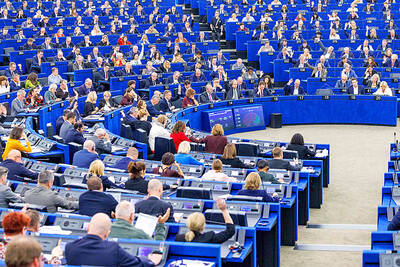
The European Parliament on Wednesday adopted a recommendation on EU-China political relations that rejected China’s efforts to restrict Taiwan’s participation in international organizations and exchanges. The recommendation, addressed to the European Council, the European Commission and EU High Representative for Foreign Affairs and Security Policy Kaja Kallas, includes several references to EU-Taiwan relations and expresses support for closer ties, saying they would bring positive benefits and have strategic importance. Describing Taiwan as a valuable partner in trade and technology, the European Parliament said it “rejects China’s attempts to coerce international organizations, third countries and other actors into restricting Taiwan’s international participation and
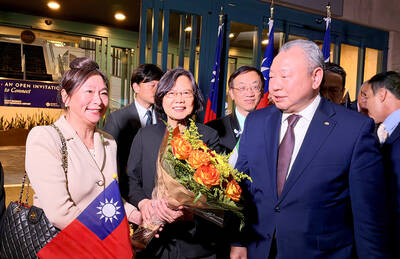
Former president Tsai Ing-wen (蔡英文) on Monday arrived in San Francisco, receiving a warm welcome from hundreds of overseas Taiwanese as she launched a week-long visit. Accompanied by Representative to the US Alexander Yui (俞大?), and head of Taiwan’s San Francisco office Wu Chih-hsiang (伍志翔), Tsai arrived at her hotel, waving, smiling and giving high-fives to Taiwanese compatriots amid cheers of “Taiwan’s democracy involves you and me” to welcome her to the San Francisco Bay Area. It is Tsai’s first visit to the US since she left office in May 2024 after serving two four-year terms as president. Tsai is today to deliver
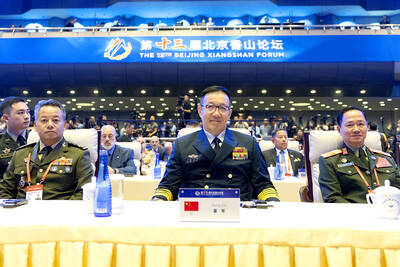
Light attack aircraft and military vehicles have arrived at a new China-Laos joint training facility announced on Tuesday last week, according to satellite images reviewed by Reuters. The images, taken by commercial satellite provider Vantor, show what security analysts believe are eight K-8 light attack jets and more than two dozen support vehicles on a runway that is still being built — China’s latest expansion of its overseas military presence. Taken on Wednesday last week — the day after the Chinese Ministry of National Defense announced it had set up the facility at Ban Keun outside the capital, Vientiane — the images


 RSS
RSS