


The Legislative Yuan yesterday passed a resolution proposed by the Democratic Progressive Party (DPP) to decommission Taichung Power Plant’s coal-fired generators by 2035, and to preserve the generators as a national security emergency reserve.
Taiwan Power Co (Taipower, 台電) had said that it would decommission the plant’s 10 coal-fired subcritical steam generators by 2046.
The resolution, which was introduced by Deputy Legislative Speaker Tsai Chi-chang (蔡其昌) of the DPP, cleared the legislative floor with a vote of 68 to zero.
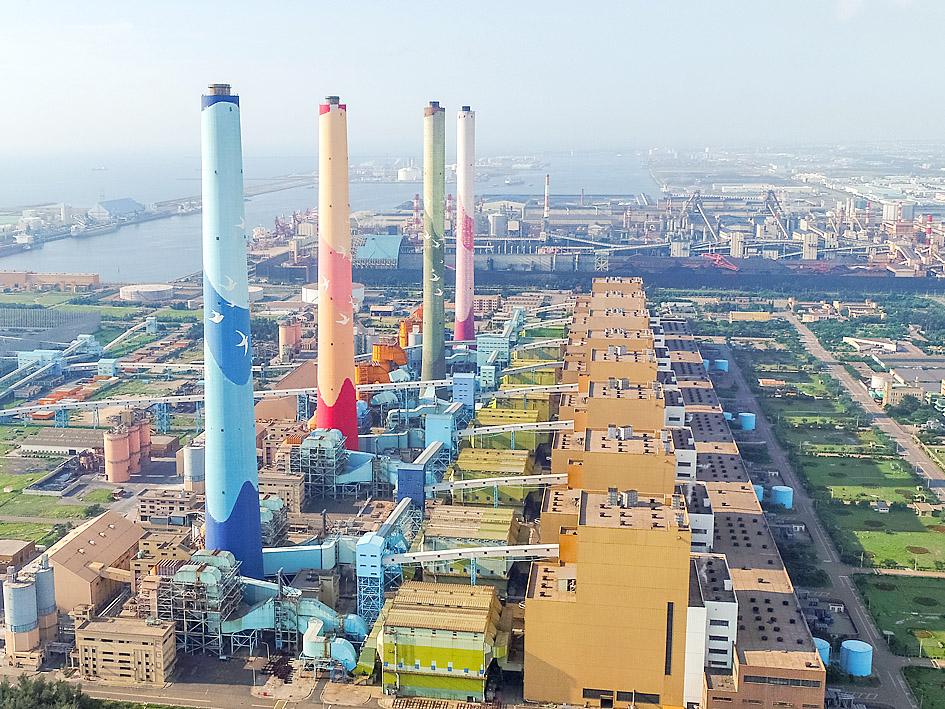
Photo courtesy of the Taichung City Government
The DPP’s version asks the government to keep construction of the plant’s natural gas-fired No. 1 and No. 2 units on schedule, and to accelerate construction of the No. 3 and No. 4 units.
The natural gas units would take over from their coal-fired counterparts one at a time after two years of continuous, normal operation.
The coal-fired boilers would be decommissioned and put in reserve, not scrapped.

Photo: Chen Yu-fu, Taipei Times
The DPP version prevailed over proposals by the Chinese Nationalist Party (KMT) and the New Power Party (NPP), which were voted down largely along party lines.
The KMT proposal asked the government to decommission two coal-fired units at a time, with the first wave of decommissioning beginning before construction of the gas-fired units would have been approved.
The KMT caucus, which abstained from voting on the DPP plan, chanted “too slow” as their DPP colleagues cast their ballots.
KMT Chairman Johnny Chiang (江啟臣), who cosponsored the draft, credited his party for pushing the DPP into retiring coal-fired generators earlier than the government had planned.
“Still, the resolution to decommission instead of scrapping raises doubts that [the DPP] might be putting on a performance” for Taichung voters, Chiang said.
Clean Air Taichung spokeswoman Shih Yu-ching (石毓菁) urged Taichung Mayor Lu Shiow-yen (盧秀燕) to not delay the DPP plan, which promises to deliver gas turbines on an accelerated timetable.
However, the DPP plan is “indeed too slow” over decommissioning the coal-fired units, which Taipower is to terminate before 2030, Shih said.
The legislature also passed a resolution ordering the Ministry of the Interior to evaluate whether the national emblem bears an inappropriate resemblance to the KMT’s emblem.
The ministry is to present a report to the legislature in two months from today.
The emblem resolution, which was proposed by the NPP, cleared the legislative floor 63 to 37.
The DPP and NPP lawmakers voted in favor, the KMT legislators voted against and the Taiwan People’s Party’s five lawmakers abstained.
The resolution states that the government must provide a clear rationale to justify the similarity of the national emblem and the KMT emblem, which “causes confusion and is inappropriate” for a democratic country.
“The KMT emblem represents only the will of a part of the people,” NPP Legislator Chiu Hsien-chih (邱顯智) said.
“The similarity of the national emblem to the party emblem suggests a lack of separation between state and party. This should not be allowed in Taiwan today,” Chiu said.
KMT Culture and Communications Committee deputy chairman Cheng Chao-hsin (鄭照新) said that people had never been confused about the state and party emblems.
“The public do not care about this issue in the middle of the COVID-19 pandemic,” Cheng said.
Additional reporting by Tsai Shu-yuan and CNA

CREDIT-GRABBER: China said its coast guard rescued the crew of a fishing vessel that caught fire, who were actually rescued by a nearby Taiwanese boat and the CGA Maritime search and rescue operations do not have borders, and China should not use a shipwreck to infringe upon Taiwanese sovereignty, the Coast Guard Administration (CGA) said yesterday. The coast guard made the statement in response to the China Coast Guard (CCG) saying it saved a Taiwanese fishing boat. The Chuan Yu No. 6 (全漁6號), a fishing vessel registered in Keelung, on Thursday caught fire and sank in waters northeast of Diaoyutai Islands (釣魚台). The vessel left Keelung’s Badouzih Fishing Harbor (八斗子漁港) at 3:35pm on Sunday last week, with seven people on board — a 62-year-old Taiwanese captain surnamed Chang (張) and six

RISKY BUSINESS: The ‘incentives’ include initiatives that get suspended for no reason, creating uncertainty and resulting in considerable losses for Taiwanese, the MAC said China’s “incentives” failed to sway sentiment in Taiwan, as willingness to work in China hit a record low of 1.6 percent, a Ministry of Labor survey showed. The Directorate-General of Budget, Accounting and Statistics (DGBAS) also reported that the number of Taiwanese workers in China has nearly halved from a peak of 430,000 in 2012 to an estimated 231,000 in 2024. That marked a new low in the proportion of Taiwanese going abroad to work. The ministry’s annual survey on “Labor Life and Employment Status” includes questions respondents’ willingness to seek employment overseas. Willingness to work in China has steadily declined from

LEVERAGE: China did not ‘need to fire a shot’ to deny Taiwan airspace over Africa when it owns ‘half the continent’s debt,’ a US official said, calling it economic warfare The EU has raised concerns about overflight rights following the delay of President William Lai’s (賴清德) planned state visit to the Kingdom of Eswatini after three African nations denied overflight clearance for his charter at the last minute. Taiwanese allies Paraguay and Saint Kitts and Nevis, as well as several US lawmakers and the Inter-Parliamentary Alliance on China (IPAC) condemned China for allegedly pressuring the countries. Lai was scheduled to fly directly to Taiwan’s only African ally from yesterday to Sunday to celebrate the 40th anniversary of King Mswati III’s accession and his 58th birthday, but Seychelles, Mauritius and Madagascar suddenly revoked
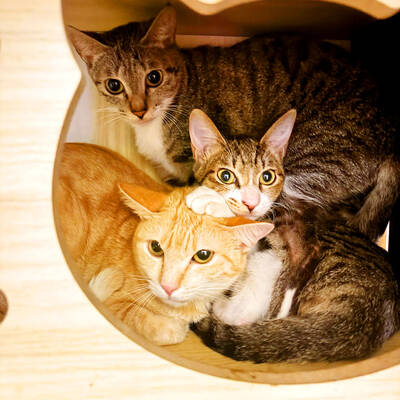
The number of pet cats in Taiwan surpassed that of pet dogs for the first time last year, reaching 1,742,033, a 32.8 percent increase from 2023, the Ministry of Agriculture said yesterday, citing a survey. By contrast, the number of pet dogs declined slightly by 1.2 percent over the same period to 1,462,528, the ministry said. Despite the shift, households with dogs still slightly outnumber those with cats by 1.2 percent. However, while the number of households with multiple dogs has remained relatively stable, households keeping more than two cats have increased, contributing to the overall rise in the feline population. The trend


 RSS
RSS