


The Ministry of Transportation and Communications yesterday said that it was considering a ban on drinking and eating on the Taiwan Railways Administration (TRA) and Taiwan High-speed Rail networks during the Lunar New Year holiday.
The ministry said it had recommended that the Central Epidemic Command Center implement the measures during the holiday due to a cluster infection at Taoyuan General Hospital.
Minister of Health and Welfare Chen Shih-chung (陳時中), who heads the center, said that the center is discussing the proposal and would announce its decision today.
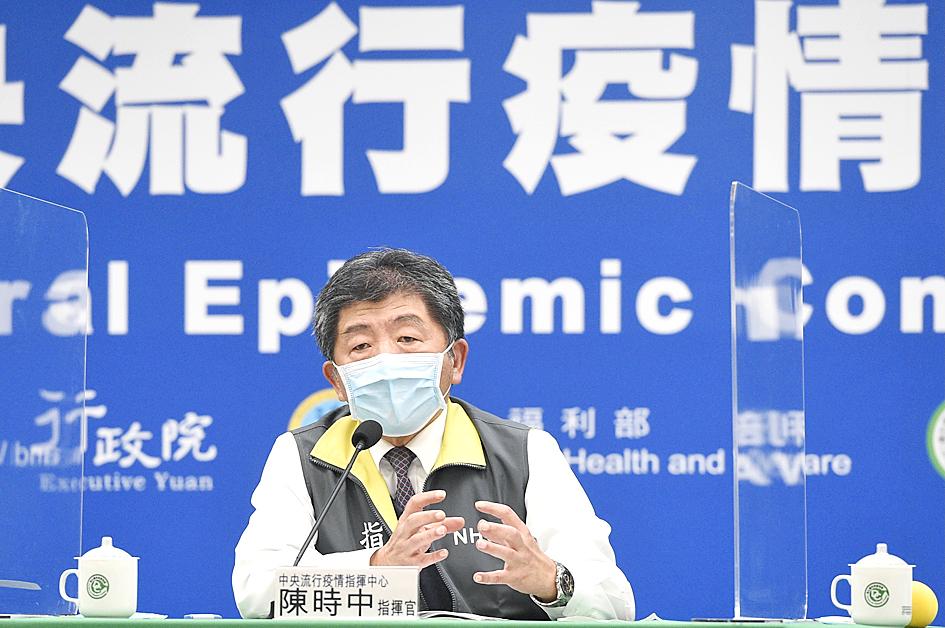
Photo: George Tsorng, Taipei Times
However, the center would be inclined to respect the ministry’s professional opinion on the matter, he added.
Separately, a TRA conductor has been asked to quarantine at home after coming into suspected contact with case No. 889, a man in his 60s who had been treated at the hospital and tested positive on Monday.
While the conductor would not normally be considered to have been in “close contact” with case No. 889, the center is taking no chances and has increased the parameter of those being placed under home quarantine, Chen said.
The public should mind their health, but there is no need to panic, he said.
“You do not have to worry unless you are notified,” Chen said.
As for the TRA asking its staff to practice self-health management, Chen said this was well within the purview of the company and he believed that such caution was called for.
Meanwhile, Minister of Transportation and Communications Lin Chia-lung (林佳龍) said that TRA operations between Rueifang (瑞芳) and Houtong (猴硐) stations in New Taipei City might resume earlier than scheduled.
Service along the section was disrupted by a massive landslide on Dec. 4 that was triggered by days of rain.
The TRA resumed two-way service along a single track on Dec. 14, and set a goal of returning to normal operations by Feb. 8, two days before the beginning of the Lunar New Year holiday.
To prevent further landslides, the agency said that it has built a retaining wall to reinforce the slopes and construction could be completed before Friday next week.
It would start laying new tracks, adjusting traffic signals and installing electric cables after the retaining wall is completed, the agency said.
“The construction went faster than we had estimated. We could be able to resume normal operations earlier than scheduled. This is crucial as people are getting ready to celebrate the Lunar New Year holiday, when a large number of people are scheduled to return home by train,” Lin said.
Additional reporting by CNA

LEVERAGE: China did not ‘need to fire a shot’ to deny Taiwan airspace over Africa when it owns ‘half the continent’s debt,’ a US official said, calling it economic warfare The EU has raised concerns about overflight rights following the delay of President William Lai’s (賴清德) planned state visit to the Kingdom of Eswatini after three African nations denied overflight clearance for his charter at the last minute. Taiwanese allies Paraguay and Saint Kitts and Nevis, as well as several US lawmakers and the Inter-Parliamentary Alliance on China (IPAC) condemned China for allegedly pressuring the countries. Lai was scheduled to fly directly to Taiwan’s only African ally from yesterday to Sunday to celebrate the 40th anniversary of King Mswati III’s accession and his 58th birthday, but Seychelles, Mauritius and Madagascar suddenly revoked
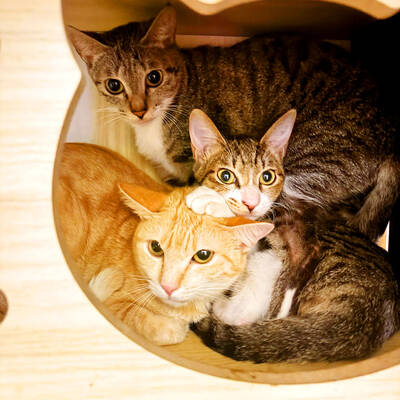
The number of pet cats in Taiwan surpassed that of pet dogs for the first time last year, reaching 1,742,033, a 32.8 percent increase from 2023, the Ministry of Agriculture said yesterday, citing a survey. By contrast, the number of pet dogs declined slightly by 1.2 percent over the same period to 1,462,528, the ministry said. Despite the shift, households with dogs still slightly outnumber those with cats by 1.2 percent. However, while the number of households with multiple dogs has remained relatively stable, households keeping more than two cats have increased, contributing to the overall rise in the feline population. The trend

China on Wednesday teased in a video an aircraft carrier that could be its fourth, and the first using nuclear power, while making an allusion to Taiwan and vowing to further build up its islands, as it looks to boost maritime power, secure resources and bolster territorial claims. The video, issued on the eve of the 77th founding anniversary of the Chinese People’s Liberation Army Navy, featured fictional officers with names that are homophones of three commissioned aircraft carriers, the Liaoning (遼寧), Shandong (山東) and Fujian (福建). Titled Into the Deep, it showed a 19-year-old named “Hejian” (何劍) joining the group, sparking
BIG YEAR: The company said it would also release its A12 chip the same year to keep a ‘reliable stream of new silicon technologies’ flowing to its customers Taiwan Semiconductor Manufacturing Co (TSMC, 台積電) yesterday said its newest A13 chip is to enter volume production in 2029 as the chipmaker seeks to hold onto its tech leadership and demand for next-generation chips used in artificial intelligence (AI), high-performance-computing (HPC) and mobile applications. TSMC, the world’s biggest contract chipmaker, also unveiled its A12 chip at its annual technology symposium in Santa Clara, California. The A12 chip, which features TSMC’s super-power-rail technology to provide backside power delivery for AI and HPC applications, is also to enter volume production in 2029, a year after the scheduled release of the A14 chip. The technology moves


 RSS
RSS