


The political head of Tibetans in exile yesterday welcomed legislation passed by the US Congress that reaffirms the rights of Tibetans to choose a successor to their spiritual leader, the Dalai Lama, a move that infuriated China.
China regards the exiled Dalai Lama as a dangerous “splittist,” or separatist, and the latest show of support from the US Congress could increase already tense ties between the two nations.
Lobsang Sangay, president of the Tibetan Central Administration (CTA), which is known as the Tibetan government-in-exile, said that the passing by the US House of Representatives and the Senate of the Tibet Policy and Support Act (TPSA) was historic.
Photo: Reuters
The Chinese Ministry of Foreign Affairs accused the US of meddling in its internal affairs and warned the US against signing the legislation into law.
China seized control of Tibet after its troops entered the region in 1950 in what it calls a “peaceful liberation.” Tibet has since become one of the most restricted and sensitive areas in the country.
The Dalai Lama fled into exile in India in 1959 after a failed uprising against Chinese rule.
The legislation calls for the establishment of a US consulate in Tibet’s main city of Lhasa, the absolute right of Tibetans to choose a successor to the Dalai Lama and the preservation of Tibet’s environment.
The legislation also proposes a “regional framework on water security” and greater participation from the community in dialogue with China on monitoring the region’s environment.
“The People’s Republic of China has already completed water transfer programs diverting billions of cubic meters of water yearly and has plans to divert more waters from the Tibetan plateau in China,” the bill said.
Environmental groups and Tibetan rights activists have expressed concern about China’s hydropower ambitions in the region, saying they could affect downstream water supplies.
China has said its leaders have the right to approve the Dalai Lama’s successor, which many see as a coercive attempt to control Tibet, where ethnic Tibetans make up about 90 percent of the population.
“By passing the TPSA, Congress has sent its message loud and clear that Tibet remains a priority for the United States and that it will continue its steadfast support for His Holiness the Dalai Lama and the CTA,” Sangay said.
“This is a victory for the Tibetan freedom struggle,” he added.

A signaling system malfunction disrupted high-speed rail (HSR) services beginning at 8am today, with trains temporarily reduced to three northbound and three southbound trains per hour as authorities conduct inspections. The malfunction occurred on a section of track in Miaoli County during pre-operation checks early this morning, forcing northbound and southbound trains to use a single track, the HSR operator said. The regular schedule has been replaced with three hourly trains offering only nonreserved seating in each direction, stopping at every station, it said, adding that business class cars would still have reserved seating. Departures from terminal stations are scheduled at the top

Taiwan is still in the process of assessing the possibility of recruiting workers from Eswatini, the Ministry of Foreign Affairs said yesterday, adding that its goal is to help Eswatini upgrade its vocational training centers. If there are plans to recruit workers from Eswatini, safeguarding national security, protecting public health and ensuring the employment rights of Taiwanese would be prerequisites, Department of West Asian and African Affairs Director-General Yen Chia-liang (顏嘉良) told a news conference. Key considerations would also include filling labor shortages in specific industries, and fostering bilateral professional and technical exchanges, he said. Yen was asked about the progress of labor

VERBOSE VESSELS: A CGA cutter and a China Coast Guard exchanged verbal barbs for more than a day in Taiwanese-controlled waters before the Chinese vessel left The Taiwanese and Chinese coast guards had a standoff near the strategically located Pratas Islands (Dongsha Islands, 東沙群島) in the north of the South China Sea, the Coast Guard Administration (CGA) said yesterday. The two sides engaged in intense radio exchanges over sovereignty claims during the 33-hour standoff. China Coast Guard vessel 3501 eventually left the restricted waters, 26.6 nautical miles (49.2km) west of the Pratas Islands, at 5pm yesterday, the CGA said. Lying approximately between southern Taiwan and Hong Kong, the Taiwan-controlled Pratas are seen by some security experts as vulnerable to Chinese attack due to their distance — more than
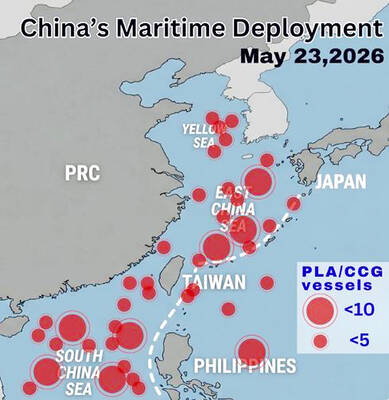
WARNING: China should stop engaging in actions that undermine regional peace and stability, as it would only build resentment among people across the Strait, the CGA said China has deployed more than 100 navy, coast guard and other vessels in waters from the Yellow Sea to the South China Sea and the western Pacific since US President Donald Trump and Chinese President Xi Jinping (習近平) met in Beijing, National Security Council Secretary-General Joseph Wu (吳釗燮) said yesterday. “In this part of the world, #China is the one & only PROBLEM wrecking the #StatusQuo & threatening regional peace & stability,” Wu wrote on X. In a separate post, he said Beijing was coercing Taiwan’s maritime domain, calling it illegal and provocative, after the Coast Guard Administration (CGA) expelled a


 RSS
RSS