


The first shipment of oil from CPC Corp, Taiwan’s (CPC, 台灣中油) oil fields in Chad arrived in Kaohsiung Port yesterday, heralded by water cannon boats.
The fanfare was to celebrate a successful end of a long and uncertain journey by the state-run company to develop its own oil fields.
CPC in 2006 secured the rights to explore the Oryx Oilfield from the government of Chad, and struck oil three years later.
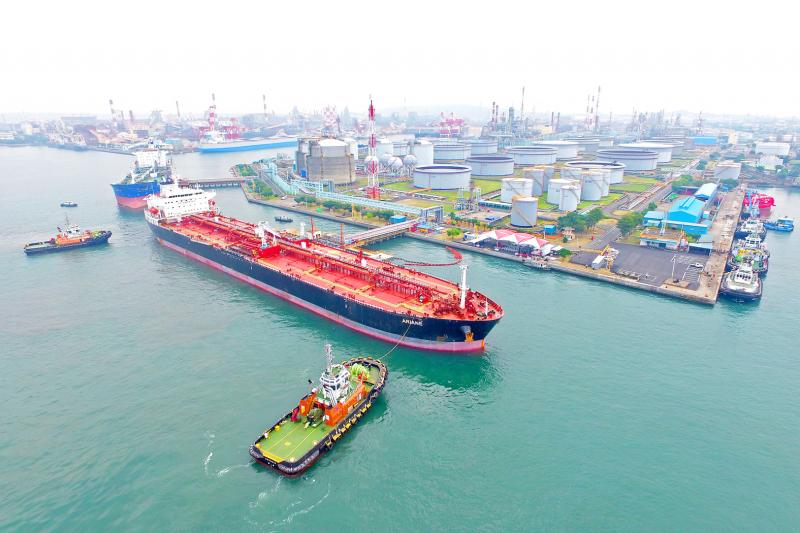
Photo: CNA
In 2017, it signed a 25-year license to develop the field.
“This is the culmination of 40 years of overseas prospecting for CPC,” chairman Jerry Ou (歐嘉瑞) said at an unloading ceremony at the port. “It proves that CPC has what it takes to independently prospect and develop fossil fuel resources abroad.”
“We will replicate our success here and develop more projects that will help achieve energy independence for Taiwan,” Ou said.
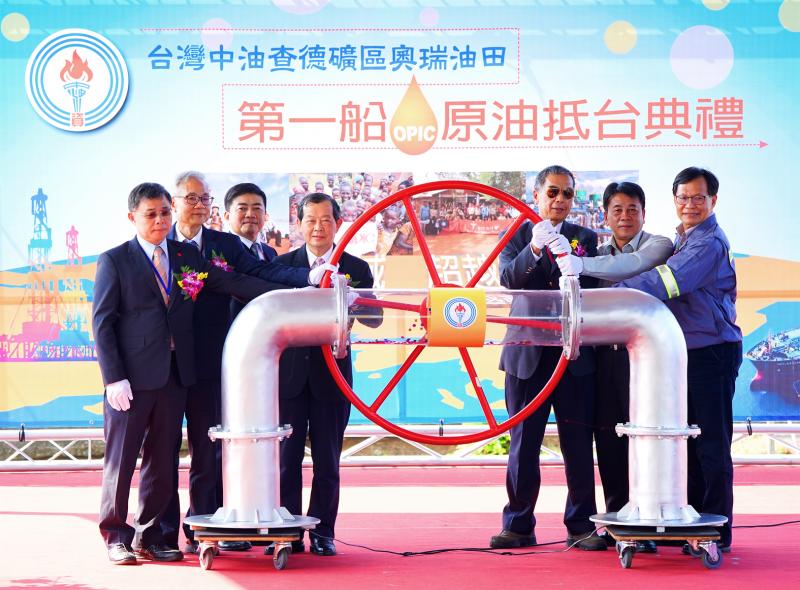
Photo: CNA
Since the field started production in February, 1.4 million barrels of oil have been produced, almost a million of which arrived in Kaohsiung yesterday.
The Oryx field is capable of producing up to 9,500 barrels per day, although it is currently producing just 5,000 barrels per day due to depressed oil prices.
However, the celebrations have been tempered by renewed doubts over China CEFC Energy Co’s (華信能源) stake in the project.
CPC sold half of its rights in the project to China CEFC Energy in 2016 for US$114 million as it sought to reduce its overseas investment risks.
CPC and CEFC China each own 35 percent of the field, and the Chadian government owns the rest.
CPC spokesman Chang Ray-chung (張瑞宗) told reporters repeatedly that CPC was “in charge” of the operations, even though the Chinese company has an equal number of shares.
“It is written into the contract that we signed with the government of Chad and CEFC China that we are the operators. We are in charge,” Chang said. “This is not in doubt.”
When asked why CPC chose CEFC China rather than a non-Chinese company, Chang said CEFC China was the only firm that would agree to CPC’s terms.
Ten other companies, Chinese and non-Chinese, were approached, but walked away after seeing the details, he said.
“We wanted a company that would take on half our prospecting costs going back 10 years prior and be responsible for half the operational costs going forward,” Chang said. “CEFC China was the only company who agreed. Their demand was owning half our stake.”
“For a project that was so expensive and uncertain, risk management is standard. If CEFC China were not a Chinese company, it would be completely non-controversial,” he said.
The profitability of the Oryx field is currently “marginal” at “current oil prices of US$40-ish a barrel,” Chang said.
“At US$100 a barrel, of course we would make a lot of money, but world oil prices are still depressed,” he said.
CPC has eight other fossil fuel sites around the world in various stages of exploration and development, Chang said.

CROSS-STRAIT COLLABORATION: The new KMT chairwoman expressed interest in meeting the Chinese president from the start, but she’ll have to pay to get in Beijing allegedly agreed to let Chinese Nationalist Party (KMT) Chairwoman Cheng Li-wun (鄭麗文) meet with Chinese President Xi Jinping (習近平) around the Lunar New Year holiday next year on three conditions, including that the KMT block Taiwan’s arms purchases, a source said yesterday. Cheng has expressed interest in meeting Xi since she won the KMT’s chairmanship election in October. A source, speaking on condition of anonymity, said a consensus on a meeting was allegedly reached after two KMT vice chairmen visited China’s Taiwan Affairs Office Director Song Tao (宋濤) in China last month. Beijing allegedly gave the KMT three conditions it had to
STAYING ALERT: China this week deployed its largest maritime show of force to date in the region, prompting concern in Taipei and Tokyo, which Beijing has brushed off Deterring conflict over Taiwan is a priority, the White House said in its National Security Strategy published yesterday, which also called on Japan and South Korea to increase their defense spending to help protect the first island chain. Taiwan is strategically positioned between Northeast and Southeast Asia, and provides direct access to the second island chain, with one-third of global shipping passing through the South China Sea, the report said. Given the implications for the US economy, along with Taiwan’s dominance in semiconductors, “deterring a conflict over Taiwan, ideally by preserving military overmatch, is a priority,” it said. However, the strategy also reiterated
‘BALANCE OF POWER’: Hegseth said that the US did not want to ‘strangle’ China, but to ensure that none of Washington’s allies would be vulnerable to military aggression Washington has no intention of changing the “status quo” in the Taiwan Strait, US Secretary of Defense Pete Hegseth said on Saturday, adding that one of the US military’s main priorities is to deter China “through strength, not through confrontation.” Speaking at the annual Reagan National Defense Forum in Simi Valley, California, Hegseth outlined the US Department of Defense’s priorities under US President Donald Trump. “First, defending the US homeland and our hemisphere. Second, deterring China through strength, not confrontation. Third, increased burden sharing for us, allies and partners. And fourth, supercharging the US defense industrial base,” he said. US-China relations under
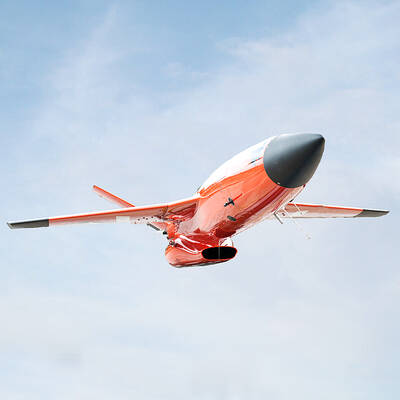
The Chien Feng IV (勁蜂, Mighty Hornet) loitering munition is on track to enter flight tests next month in connection with potential adoption by Taiwanese and US armed forces, a government source said yesterday. The kamikaze drone, which boasts a range of 1,000km, debuted at the Taipei Aerospace and Defense Technology Exhibition in September, the official said on condition of anonymity. The Chungshan Institute of Science and Technology and US-based Kratos Defense jointly developed the platform by leveraging the engine and airframe of the latter’s MQM-178 Firejet target drone, they said. The uncrewed aerial vehicle is designed to utilize an artificial intelligence computer


 RSS
RSS