


The Central Epidemic Command Center (CECC) yesterday announced a program of disease prevention measures for the autumn and winter.
Starting on Dec. 1, the program would tighten measures regarding border controls and local communities, while increasing testing, said Minister of Health and Welfare Chen Shih-chung (陳時中), who heads the center.
The program is expected to run until Feb. 28, but the length could be altered, he added.

Photo: CNA
“To enter Taiwan, all travelers will need to provide a negative result from a polymerase chain reaction (PCR) test taken within three days of boarding their flight,” Chen said, adding that the rule applies to foreign nationals and Taiwanese.
Those with emergency situations could apply for special entry, he said.
If people come from areas where a PCR test or a result certificate cannot be obtained, they could get Ministry of Foreign Affairs approval to enter Taiwan, but they must pay for a PCR test upon their arrival, he added.
The test result must be issued by a government-accredited hospital in their country of departure, with a report in Chinese or English.
The report must show the name on the passenger’s passport, their date of birth, the specimen collection date, result release date, name of the tested virus, testing method and result interpretation.
“Enhanced COVID-19 prevention at the local community level is mainly about wearing a mask,” Chen said.
People would be asked to wear a mask at eight types of public venue: healthcare and long-term care facilities, public transportation, markets, schools, sports and exhibition venues, places of worship, recreational venues, and government facilities and business venues, he said.
Those failing to wear a mask after being asked would face a fine of up to NT$15,000 due to a breach of the Communicable Disease Control Act (傳染病防治法), the center said.
People could still remove their mask when eating or drinking, or if social distancing is possible or boards separate the seating, he said, adding that people should wear a mask at crowded outdoor gatherings.
The CECC would encourage hospitals to report suspected cases of disease, and give them incentives to increase testing on patients, especially those with pneumonia, and to monitor the health of medical personnel, Chen said.
The center said that it would remind physicians to report suspected cases and refer them for testing at hospitals, and amend the procedures for reporting and testing symptoms of those under home quarantine.
Asked whether testing capacity would be enough to cope with a possible increase in confirmed cases, Chen said that many countries’ healthcare systems have been overwhelmed by a surge in cases, so the center prefers to test more and tighten control measures.
Other program details can be found on the Center for Disease Control’s Web site at www.cdc.gov.tw/En.
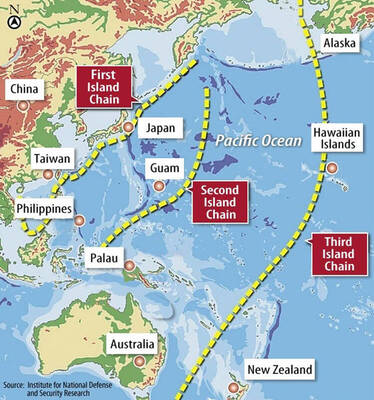
The US government has signed defense cooperation agreements with Japan and the Philippines to boost the deterrence capabilities of countries in the first island chain, a report by the National Security Bureau (NSB) showed. The main countries on the first island chain include the two nations and Taiwan. The bureau is to present the report at a meeting of the legislature’s Foreign Affairs and National Defense Committee tomorrow. The US military has deployed Typhon missile systems to Japan’s Yamaguchi Prefecture and Zambales province in the Philippines during their joint military exercises. It has also installed NMESIS anti-ship systems in Japan’s Okinawa

‘WIN-WIN’: The Philippines, and central and eastern European countries are important potential drone cooperation partners, Minister of Foreign Affairs Lin Chia-lung said Minister of Foreign Affairs Lin Chia-lung (林佳龍) in an interview published yesterday confirmed that there are joint ventures between Taiwan and Poland in the drone industry. Lin made the remark in an exclusive interview with the Chinese-language Liberty Times (the Taipei Times’ sister paper). The government-backed Taiwan Excellence Drone International Business Opportunities Alliance and the Polish Chamber of Unmanned Systems on Wednesday last week signed a memorandum of understanding in Poland to develop a “non-China” supply chain for drones and work together on key technologies. Asked if Taiwan prioritized Poland among central and eastern European countries in drone collaboration, Lin

BACK TO WORK? Prosecutors said they are considering filing an appeal, while the Hsinchu City Government said it has applied for Ann Kao’s reinstatement as mayor The High Court yesterday found suspended Hsinchu mayor Ann Kao (高虹安) not guilty of embezzling assistant fees, reducing her sentence to six months in prison commutable to a fine from seven years and four months. The verdict acquitted Kao of the corruption charge, but found her guilty of causing a public official to commit document forgery. The High Prosecutors’ Office said it is reviewing the ruling and considering whether to file an appeal. The Taipei District Court in July last year sentenced Kao to seven years and four months in prison, along with a four-year deprivation of civil rights, for contravening the Anti-Corruption

NO CONFIDENCE MOTION? The premier said that being toppled by the legislature for defending the Constitution would be a democratic badge of honor for him Premier Cho Jung-tai (卓榮泰) yesterday announced that the Cabinet would not countersign the amendments to the local revenue-sharing law passed by the Legislative Yuan last month. Cho said the decision not to countersign the amendments to the Act Governing the Allocation of Government Revenues and Expenditures (財政收支劃分法) was made in accordance with the Constitution. “The decision aims to safeguard our Constitution,” he said. The Constitution stipulates the president shall, in accordance with law, promulgate laws and issue mandates with the countersignature of the head of the Executive Yuan, or with the countersignatures of both the head of the Executive Yuan and ministers or


 RSS
RSS