


Starting on Jan. 1 next year, hand-shaken tea shops, convenience stores and fast-food restaurants would have to list on site the total sugars and calories in the freshly made drinks that they sell, the Food and Drug Administration (FDA) said yesterday as it announced a draft amendment to the Regulations Governing the Labeling of On-site-produced Drinks at Drinks Industry Convenience Chain Stores and Fast-food Industry (連鎖飲料便利商店及速食業之現場調製飲料標示規定).
The proposed amendment also includes modifications to the standards for marking calories, caffeine content and fruit content.
Shops are currently only required to mark the total sugar content of the drinks produced on site, but consumers often do not know how many calories are contained in additional toppings, such as tapioca pearls, pudding, grass jelly, nata de coco jelly or taro balls, FDA Food Safety Division head Lee Wan-chen (李婉媜) said.
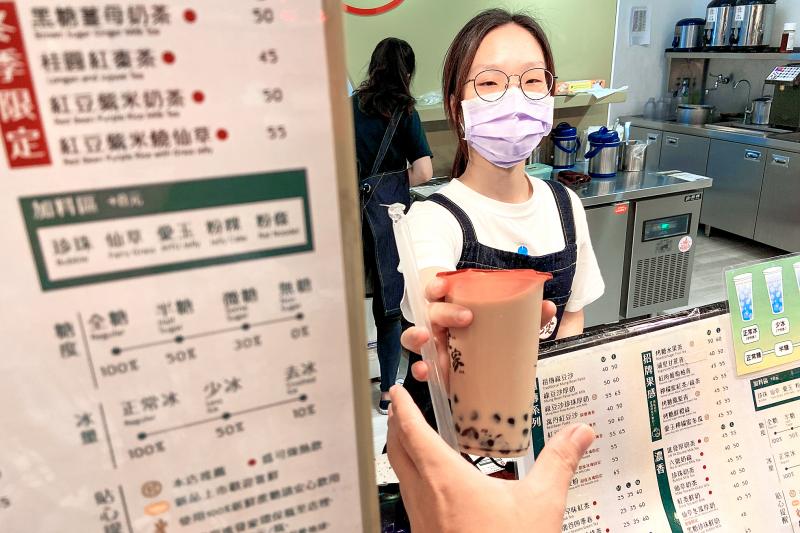
Photo: George Tsorng, Taipei Times
The proposal would require freshly made drinks sold by beverage stores to have a nutrition label that specifies the sugar and calorie content of all elements of the drink.
They would have to provide the maximum total sugar content, using sugar cubes — equal to five grams of sugar — as the standard unit, as well as the maximum total calories, including toppings, Lee said.
The regulations now require shops to mark the caffeine content of drinks with a red, yellow or green mark — signaling more than 201mg, between 101 and 200mg, and less than 100mg of caffeine respectively, but the amendment would require them to mark the maximum caffeine content as well, Lee said.
Under the proposal, fruit or vegetable drinks that contain less than 10 percent real fruit or vegetable juice would have to be labeled by manufacturers as a “drink,” or a name with the same meaning, Lee said.
Drinks with no real fruit or vegetable juice would have to be renamed as “flavored” or as a “XX flavor” beverage, she added.
Additional reporting by CNA
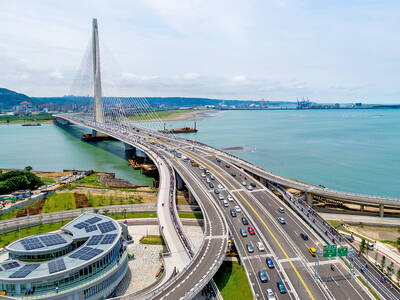
The Ministry of Transportation and Communications yesterday inaugurated the Danjiang Bridge across the Tamsui River in New Taipei City, saying that the structure would be an architectural icon and traffic artery for Taiwan. Feted as a major engineering achievement, the Danjiang Bridge is 920m long, 211m tall at the top of its pylon, and is the longest single-pylon asymmetric cable-stayed bridge in the world, the government’s Web site for the structure said. It was designed by late Iraqi-British architect Zaha Hadid. The structure, with a maximum deck of 70m, accommodates road and light rail traffic, and affords a 200m navigation channel for boats,
Taiwan Semiconductor Manufacturing Co (TSMC, 台積電), the world’s largest foundry service provider, yesterday said that global semiconductor revenue is projected to hit US$1.5 trillion in 2030, after the figure exceeds US$1 trillion this year, as artificial intelligence (AI) demand boosts consumption of token and compute power. “We are still at the beginning of the AI revolution, but we already see a significant impact across the whole semiconductor ecosystem,” TSMC deputy cochief operating officer Kevin Zhang (張曉強) said at the company’s annual technology symposium in Hsinchu City. “It is fair to say that in the past decade, smartphones and other mobile devices were
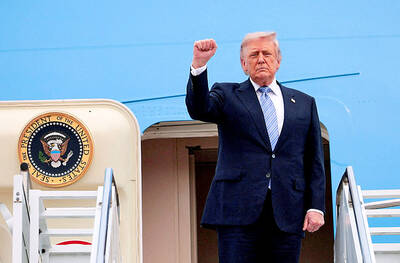
US-CHINA SUMMIT: MOFA welcomed US reassurance of no change in its Taiwan policy; Trump said he did not comment when Xi talked of opposing independence US President Donald Trump yesterday said he has not made a decision on whether to move forward with a major arms package for Taiwan after hearing concerns about it from Chinese President Xi Jinping (習近平). Trump’s comments on Taiwan came as he flew back to Washington after wrapping up critical talks in which both leaders said important progress was made in stabilizing US-China relations even as deep differences persist between the world’s two biggest powers on Iran and Taiwan. “I will make a determination,” Trump said, adding: “I’ll be making decisions. But, you know, I think the last thing we need right
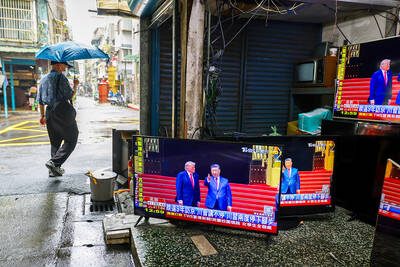
TAIWAN ISSUE: US treasury secretary Scott Bessent said on the first day of meetings that ‘it wouldn’t be a US-China summit without the Taiwan issue coming up’ There were no surprises on the first day of the summit between US President Donald Trump and Chinese President Xi Jinping (習近平), the Mainland Affairs Council (MAC) said yesterday, as the government reiterated that cross-strait stability is crucial to the Asia-Pacific region, as well as the world. As the two presidents met for a highly anticipated summit yesterday, Chinese state media reported that Xi warned Trump that missteps regarding Taiwan could push their two countries into “conflict.” Trump arrived in China with accolades for his host, calling Xi a “great leader” and “friend,” and extending an invitation to visit the White House


 RSS
RSS