


A Taiwanese bird protection group yesterday said that it has been kicked out of BirdLife International — a global conservation partnership — after it refused to sign a statement saying it would never advocate independence.
The Taipei-based Chinese Wild Bird Federation said that BirdLife International last week voted to remove it, ending a partnership that had been in place since 1996.
Over the past 20 years, the federation has changed its English name three times to satisfy BirdLife International, and recently the international group demanded that it change its Chinese name and sign a statement that it is “formally committing to not promote or advocate the legitimacy of the Republic of China (ROC) or the independence of Taiwan from China.”

Photo: Liu Hsiao-hsin, Taipei Times
The federation said that it was informed that its Chinese name — which contains “ROC” — “posed a risk” to UK-based BirdLife.
Signing such a statement would be inappropriate, because “we are a conservation organization,” not a political one, it said.
The federation said that as a non-governmental organization, it has never expressed a stance on the matter and that “our removal seems to be an example of politics getting in the way of good conservation.”
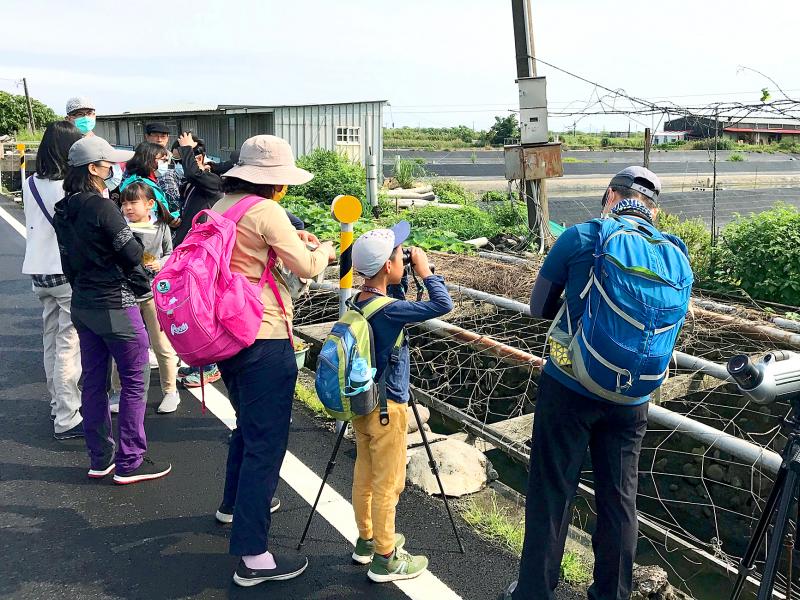
Photo courtesy of the Luodong Forest District Office
BirdLife also informed the federation that it would not participate in any activity fully or partly funded by Taipei, and prohibited the federation from using BirdLife’s name or logo in any media bearing an ROC flag or symbol.
BirdLife did not respond to requests for comment.
Federation deputy secretary-general Allen Lyu (呂翊維) said that the group has long had interactions with Japanese groups and that it would reach out to them, or groups in the US and Europe, to discuss whether a response to its removal could be organized.
The federation said that it would explain its plans to the public on Wednesday next week.
There are no national borders for birds, it said, adding that cross-border collaboration on bird conservation efforts is important.
It remains committed to biodiversity, despite the removal, it said.
Founded in 1988, the federation is composed of 21 regional bird associations or environmental conservation groups across Taiwan, and has contributed to the conservation of black-faced spoonbills and Chinese crested terns.
It promotes citizen science movements for bird research, including eBird Taiwan and the annual New Year Bird Count, a national census of birds that the organization has conducted since 2013.
The Ministry of Foreign Affairs yesterday accused the Chinese government of intervening in an ecological protection organization that should be apolitical.
The ministry would ask the Taipei Representative Office in the UK to lodge a protest with BirdLife International, which is headquartered in Cambridge, ministry spokeswoman Joanne Ou (歐江安) said in a statement.
BirdLife International has neglected the federation’s longtime contributions to bird conservation since 1996, but joined the Chinese government to pressure the group, for which the ministry expressed its deep regret and dissatisfaction, Ou said.
After learning of the federation’s plight in July, the ministry has maintained close contact with it and continued to offer help, she said.
The ministry highly respects the federation defending its rights and national dignity, she said.
Additional reporting by Lu Yi-hsuan and Lin Chia-nan

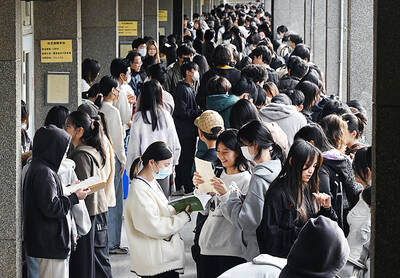
A global survey showed that 60 percent of Taiwanese had attained higher education, second only to Canada, the Ministry of the Interior said. Taiwan easily surpassed the global average of 43 percent and ranked ahead of major economies, including Japan, South Korea and the US, data from the Organisation for Economic Co-operation and Development (OECD) for 2024 showed. Taiwan has a high literacy rate, data released by the ministry showed. As of the end of last year, Taiwan had 20.617 million people aged 15 or older, accounting for 88.5 percent of the total population, with a literacy rate of 99.4 percent, the data

CCP ‘PAWN’? Beijing could use the KMT chairwoman’s visit to signal to the world that many people in Taiwan support the ‘one China’ principle, an academic said Chinese Nationalist Party (KMT) Chairwoman Cheng Li-wun (鄭麗文) yesterday arrived in China for a “peace” mission and potential meeting with Chinese President Xi Jinping (習近平), while a Taiwanese minister detailed the number of Chinese warships currently deployed around the nation. Cheng is visiting at a time of increased Chinese military pressure on Taiwan, as the opposition-dominated Legislative Yuan stalls a government plan for US$40 billion in extra defense spending. Speaking to reporters before going to the airport, Cheng said she was going on a “historic journey for peace,” but added that some people felt uneasy about her trip. “If you truly love Taiwan,

NEW LOW: The council in 2024 based predictions on a pessimistic estimate for the nation’s total fertility rate of 0.84, but last year that rate was 0.69, 17 percent lower An expected National Development Council (NDC) report expects the nation’s population to drop below 12 million by 2065, with the old-age dependency ratio to top 100 percent sooner than 2070, sources said yesterday. The council is slated to release its latest population projections in August, using an ultra-low fertility model, the sources said. The previous report projected that Taiwan’s population would fall to 14.37 million by 2070, but based on a new estimate of the total fertility rate (TFR) — the average number of children born to a woman over her lifetime — the population is expected to reach 12 million by
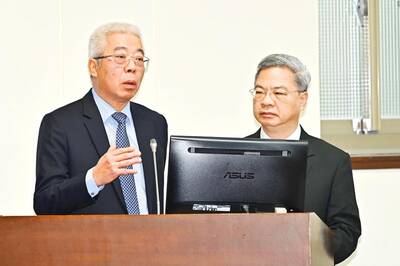
Taiwan has arranged for about 8 million barrels of crude oil, or about one-third of its monthly needs, to be shipped from the Red Sea this month to bypass the Strait of Hormuz and ease domestic supply pressures, CPC Corp, Taiwan (CPC, 台灣中油) said yesterday. The state-run oil company has worked with Middle Eastern suppliers to secure routes other than the Strait of Hormuz, through which about 20 percent of the world’s oil and liquefied natural gas typically passes, CPC chairman Fang Jeng-zen (方振仁) said at a meeting of the legislature’s Economics Committee in Taipei. Suppliers in Saudi Arabia have indicated they


 RSS
RSS