


Taiwan’s exports last month rose 0.4 percent from a year earlier to US$28.2 billion, ending four months of declines, thanks to robust demand for electronics used in remote working and distance learning as COVID-19 infections spiked abroad, the Ministry of Finance said yesterday.
The pickup was a pleasant surprise, as the ministry last month bet on a year-on-year retreat of 1.5 to 4 percent.
“Semiconductors as well as information and communications products continued to benefit from 5G deployment and demand for laptops, desktops, tablets and TVs,” Department of Statistics Director-General Beatrice Tsai (蔡美娜) told a news conference in Taipei.
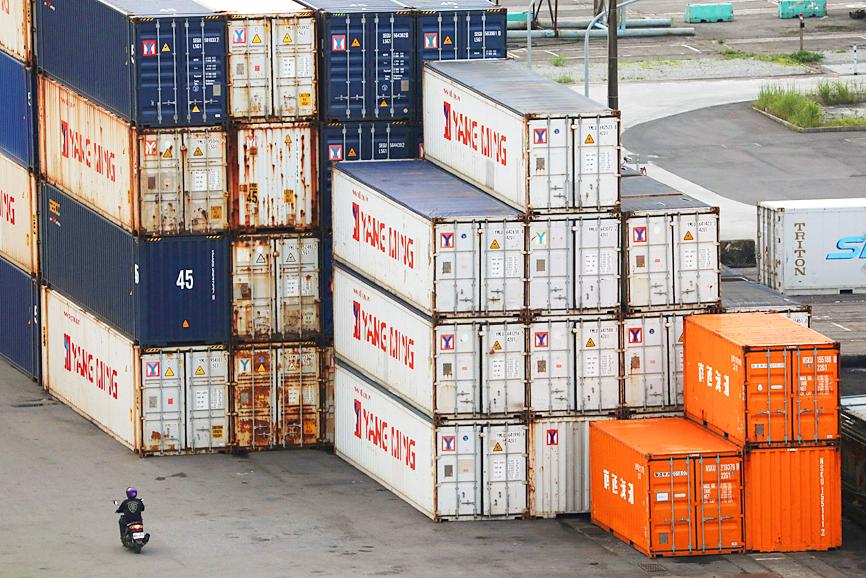
Photo: Ann Wang, Reuters
Shipments of electronic components expanded 15.5 percent to US$10.98 billion, advancing by a double-digit percentage for the eighth month in a row, Tsai said.
Exports of semiconductors gained 16.6 percent, while capacitors and resistors soared 33.6 percent, the ministry’s report showed.
Easing declines in the prices of raw materials, base metals and other non-tech products helped push overall exports into expansion mode, although they remained significantly cheaper from price levels a year earlier, Tsai said.
The pickup in exports is likely an isolated episode, as this critical economic barometer might falter again, with a retreat of 0.5 to 2.5 percent this month and beyond, Tsai said.
Export volume might improve quarter by quarter in the second half of this year on the back of the peak season, but would have difficulty beating last year’s results, Tsai said.
“That is because the ongoing COVID-19 pandemic and revived US-China trade tensions generate severe uncertainty,” Tsai said, adding that major technology firms have provided cautious guidance for this quarter and shy away from comments for next quarter due to poor order visibility.
Shipments to China expanded 12.7 percent, while those to the US gained 7.8 percent, the report said.
Exports to Europe, Japan and ASEAN markets have not picked up, but the pace of decline tapered off, Tsai said.
Imports weakened 6.8 percent to US$22.83 billion, allowing Taiwan to keep a trade surplus of US$5.37 billion, a 48.8 percent bump year-on-year, the report said.
Cheaper fuel prices underpinned the trend, Tsai added.
Imports of capital equipment increased 13.2 percent due mainly to local firms purchasing semiconductor equipment to maintain technology leadership and expand capacity, Tsai said.
“It is safe to say that the worst [economic fallout] of the virus outbreak is over for Taiwan, with a high degree of uncertainty globally,” she said.
In the first seven months, exports managed a mild 0.5 percent gain to US$182.62 billion, whereas imports slipped 1.3 percent to US$159.49 billion, the ministry said.
“Non-tech products will continue to drag down overall shipments for the rest of the year, despite stabilized prices,” Tsai said.
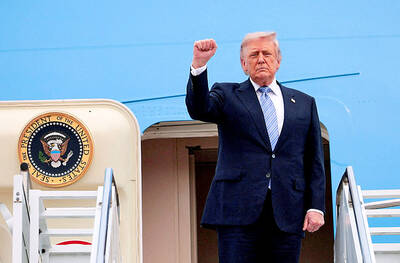
US-CHINA SUMMIT: MOFA welcomed US reassurance of no change in its Taiwan policy; Trump said he did not comment when Xi talked of opposing independence US President Donald Trump yesterday said he has not made a decision on whether to move forward with a major arms package for Taiwan after hearing concerns about it from Chinese President Xi Jinping (習近平). Trump’s comments on Taiwan came as he flew back to Washington after wrapping up critical talks in which both leaders said important progress was made in stabilizing US-China relations even as deep differences persist between the world’s two biggest powers on Iran and Taiwan. “I will make a determination,” Trump said, adding: “I’ll be making decisions. But, you know, I think the last thing we need right
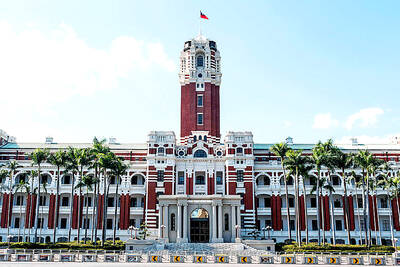
SECURITY: Taipei presses the US for arms supplies, saying the arms sales are not only a reflection of the US security commitment to Taiwan but also serve as a mutual deterrent against regional threats Taiwan is committed to preserving the cross-strait “status quo” and contributing to regional peace and stability, the Presidential Office said yesterday. “It is an undeniable fact that the Republic of China is a sovereign and independent democratic nation,” Presidential Office spokeswoman Karen Kuo (郭雅慧) reiterated, adding that Beijing has no right to claim sovereignty over Taiwan. The statements came after US President Donald Trump warned against Taiwanese independence. Trump wrapped up a state visit to Beijing on Friday, during which Chinese President Xi Jinping (習近平) had pressed him not to support Taiwan. Taiwan depends heavily on US security backing to deter China from carrying
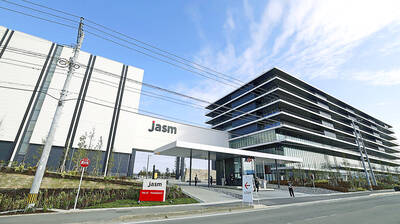
The subsidiary of Taiwan Semiconductor Manufacturing Co (TSMC, 台積電) in Kumamoto, Japan, turned a profit in the first quarter of this year, marking the first time the first fab of the unit has become profitable since mass production started at the end of 2024. According to the contract chipmaker’s financial statement released on Friday, Japan Advanced Semiconductor Manufacturing Inc (JASM), a joint venture running the fab in Kumamoto, posted NT$951 million (US$30.19 million) in profit in the January-to-March period, compared with a loss of NT$1.39 billion in the previous quarter, and a loss of NT$3.25 billion in the first quarter of
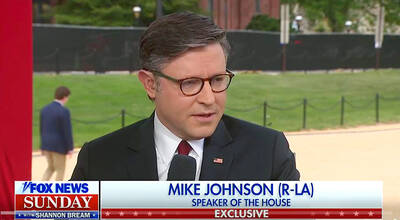
RESOLUTE BACKING: Two Republican senators are planning to introduce legislation that would impose immediate sanctions on China if it attempts to invade Taiwan US House of Representatives Speaker Mike Johnson on Sunday reaffirmed US congressional support for Taiwan, saying the US and “all freedom-loving people” have a stake in preventing China from seizing Taiwan by force. Johnson made the remarks in an interview with Fox News Sunday on US President Donald Trump’s summit with Chinese President Xi Jinping (習近平) last week. In an interview that aired on Friday on Fox News, just as Trump wrapped up a high-stakes visit to China, he said he has yet to green-light a new US$14 billion arms package to Taiwan and that it “depends on China.” “It’s a very good


 RSS
RSS