


South Korea yesterday urged North Korea to scrap a plan to launch propaganda leaflets across the border, after Pyongyang said it was ready to float 12 million leaflets in what would be the largest such psychological campaign against its southern rival.
Pyongyang has in the past few weeks issued a series of vitriolic condemnations of Seoul over anti-North Korea leaflets, which defectors based in South Korea send across the border — usually attached to balloons or floated in bottles.
Pyongyang said it would have nothing more to do with Seoul and last week blew up a liaison office on its side of the border that symbolized inter-Korean rapprochement, while threatening to bolster its military presence in and near the demilitarized zone.
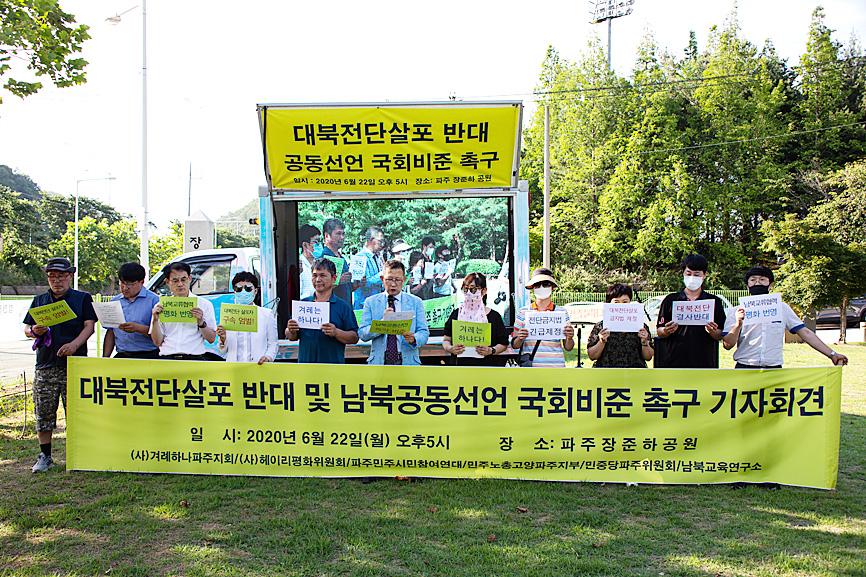
Photo: EPA-EFE
South Korean Ministry of Unification spokesman Yoh Sangkey said that North Korea must suspend its plan to send anti-Seoul leaflets that “are not helpful to South-North relations at all.”
Earlier yesterday, North Korea said it had manufactured 12 million propaganda leaflets to be floated toward South Korea aboard 3,000 balloons and other unspecified delivery equipment.
“Our plan of distributing the leaflets against the enemy is an eruption of the unquenchable anger of all the people and the whole society,” the North’s official Korean Central News Agency said. “The time for retaliatory punishment is drawing near.”
One of the leaflets shown in the official Rodong Sinmun carried an image of South Korean President Moon Jae-in drinking from a cup and accused him of having “eaten it all, including the north-south Korea agreement.”
South Korean Minister of Defense Jeong Kyeong-doo yesterday told lawmakers that how his military responds to potential North Korean leafleting depends on what delivery equipment the North would use.
A South Korean activist has said that he would also drop about 1 million leaflets over the border around Thursday, the 70th anniversary of the start of the 1950-1953 Korean War.
South Korean officials have said they would ban civilian activists from launching balloons toward North Korea.
Both Koreas used to regularly send leaflets and loudspeaker broadcasts to the other side, but agreed to stop such activities in the Panmunjom Declaration that Moon and North Korean leader Kim Jong-un signed at their first summit in 2018.
North Korea has begun setting up loudspeakers at multiple locations along the border to broadcast propaganda, the South’s Yonhap news agency reported yesterday, citing an official of the Joint Chiefs of Staff.
Inter-Korean relations have been in a deep freeze following the collapse of a summit in Hanoi between Kim and US President Donald Trump early last year over what the nuclear-armed North would be willing to give up in exchange for a loosening of sanctions.

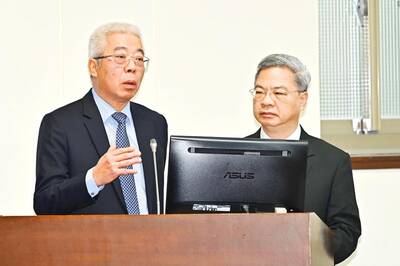
Taiwan has arranged for about 8 million barrels of crude oil, or about one-third of its monthly needs, to be shipped from the Red Sea this month to bypass the Strait of Hormuz and ease domestic supply pressures, CPC Corp, Taiwan (CPC, 台灣中油) said yesterday. The state-run oil company has worked with Middle Eastern suppliers to secure routes other than the Strait of Hormuz, through which about 20 percent of the world’s oil and liquefied natural gas typically passes, CPC chairman Fang Jeng-zen (方振仁) said at a meeting of the legislature’s Economics Committee in Taipei. Suppliers in Saudi Arabia have indicated they
A global survey showed that 60 percent of Taiwanese had attained higher education, second only to Canada, the Ministry of the Interior said. Taiwan easily surpassed the global average of 43 percent and ranked ahead of major economies, including Japan, South Korea and the US, data from the Organisation for Economic Co-operation and Development (OECD) for 2024 showed. Taiwan has a high literacy rate, data released by the ministry showed. As of the end of last year, Taiwan had 20.617 million people aged 15 or older, accounting for 88.5 percent of the total population, with a literacy rate of 99.4 percent, the data
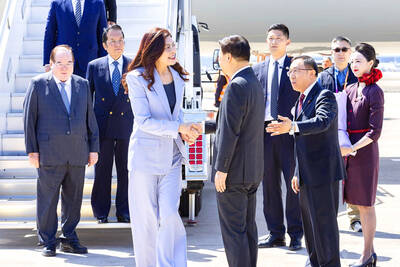
CCP ‘PAWN’? Beijing could use the KMT chairwoman’s visit to signal to the world that many people in Taiwan support the ‘one China’ principle, an academic said Chinese Nationalist Party (KMT) Chairwoman Cheng Li-wun (鄭麗文) yesterday arrived in China for a “peace” mission and potential meeting with Chinese President Xi Jinping (習近平), while a Taiwanese minister detailed the number of Chinese warships currently deployed around the nation. Cheng is visiting at a time of increased Chinese military pressure on Taiwan, as the opposition-dominated Legislative Yuan stalls a government plan for US$40 billion in extra defense spending. Speaking to reporters before going to the airport, Cheng said she was going on a “historic journey for peace,” but added that some people felt uneasy about her trip. “If you truly love Taiwan,

NEW LOW: The council in 2024 based predictions on a pessimistic estimate for the nation’s total fertility rate of 0.84, but last year that rate was 0.69, 17 percent lower An expected National Development Council (NDC) report expects the nation’s population to drop below 12 million by 2065, with the old-age dependency ratio to top 100 percent sooner than 2070, sources said yesterday. The council is slated to release its latest population projections in August, using an ultra-low fertility model, the sources said. The previous report projected that Taiwan’s population would fall to 14.37 million by 2070, but based on a new estimate of the total fertility rate (TFR) — the average number of children born to a woman over her lifetime — the population is expected to reach 12 million by


 RSS
RSS