


Two former legislative assistants were detained yesterday after being questioned by Taipei prosecutors about their alleged involvement collecting classified materials and meeting minutes from the Legislative Yuan, the Ministry of Foreign Affairs and the Mainland Affairs Council, and passing on lists of government personnel and reporters to Chinese intelligence officials.
A third suspect was released on bail after questioning.
The Taipei District Prosecutors’ Office said that Lee Yi-hsien (李易諴), Chen Wei-jen (陳惟仁) and Lin Yung-ta (林雍達) were questioned following raids conducted by prosecutors and officers from the Ministry of Justice Investigation Bureau’s National Security Operations Division.
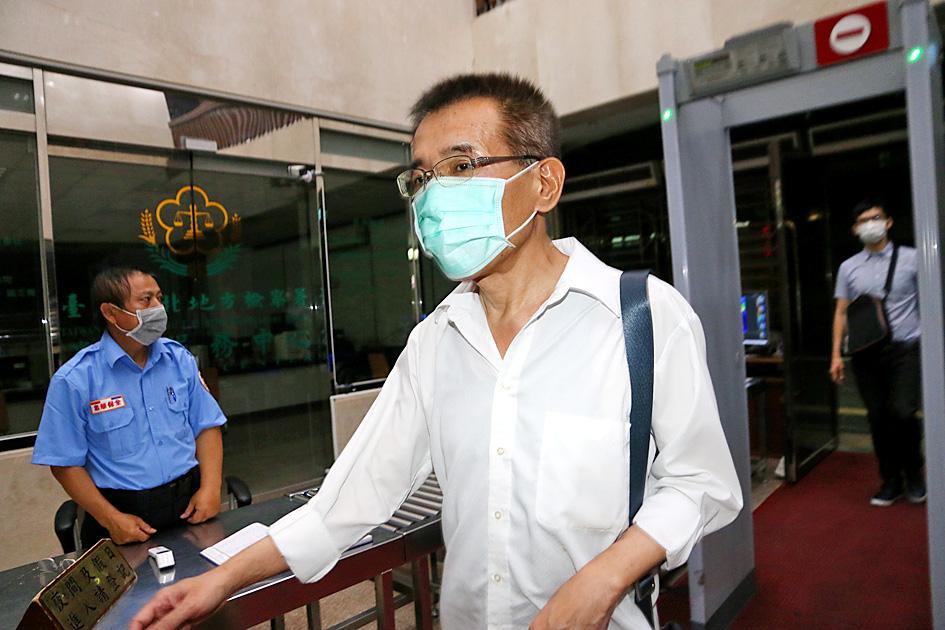
Photo: Chen Wei-tzu, Taipei Times
The trio allegedly passed material to Chinese Ministry of State Security officials while working as aides to Chinese Nationalist Party (KMT) lawmakers between 2014 and 2018.
Lee and Chen were detained after questioning for allegedly contravening the National Security Act (國家安全法) and setting up a spy network for China, while Lin was released on bail of NT$100,000 (US$3,372).
Lee worked for then-KMT legislator Chang Li-shan (張麗善), who is now Yunlin County commissioner, while Chen and Lin worked for then-KMT legislator Chen Shu-huey (陳淑慧), who is now Chiayi deputy mayor.

Photo: Chen Wei-tzu, Taipei Times
Lin had also worked for then-legislator Chen Chin-ting (陳進丁) from 1999 to 2008.
Chen Chin-ting was a KMT member until 2002 when he joined the Non-Partisan Solidarity Union. He later joined the Democratic Progressive Party (DPP) in 2010.
Prosecutors said that Lee had worked many years as a correspondent for Malaysia’s Chinese-language Oriental Daily News and the Commons Daily in Taiwan, while Lin, after leaving his legislative aide job, formed connections with several Chinese business interests and made frequent visits to China.
The trio allegedly was recruited by Chinese officials, through offers of money, to gather government materials and personnel lists, and to recruit more people for a spy network, prosecutors said.
Using their access as legislative aides, they allegedly collected volumes of sensitive documents, internal reports and meeting minutes at the Legislative Yuan and government ministries, reportedly focusing on the foreign ministry and the council.
They used their connections with local reporters covering politics to collect other material, and compile lists of government personnel, media workers and legislative assistants, prosecutors said.
Chang told reporters that she has not had contact with Lee since she gave up her seat in the legislature in 2018.
Lee had not formally registered as a legislative assistant, but had just volunteered to help at some of her news conferences, Chang said, adding that Lee would not have had the opportunity to review legal documents at that time.
Chen Shu-huey told reporters that Chen Wei-jen and Lin had left her office in 2009 and that she did not remember much about them.
DPP Legislator Wang Ting-yu (王定宇) said that the espionage case highlights the affinity the KMT and members of the pan-blue camp have for China, and how they seldom pay attention to leaks and security breaches.
“Most spy cases have involved politicians from the pan-blue camp and pro-China red political groups,” Wang said.
“This is potentially very damaging, as the suspects used their jobs as legislative assistants and media workers to gather sensitive information and classified documents, while their work to develop a spy network for China could have a more serious impact,” Wang added.
A preliminary investigation by the Ministry of Foreign Affairs showed that no ministry personnel were involved in the case or under investigation by prosecutors, ministry spokeswoman Joanne Ou (歐江安) told reporters.

PROVOCATIVE: Chinese Deputy Ambassador to the UN Sun Lei accused Japan of sending military vessels to deliberately provoke tensions in the Taiwan Strait China denounced remarks by Japan and the EU about the South China Sea at a UN Security Council meeting on Monday, and accused Tokyo of provocative behavior in the Taiwan Strait and planning military expansion. Ayano Kunimitsu, a Japanese vice foreign minister, told the Council meeting on maritime security that Tokyo was seriously concerned about the situation in the East China and South China seas, and reiterated Japan’s opposition to any attempt to change the “status quo” by force, and obstruction of freedom of navigation and overflight. Stavros Lambrinidis, head of the EU delegation to the UN, also highlighted South China Sea
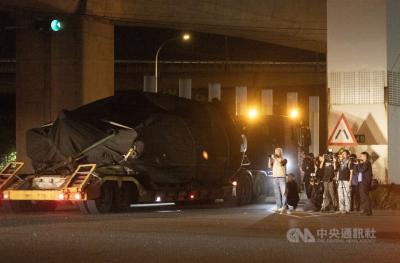
The final batch of 28 M1A2T Abrams tanks purchased from the US arrived at Taipei Port last night and were transported to the Armor Training Command in Hsinchu County’s Hukou Township (湖口), completing the military’s multi-year procurement of 108 of the tanks. Starting at 12:10am today, reporters observed more than a dozen civilian flatbed trailers departing from Taipei Port, each carrying an M1A2T tank covered with black waterproof tarps. Escorted by military vehicles, the convoy traveled via the West Coast Expressway to the Armor Training Command, with police implementing traffic control. The army operates about 1,000 tanks, including CM-11 Brave Tiger
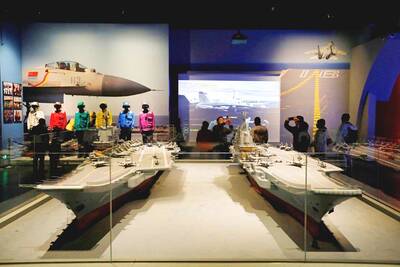
China on Wednesday teased in a video an aircraft carrier that could be its fourth, and the first using nuclear power, while making an allusion to Taiwan and vowing to further build up its islands, as it looks to boost maritime power, secure resources and bolster territorial claims. The video, issued on the eve of the 77th founding anniversary of the Chinese People’s Liberation Army Navy, featured fictional officers with names that are homophones of three commissioned aircraft carriers, the Liaoning (遼寧), Shandong (山東) and Fujian (福建). Titled Into the Deep, it showed a 19-year-old named “Hejian” (何劍) joining the group, sparking
Taiwan Semiconductor Manufacturing Co (TSMC, 台積電), the world’s largest contract chipmaker, said it expects its 2-nanometer (2nm) chip capacity to grow at a compound annual rate of 70 percent from this year to 2028. The projection comes as five fabs begin volume production of 2-nanometer chips this year — two in Hsinchu and three in Kaohsiung — TSMC senior vice president and deputy cochief operating officer Cliff Hou (侯永清) said at the company’s annual technology symposium in Silicon Valley, California, last week. Output in the first year of 2-nanometer production, which began in the fourth quarter of last year, is expected to


 RSS
RSS