


The government is to adopt different disease prevention measures to regulate the entry of business travelers and international tourists once the borders are reopened, Minister of Health and Welfare Chen Shih-chung (陳時中) said yesterday.
Chen, who heads the Central Epidemic Command Center (CECC), was speaking at a seminar hosted by Democratic Progressive Party Legislator Mark Ho (何志偉).
The center is considering shortening the quarantine time for business travelers — including trade, technology and healthcare professionals — from 14 days to between five and 10 days, Chen said.
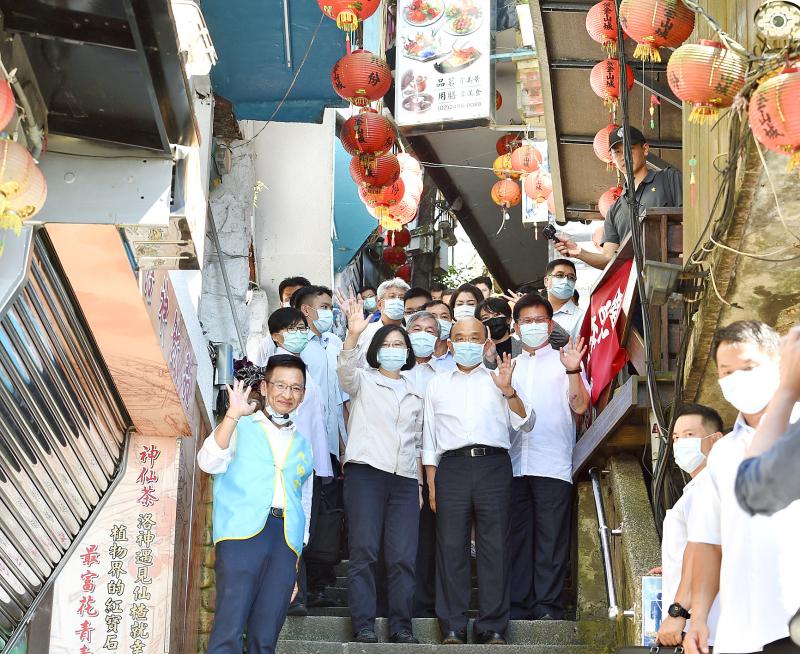
Photo courtesy of the Presidential Office Press Club
Before business travelers are allowed to enter the nation, they must present immigration officials with a polymerase chain reaction screening certificate showing that they tested negative for COVID-19 before arrival, Chen said.
To regulate the activities of business travelers within the nation, Chen said that local sponsors must ensure that their guests make reservations at certified disease prevention hotels in advance.
They must present a disease prevention plan stating whether their guests would travel to specific locations or engage in restricted activities in non-specific locations, he said, adding that the plan should also list transportation arrangements the sponsors make for their guests.
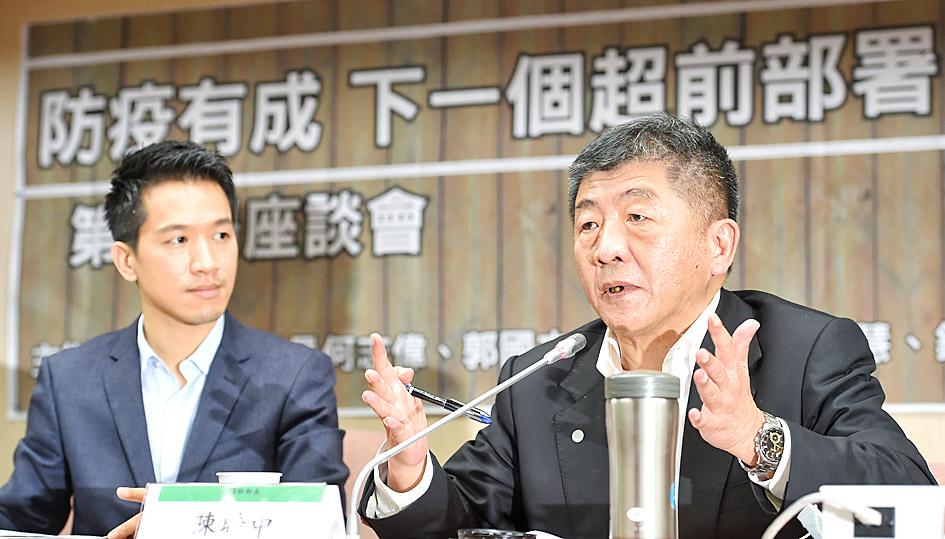
Photo: Liu Hsin-de, Taipei Times
“While they are in quarantine, business travelers can meet with their local sponsors or contacts at the disease prevention hotels at which they are staying, provided the meetings proceed with proper protection for all the participants. After fulfilling their quarantine requirements, they can then go out and visit factories or other sites they need to see during their trip,” Chen said. “These measures would ensure that all the people they come in contact with are traceable in case they are infected.”
Meanwhile, officials from the Centers for Disease Control (CDC) would help trade show organizers devise disease prevention plans so that participants from overseas and locals can remain separated.
“We are really hesitant about reopening our borders to international tourists, as they will not enjoy their trips ... if they can only visit specific locations or come in contact with specific people,” he said.
“However, we are not giving up,” Chen said. “In general, we are leaning toward reopening borders to certain countries or territories under the principle of reciprocity and mutual authentication.”
Chen said the WHO has listed the COVID-19 outbreak in Beijing as a major public health event, but it would have a minimal effect on Taiwan, as the nation has its own border control policies to contain the pandemic.
However, the outbreak could further postpone the reopening of the borders to Chinese tourists, he added.
Separately, Minister of Transportation and Communications Lin Chia-lung (林佳龍) said that the government would divide countries into different categories based on their pandemic situation. His ministry would be fully prepared as the nation gradually relaxes border controls, he added.
In addition to China, countries such as Japan and South Korea have reported an increase in COVID-19 cases after they ended lockdowns, Lin said.
The government would take these situations into account when it determines how borders should be reopened, he added.
The CECC is scheduled to unveil details of its plan for easing border controls today.
In related news, the CECC said that it had received tip-offs claiming that the married couple who tested positive for COVID-19 after returning to Taiwan from Bangladesh on Saturday did not wear protective clothing and frequently coughed during the flight.
CDC Deputy Director-General Chuang Jen-hsiang (莊人祥), the CECC’s spokesperson, yesterday said that surveillance footage at the airport showed that the couple only wore masks and not protective clothing.
The CECC would clarify the situation with the local health department, Chuang added.
If the couple made false health declarations, they could face fines of NT$60,000 to NT$300,000 for breaching the Communicable Disease Control Act (傳染病防治法), he said.
Additional reporting by Lee I-chia

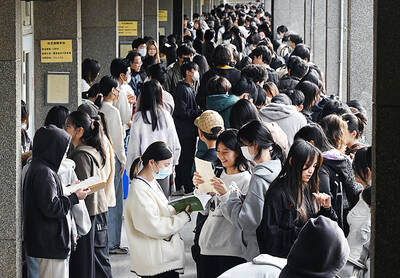
A global survey showed that 60 percent of Taiwanese had attained higher education, second only to Canada, the Ministry of the Interior said. Taiwan easily surpassed the global average of 43 percent and ranked ahead of major economies, including Japan, South Korea and the US, data from the Organisation for Economic Co-operation and Development (OECD) for 2024 showed. Taiwan has a high literacy rate, data released by the ministry showed. As of the end of last year, Taiwan had 20.617 million people aged 15 or older, accounting for 88.5 percent of the total population, with a literacy rate of 99.4 percent, the data

NEW LOW: The council in 2024 based predictions on a pessimistic estimate for the nation’s total fertility rate of 0.84, but last year that rate was 0.69, 17 percent lower An expected National Development Council (NDC) report expects the nation’s population to drop below 12 million by 2065, with the old-age dependency ratio to top 100 percent sooner than 2070, sources said yesterday. The council is slated to release its latest population projections in August, using an ultra-low fertility model, the sources said. The previous report projected that Taiwan’s population would fall to 14.37 million by 2070, but based on a new estimate of the total fertility rate (TFR) — the average number of children born to a woman over her lifetime — the population is expected to reach 12 million by
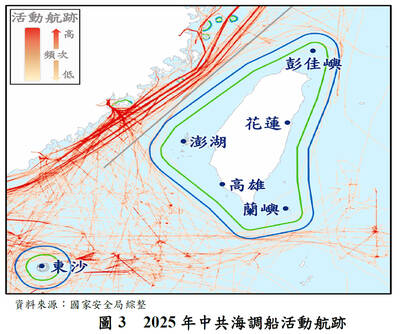
INTENSIFYING THREATS: Beijing’s tactics include massive attacks on the government service network, aircraft and naval vessel incursions and damaging undersea cables China is prepared to interfere in November’s nine-in-one local elections by launching massive attacks on the Taiwanese government’s service network (GSN), a report published by the National Security Bureau showed. The report was submitted to the Legislative Yuan ahead of the bureau’s scheduled briefing at the Foreign Affairs and National Defense Committee tomorrow. The national security team has identified about 13,000 suspicious Internet accounts and 860,000 disputed messages, the bureau said of China’s cognitive warfare against Taiwan. The disputed messages focus on major foreign affairs, national defense and economic issues, which were produced using generative artificial intelligence (AI) and distributed through Chinese
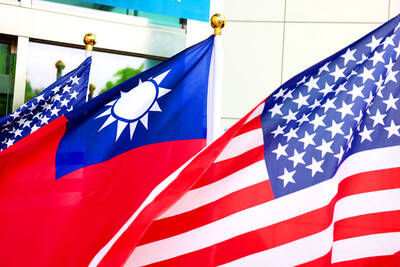
COUNTERING HOSTILITY: The draft bill would require the US to increase diplomatic pressure on China and would impose sanctions on those who sabotage undersea cable networks US lawmakers on Thursday introduced a bipartisan bill to bolster the resilience of Taiwan’s submarine cables to counter China’s hostile activities. The proposal, titled the critical undersea infrastructure resilience initiative act, was cosponsored by Republican representatives Mike Lawler and Greg Stanton, and Democratic Representative Dave Min. US Senators John Curtis and Jacky Rosen also introduced a companion bill in the US Senate, which has passed markup at the chamber’s Committee on Foreign Relations. The House’s version of the bill would prioritize the deployment of sensors to detect disruptions or potential sabotage in real-time and enhance early warning capabilities through global intelligence sharing frameworks,


 RSS
RSS