


National Taiwan University (NTU) yesterday rejected a proposal by students to establish a transitional justice task force to deal with authoritarian symbols on campus and review the school’s history.
The NTU Student Association proposed that historical researchers and representatives from the Gallery of NTU History, as well as students and faculty from each college, could be invited to form a campus transitional justice task force.
The main duties of the task force would be to investigate and publish facts about historical events, plan commemorative and educational events, remove authoritarian symbols and preserve historical sites of injustice, the proposal said.
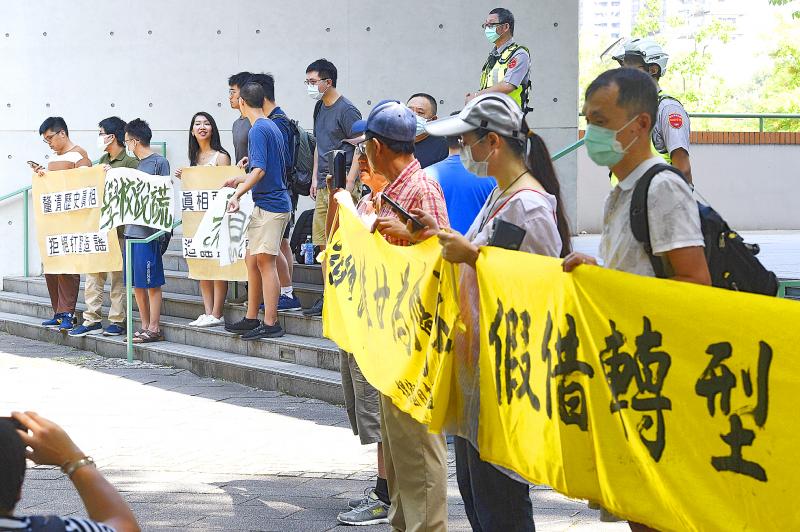
Photo: George Tsorng, Taipei Times
After a university affairs meeting yesterday, NTU Student Association president Tu Chun-ching told reporters that the proposal had been voted on and rejected.
However, discussion in the meeting highlighted that NTU needs the task force, as many university faculty members have insufficient understanding of historical events that had occurred on campus and how to deal with them, Tu said.
“Many people mistakenly believe that the transitional justice task force would lead to political struggle and chaos,” he said. “Much of the long-term confusion and conflict has been caused by the wounds of history, which were never acknowledged and dealt with properly, and the victims’ voices have long been neglected.”
Some faculty viewed the proposal as a means for political struggle, and a lecturer even suggested that the discussion be halted, which was very regrettable, Tu said.
It is not a defeat, as it has attracted attention on the importance of the issue, he added.
NTU vice president Chou Chia-pei (周家蓓) told a news conference that 109 people had voted against the students’ proposal and 24 had voted for it.
The student association president was given sufficient time to explain the proposal, after which faculty expressed their opinions, she said, adding that the student representatives did not raise their hands to speak when they were allowed to.
The seventh faculty member to speak suggested that the discussion be halted, as every participant clearly understood the proposal by then, she said, adding that 109 people voted in favor of halting the discussion and one voted against it.
NTU president Kuan Chung-ming (管中閔) said that the faculty member who suggested ending the discussion had said that NTU is not excluded from the nation’s regulations, so it already has laws on promoting transitional justice.
“Exploring historical events and deriving scientific formulas are different,” Kuan said, adding that historical events are more complicated, as the data could be scattered and lost over time, or interpreted from different perspectives.
Although the proposal was rejected, the university encourages academics to put aside prejudice, keep an open mind, and explore the truth through academic research, which could serve as important reference for compiling a history of the university, he said.
The proposal to implement a campus transitional justice task force resulted in a group of NTU alumni launching an online petition on Thursday to preserve NTU landmarks, such as the Fu Bell (傅鐘) and Fu Garden (傅園), as the group believed the task force aimed to remove them.
The student association on Friday clarified that its proposal did not mention removing any particular landmark, and that the group’s petition was misleading.
Several representatives from the group of alumni and the student association yesterday held banners in front of the building where the meeting was being held.
The university separated the groups to prevent possible conflict.

Right-wing political scientist Laura Fernandez on Sunday won Costa Rica’s presidential election by a landslide, after promising to crack down on rising violence linked to the cocaine trade. Fernandez’s nearest rival, economist Alvaro Ramos, conceded defeat as results showed the ruling party far exceeding the threshold of 40 percent needed to avoid a runoff. With 94 percent of polling stations counted, the political heir of outgoing Costa Rican President Rodrigo Chaves had captured 48.3 percent of the vote compared with Ramos’ 33.4 percent, the Supreme Electoral Tribunal said. As soon as the first results were announced, members of Fernandez’s Sovereign People’s Party
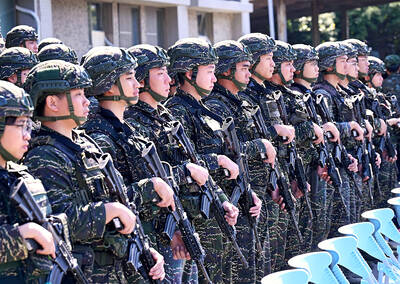
MORE RESPONSIBILITY: Draftees would be expected to fight alongside professional soldiers, likely requiring the transformation of some training brigades into combat units The armed forces are to start incorporating new conscripts into combined arms brigades this year to enhance combat readiness, the Executive Yuan’s latest policy report said. The new policy would affect Taiwanese men entering the military for their compulsory service, which was extended to one year under reforms by then-president Tsai Ing-wen (蔡英文) in 2022. The conscripts would be trained to operate machine guns, uncrewed aerial vehicles, anti-tank guided missile launchers and Stinger air defense systems, the report said, adding that the basic training would be lengthened to eight weeks. After basic training, conscripts would be sorted into infantry battalions that would take
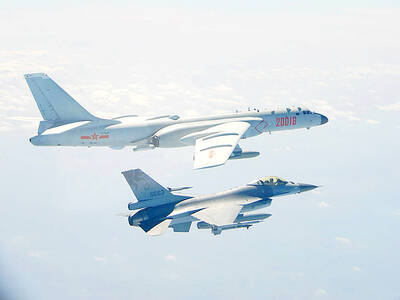
GROWING AMBITIONS: The scale and tempo of the operations show that the Strait has become the core theater for China to expand its security interests, the report said Chinese military aircraft incursions around Taiwan have surged nearly 15-fold over the past five years, according to a report released yesterday by the Democratic Progressive Party’s (DPP) Department of China Affairs. Sorties in the Taiwan Strait were previously irregular, totaling 380 in 2020, but have since evolved into routine operations, the report showed. “This demonstrates that the Taiwan Strait has become both the starting point and testing ground for Beijing’s expansionist ambitions,” it said. Driven by military expansionism, China is systematically pursuing actions aimed at altering the regional “status quo,” the department said, adding that Taiwan represents the most critical link in China’s
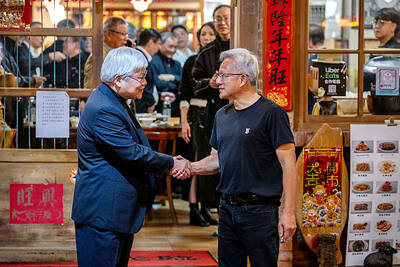
‘REALLY PROUD’: Nvidia would not be possible without Taiwan, Huang said, adding that TSMC would be increasing its capacity by 100 percent Nvidia Corp CEO Jensen Huang (黃仁勳) on Saturday praised and lightly cajoled his major Taiwanese suppliers to produce more to help power strong demand for artificial intelligence (AI), capping a visit to the country of his birth, where he has been mobbed by adoring fans at every step. Speaking at an impromptu press conference in the rain outside a Taipei restaurant, where he had hosted suppliers for a “trillion-dollar dinner,” named after the market capitalization of those firms attending, Huang said this would be another good year for business. “TSMC needs to work very hard this year because I need a lot


 RSS
RSS